

s
Author’s Note. I continue to dwell in the question of paradigms because I keep bumping into their immune systems—the moment a worldview begins defending itself against what it cannot yet see. These essays are my way of processing those encounters as I experience them. This piece continues a line of inquiry I began last week in Seeing Through the Paradigm.
One — When the Hose Comes On
There is a moment in certain conversations when the temperature in the room changes, and if you have learned to feel for it, you can feel it arrive before anyone has said the sentence that caused it.
Until that moment, everything is open. You are talking about the things people talk about now when they are being serious: the climate, the soil, the quiet erosion of the supply chains we assumed would always deliver, the strange new fragility of systems that were supposed to be the most robust things we had ever built. The conversation is intelligent. It is curious. It is even generous. New ideas are welcomed into the room the way a host welcomes guests, and for a while it feels as though anything might be thinkable.
And then you cross a line that nobody drew and nobody can see.
Usually it happens because you say something slightly too true. You suggest that nature is not an externality sitting outside the economy but the productive infrastructure underneath it — the thing that makes the economy possible in the first place. You suggest that maximizing financial return and maximizing value are not the same act, and have perhaps quietly become opposites. You wonder aloud whether the economy should really go on being the largest container, the master system inside which ecology and community and human tenderness are all expected to find their small assigned places. And suddenly the conversation closes, the way a sea anemone closes when a shadow passes over it — not from malice, but from something older than malice.
You can almost feel the withdrawal in your own body. I have come to call this moment the hose coming on, and I will explain the phrase before the essay is done.
For years I experienced these moments as personal failures. I would replay them afterward and wonder whether I had explained the idea clumsily, whether I had pushed a half-step too far, whether the person across from me was simply unwilling to see what seemed, to me, to be growing more visible by the season.
I now think that reading of the situation was almost entirely wrong. It was not a failure of my rhetoric, and it was not, in any simple sense, a failure of the other person’s character. It was something both larger and more forgiving than either of us. It was the collective. It was the economy. Or, to say it as precisely as I know how, it was the paradigm through which an entire civilization has learned to see — reaching to protect itself, through us, without our consent and mostly without our knowledge.
A paradigm is a far stranger and more powerful thing than an opinion. Opinions are possessions; we know we have them, we can set them down and pick up others. A paradigm is the architecture underneath the opinions, the frame that decides which questions sound reasonable before we have finished asking them, which evidence is permitted to count as evidence, which forms of value are real enough to be measured, and which imagined futures get to be called realistic while the rest are dismissed, gently, as naïve. Live inside a paradigm long enough and it stops feeling like a lens at all. It becomes indistinguishable from reality. We are certain we are looking through a clear window at the world, when much of the time we are looking into a mirror and mistaking our own reflected assumptions for the landscape beyond the glass.
The financial paradigm holds this kind of power more completely than almost any worldview in human history, because it has built an astonishingly coherent world around itself and then furnished that world down to the smallest detail. Price, yield, return, risk, liquidity, assets, productivity, growth: each of these concepts leans on the others so that the whole structure stands without visible support, like a stone arch. Institutions are organized around it. Careers are rewarded through it. Universities transmit it to the young as though it were arithmetic rather than cosmology. And all day the markets murmur it back to us — the screens flickering their green and red confirmations that these are indeed the things that matter, that this is indeed what the world is made of. Inside that world, everything makes sense. That interior coherence is precisely what makes stepping outside it so nearly impossible, because there appears to be nothing outside it to step into.
There is a word that comes close to what I am trying to describe, and the word is faith. But even faith is not quite right. The Spanish fe points at something deeper than the English word usually reaches — a conviction held so deeply that it no longer registers as a belief at all, and at its furthest extreme becomes something like dogma: a certainty whose founding assumptions have slipped entirely below the waterline of awareness. You do not defend the paradigm because someone assigned you to defend it. You defend it because, over the years, it has quietly become part of who you are. And here we arrive at one of the most remarkable properties these structures possess, one I did not fully believe until I had watched it work on people I love, and on myself.
Paradigms have immune systems.
A living body must, every second, tell the difference between what belongs to it and what threatens its integrity — self from not-self, nourishment from infection. A paradigm does something eerily similar with ideas. An idea that can be absorbed is absorbed. An idea that can be translated into the existing vocabulary is translated. An idea that can be priced is priced, and thereby domesticated. But an idea that threatens the load-bearing architecture itself meets a different reception. Sometimes it is ridiculed. Sometimes it is quietly marginalized, moved to the edge of the room where it cannot do any structural damage. Sometimes it is diluted, patiently, over years, until it means very nearly the opposite of what it first meant. And sometimes — this is the most elegant defense of all — it is captured.
Consider what happened to sustainability. It entered the world as a genuine challenge to the trajectory of industrial civilization, a suggestion that the whole direction might be wrong. Somewhere along the way, in boardroom after boardroom, it was converted into a strategy for sustaining the industrial model itself.
The animating question quietly rotated on its axis. It went from how must the system change so that life can go on flourishing? to the far more manageable how can the existing system keep operating with somewhat fewer negative consequences? The word survived intact. The worldview it had been carrying was left behind on the road.
Something similar is now underway with regeneration, and I watch it with a mixture of hope and dread. Regeneration arrived carrying a proposition more unsettling than sustainability ever did. It says that living systems do not merely need to be shielded from human damage — that human activity can actively participate in restoring the earth’s capacity to evolve and adapt and flourish. Agriculture can build soil rather than mine it. Watersheds can recover. Biodiversity can return. Communities can become participants in stewardship rather than mere units of labor and consumption. Capital, most radically of all, can become a servant of living systems instead of demanding that living systems serve it.
And almost the moment those ideas gained a foothold, the old paradigm began translating them into its mother tongue: regenerative products, regenerative premiums, regenerative assets, regenerative alpha. The word survives. The worldview underneath it quietly disappears.
I want to be careful here, because it would be easy and lazy to call this a conspiracy. It is something more interesting than conspiracy, and harder to confront, because there is no one to confront. It is systemic self-preservation, distributed across millions of well-meaning people, none of whom experience themselves as guarding anything.
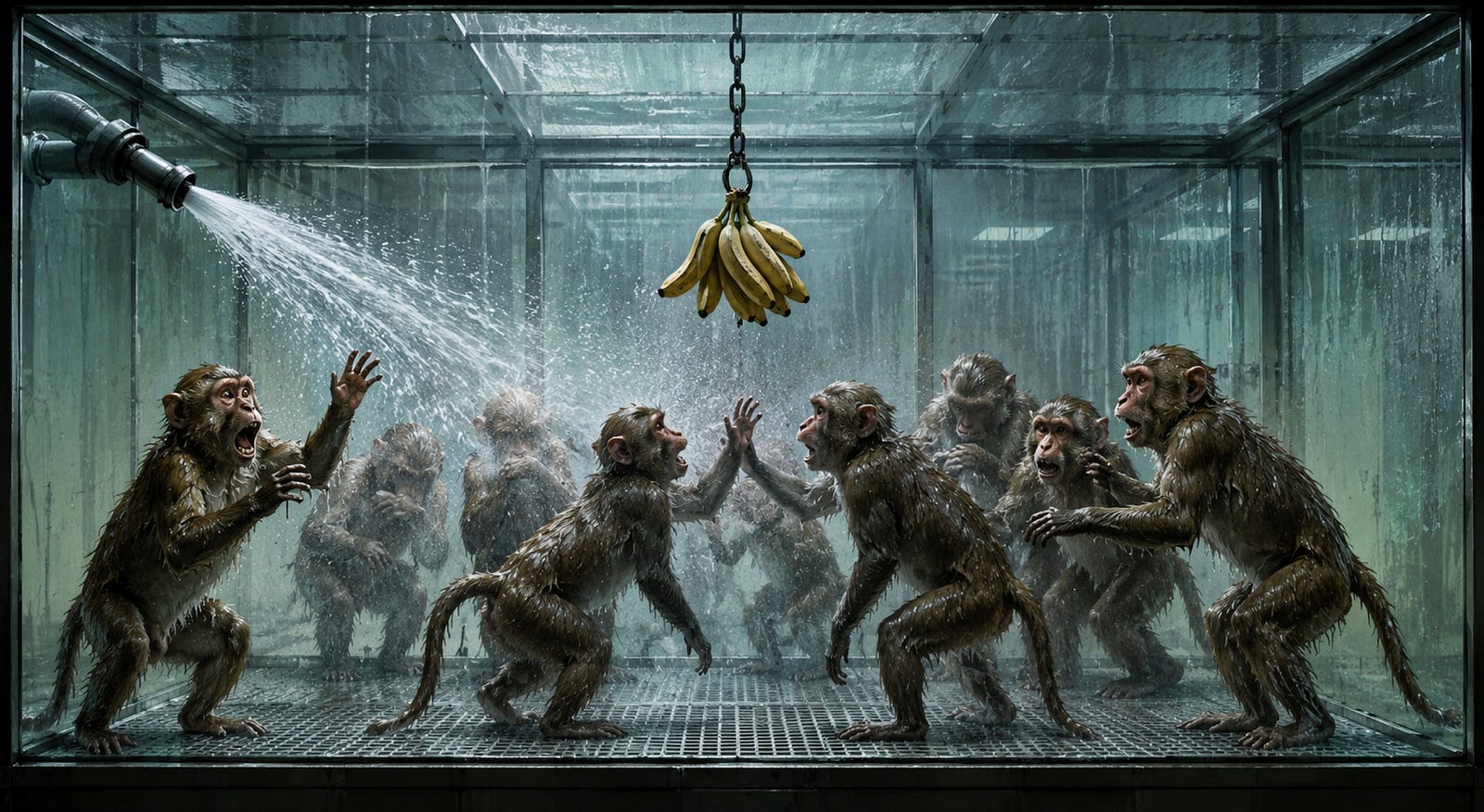
There is an old story, often told, about monkeys and a banana and a hose of cold water. Its credentials as a real experiment are thin, so it is better to receive it as a parable than as data — but as a parable it is nearly perfect.
A group of monkeys shares an enclosure. Above them hangs a banana. Every time one monkey reaches for it, all the monkeys are blasted with freezing water. Soon, sensibly, nobody reaches for the banana. Then one of the original monkeys is removed and a newcomer put in his place. The newcomer sees the banana and does the obvious thing — he moves toward it — and the others fall on him and stop him before he can climb, and he has no idea why. One by one the original monkeys are swapped out, until eventually every monkey who ever felt the cold water is gone. The hose has long since been turned off. No monkey in the cage has ever been sprayed. And still nobody reaches for the banana, and worse, they enforce the prohibition on each other with real violence. Nobody remembers the hose. Nobody needs to. The collective has become the hose.
That is what makes paradigms so durable, and so hard to argue with: enforcement becomes distributed until no central authority is required to maintain it. Colleagues enforce it. Investment committees enforce it. Universities enforce it. Editorial boards enforce it. Consumers enforce it with their purchases and journalists with their framings and friends across the dinner table with a single lifted eyebrow. We enforce it on one another, nearly always with good intentions, because whatever lies outside the paradigm genuinely appears to us to be irresponsible, or irrational, or simply impossible. And then, most efficiently of all, we enforce it on ourselves. The walls have migrated inward. The enclosure is now interior.
And yet something is changing, and this is the part that keeps me at my desk. The banana still hangs there, but more of the monkeys are beginning to wonder, out loud, why no one is allowed to touch it.
We are living through a peculiar historical moment, because reality itself has started pressing against the walls of the prevailing paradigm from the outside. Planetary boundaries are being crossed. Climate instability is becoming harder and harder to experience as a distant abstraction when the smoke is in your own valley. Soil degradation, water stress, biodiversity loss, the fraying of ecosystems — these are entering the same conversations that used to be reserved almost entirely for growth and productivity and financial risk. Regeneration is no longer a discussion happening only at the margins among a few farmers and mystics. Farmers are talking about it. Investors are talking about it. Corporations are talking about it, sometimes sincerely. Governments are beginning, haltingly, to talk about it. And most important of all, ordinary people increasingly sense in their bodies that something about our relationship with the living world is structurally wrong, even when they do not yet have the language to name what a different relationship might feel like.
This is how paradigms begin to loosen — not because everyone changes their mind at once, in some grand synchronized awakening, but because anomalies accumulate. Reality keeps handing the reigning worldview information it cannot comfortably explain.
What used to sound fringe starts to sound plausible; what used to sound naïve starts to look practical; questions that once seemed unnecessary become unavoidable. And still, conversation after conversation, the moment comes. You can travel remarkably far together before you reach it. You can discuss resilience and biodiversity and regenerative agriculture and climate adaptation and community, and even entertain the possibility that ecosystems hold forms of value our balance sheets are simply not built to see. But then you touch the deeper architecture — you say that returns might sometimes have to become subordinate to resilience, that land cannot honestly be reduced to an asset, that the efficiency we worshiped is exactly what made our systems brittle, that some things should be governed as commons, that growth itself cannot remain the unquestioned organizing principle of an economy embedded inside a finite living planet — and there it is again. The invisible line. The immune response activates. The conversation contracts.
The hose comes on.
Understanding this changes how I sit across from another person now. Because the one who has gone quiet may not be rejecting an idea at all. They may be defending an entire architecture of meaning — one woven through their education, their profession, their status, their sense of belonging, their security, their very identity. To question the paradigm can feel, from the inside, like being asked to question the self. This is why evidence, by itself, so reliably fails. We keep imagining that transformation is a matter of supplying enough information: one more graph, one more paper, one more drought, one more planetary-boundary diagram, one more economic model proving that prevention costs less than collapse. But paradigms are almost never surrendered because someone lost an argument. They weaken when the world they describe stops matching the world people actually live in.
And that, I have come to believe, may be roughly where we now stand. The old paradigm remains extraordinarily powerful; its institutions dominate, its language still decides what counts as serious, its rewards are still enormous, its immune system is still working beautifully. But the world outside the enclosure is changing faster than the rules inside it. The hose still comes on. And more of us, quietly, are beginning to ask the one question paradigms fear more than any disagreement, the question that cannot be answered from inside the frame:
Why?
Two — The Immune System Needs a Name
Once the immune response has activated, something else happens, and it happens so smoothly that we rarely notice it as a separate act. Having sensed the threat, the system now needs to place you somewhere. If the idea you carried cannot be comfortably digested, then the person carrying it must be classified — filed under a heading that the paradigm already knows how to handle. You become an environmentalist. An activist. A socialist, a communist, a capitalist, a technocrat, a fascist, a utopian, a radical. There must be a box somewhere into which you can be set down, because a labeled thing is a managed thing.
The label does real work. It saves the system from ever having to meet the idea itself. If you can be identified as an activist, your argument can be received as activism rather than as thought. If you are a socialist, your criticism of markets becomes ideology and can be discounted at the ideological rate. If you are an environmentalist, your concern for the living infrastructure of the planet can be quarantined away from the supposedly serious business of economics. And if you are a utopian, your proposal need never be measured against the actual failures of the present system, because it has already been declared unrealistic before anyone examined it. Classification, in other words, is containment — and it is uncannily close to how a body’s immune system behaves. The foreign object must first be identified. Friend or enemy. Self or not-self. Only once it has been named a threat can the appropriate response be released.
The extraordinary thing is that no central authority coordinates any of this. The paradigm acts through us, using each of us as an instrument in turn: through the investment committee, through the newspaper column, through the university department, through the dinner-table conversation, through the colleague who raises an eyebrow, through the old friend who asks, with a small smile, when exactly you became “an environmentalist.” The defense system has gone fully social; it lives in the tissue of our relationships. And here is the detail that first made me suspect something deeper was underway: the intensity of this immune response seems to be rising, not falling. That deserves our attention, because a healthy body does not escalate its defenses against a threat it has comfortably neutralized. Escalation is a sign of alarm.
So let me offer a frame that has helped me see the alarm without dividing the world into the good and the wicked.
It comes from the Three Horizons, and its great virtue is precisely that it refuses that division.
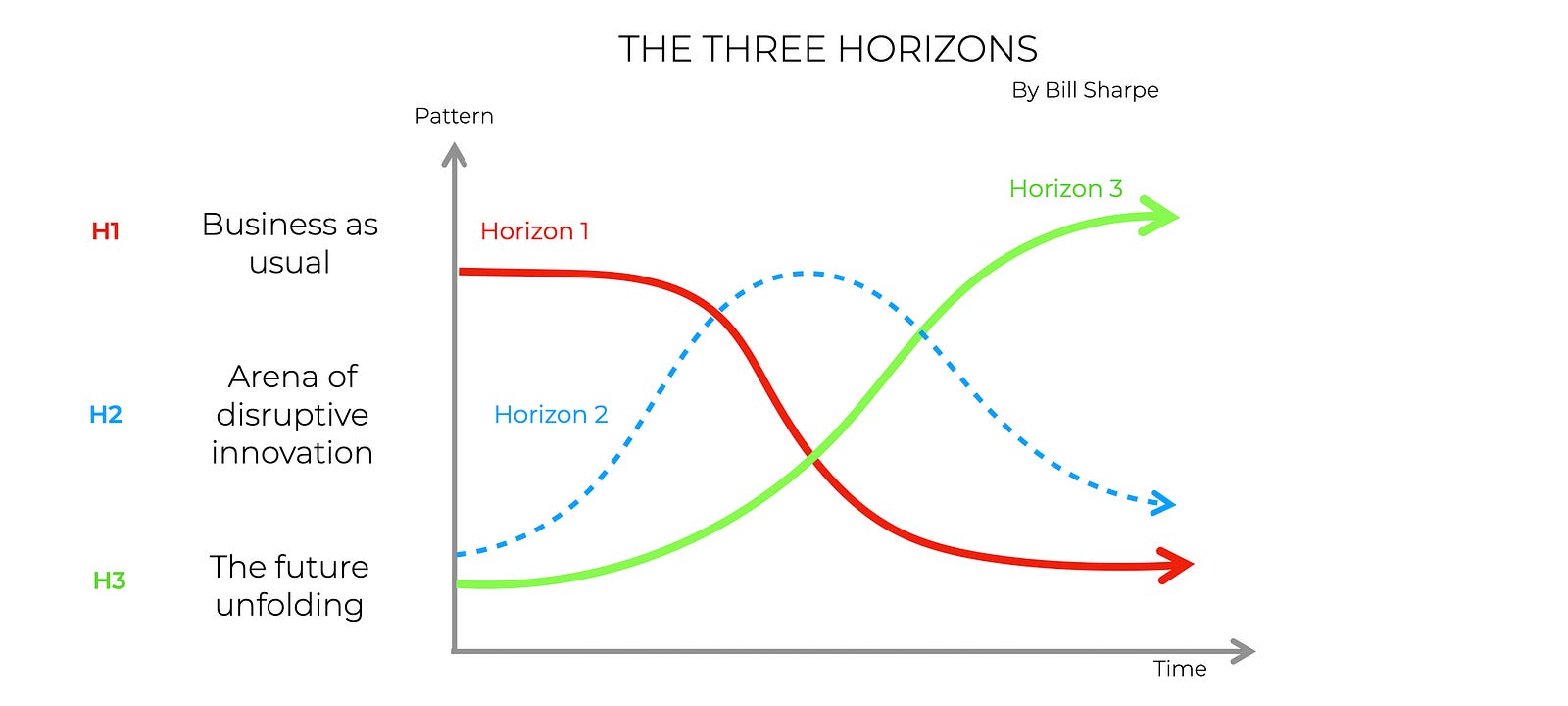
Horizon 1 is the dominant system — the world whose institutions, incentives, infrastructures, and assumptions organize the present. It is easy, from a certain righteous distance, to speak of Horizon 1 as though it were merely a mistake we are waiting to correct, but that is not honest. Horizon 1 has delivered extraordinary things. Industrial production, global markets, scientific specialization, financial systems, technological infrastructure — these have generated forms of abundance that earlier civilizations could scarcely have dreamed. I am typing these words on its fruits. But every successful system eventually runs into the limits created by its own success, and this is where the story turns.
Horizon 1 was built around a particular logic: growth, scale, optimization, control, and the ability to mobilize resources ever more efficiently. Under that logic, over generations, a great translation took place. Nature became resources. Places became assets. Living knowledge became intellectual property. Human attention became a market to be harvested. Time itself became productivity. The architecture rewarded, faithfully, whatever could be measured, standardized, extracted, and scaled — and for a long stretch of history this worked astonishingly well, because the environment it operated in was relatively slow, relatively stable, relatively forgiving. Then the environment changed.
This is the point at which the familiar drawing of the Three Horizons needs another axis. We usually sketch it flat: time running left to right, Horizon 1 declining, Horizon 2 rising through the middle as a turbulent zone of innovation, Horizon 3 emerging on the far side as the possible future. But imagine adding a vertical axis and calling it complexity — or better, complexity and exponentiality. The transition now underway is not simply moving through time. It is moving while the operating environment itself accelerates: more actors, more connections, more feedback loops, more information, more technological capability, more interdependence, faster propagation, shorter reaction times. Artificial intelligence, autonomous systems, distributed energy, biotechnology, digital networks, new forms of finance, radically cheaper coordination — these are not merely new tools plugged into an old economy. They change the medium the economy swims in.
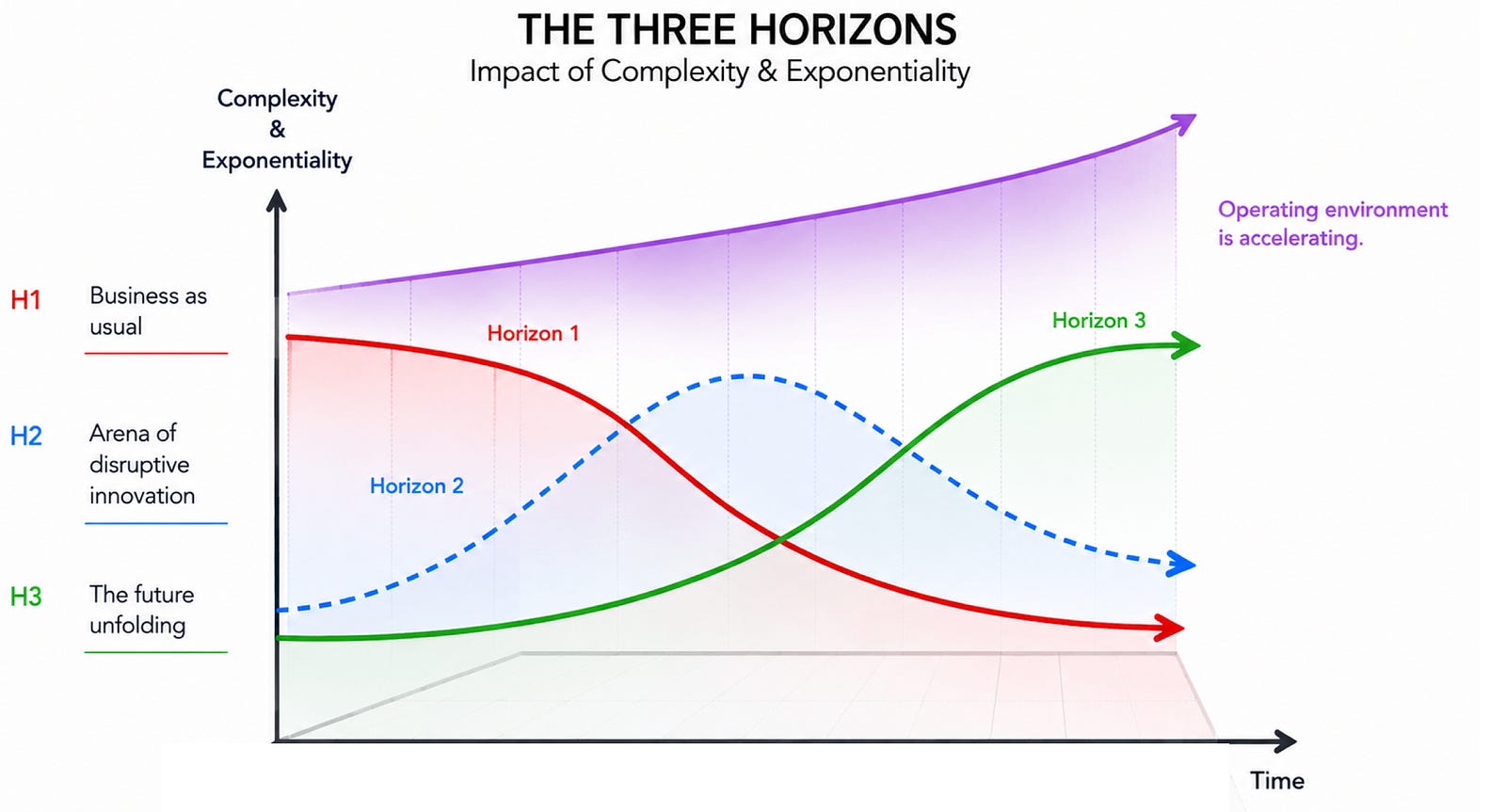
This matters because Horizon 1 has met Horizon 2 before, many times, and has always won. Steam displaced muscle. Electricity reorganized industry. Automobiles reorganized cities. Telecommunications reorganized distance. Computing reorganized information. Each time, the dominant system proved wonderfully good at absorbing the disruption: it commercialized the new thing, financed it, scaled it, standardized it, and eventually controlled most of it. This is one of Horizon 1’s greatest evolutionary gifts — the ability to swallow its own challengers and metabolize them into extensions of itself. It is why so many revolutions end up wearing the uniform of the thing they meant to overthrow.
But the present Horizon 2 may be different in kind, not merely in degree. The very technologies Horizon 1 is trying to absorb are increasing the complexity of the environment faster than institutions built for command and prediction and control can process it.
The system is attempting to control the forces that are making control itself progressively impossible. And this produces a strange and telling paradox, which I will let stand as a short litany because I think each line deserves its own breath. The more uncertain the world becomes, the more fiercely the old paradigm reaches for certainty. The more distributed power becomes, the more urgently it tries to centralize. The more unpredictable systems become, the more aggressively it insists on predicting them. The more plural the world becomes, the more anxiously it classifies. The more reality escapes its categories, the more rigid those categories grow.
Which means that what looks, from the outside, like strength may sometimes be the visible surface of fragility. A system that senses the declining effectiveness of its familiar strategies does not automatically become more adaptive.
Very often it becomes more itself: more control, more extraction, more concentration, more optimization, more insistence that the models still work. This is one way to understand the radicalization of Horizon 1 — not as an ideology belonging to a single political camp, but as a systemic reflex, the flinch of a body that feels its old defenses failing and responds by tightening them.
We can see the same reflex in geopolitics, where great powers still reach instinctively for the tools of an era in which military superiority, control over territory, financial sanctions, or command of strategic resources could reliably determine outcomes — even as contemporary conflict flows through drones, cyber capabilities, decentralized networks, information systems, asymmetric technologies, proxy actors, and globally interwoven energy and financial markets. Power is still real. But the relationship between power and control has become nonlinear: a stronger intervention can now generate a stronger counter-reaction, a small local action can trigger a global feedback loop, a cheap technology can humble an enormously expensive infrastructure.
The same tension appears in markets, and here an insight from ecological network theory, associated with the work of Bernard Lietaer, becomes clarifying.
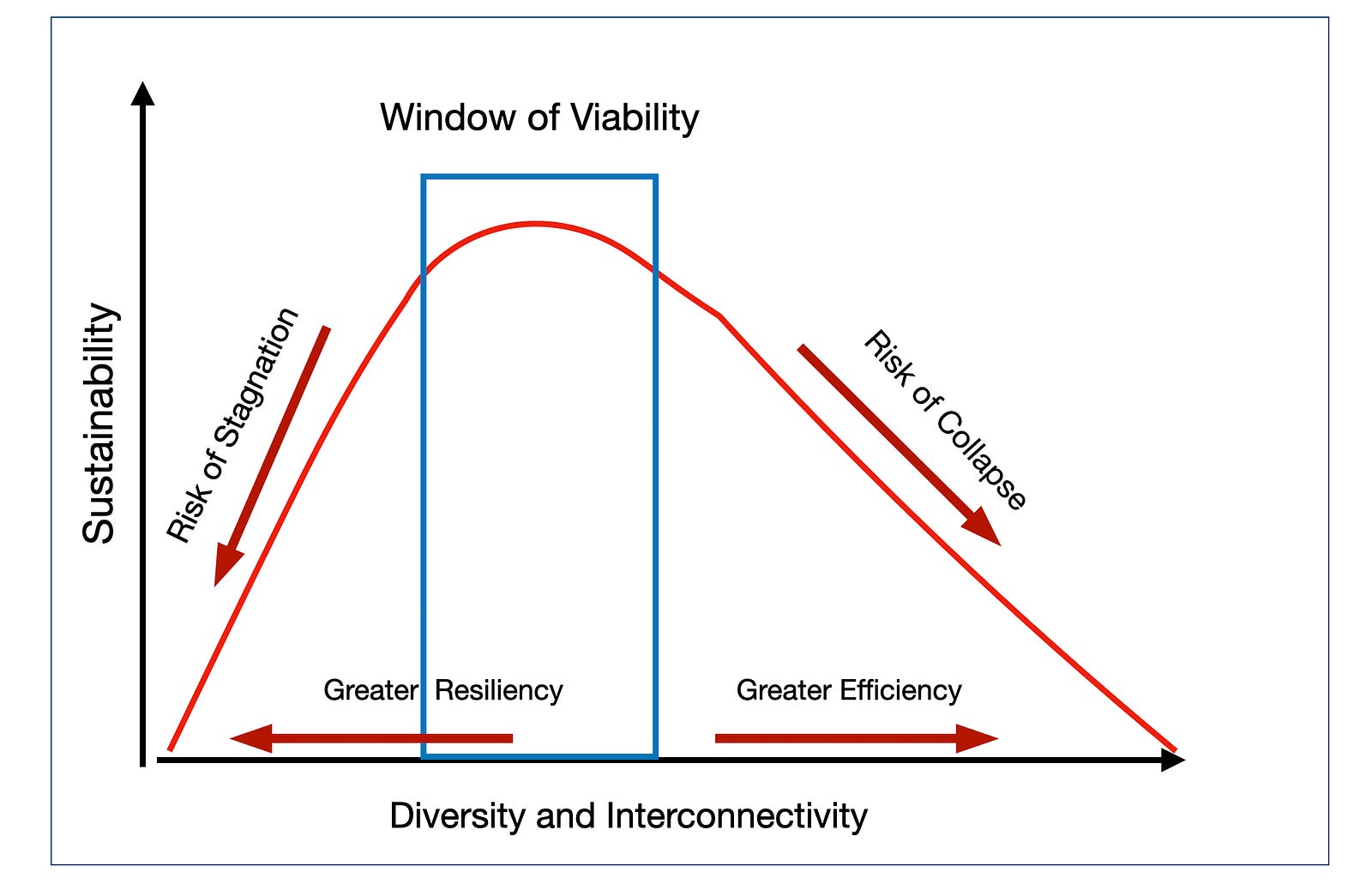
Every complex system lives inside a tension between efficiency and resilience. Too little efficiency, and resources are squandered; the system starves. But too little diversity, redundancy, and connectivity, and the system becomes brittle; it snaps. A forest composed entirely of its single most productive tree would not be the most successful forest in the world. It would be a plantation waiting for the right pathogen to find it. Yet much of modern economic design has pursued something remarkably like that plantation: just-in-time supply chains, concentrated production, financial leverage, monocultures, hyper-specialization, global sourcing, lean inventories, maximum asset utilization. Each of these strips out what looks, through the eyes of efficiency, like waste.
But living systems have a different name for that so-called waste. They call it redundancy, and redundancy is one of the places where resilience hides. A seed bank is inefficient right up until the crop fails. A full pantry is inefficient right up until the ships stop arriving. Biodiversity is inefficient right up until conditions change. Distributed capacity is inefficient right up until the centralized system goes dark. Slack is inefficient right up until the moment adaptation becomes a matter of survival. This may be one of the deepest confusions built into Horizon 1: it has mistaken efficiency for fitness, and the two are not the same. Fitness is contextual — it is the capacity to remain viable as conditions change — and conditions are now changing with a speed that would have seemed like science fiction a generation ago.
This is why the vertical axis matters so much. As complexity and exponentiality rise, the system does not merely need more powerful tools. It needs different capacities altogether: adaptability, diversity, redundancy, distributed intelligence, reciprocity, the ability to learn, the ability to sense feedback, the capacity to reorganize without collapsing. These are not, at root, mechanical properties that you can install. They are properties of living things. And this, perhaps, explains the strange weather of the moment we are passing through. Horizon 1 is not merely being challenged by some tidy future called Horizon 3. It is being destabilized by Horizon 2 — by its own children. The technologies it hoped would extend its control are increasing the complexity within which control must operate. The markets it optimized for efficiency are revealing their brittleness. The ecological systems it filed under “externalities” are returning as hard constraints. The information networks it built to connect us are fragmenting the shared story that held it together. The very tools built to increase prediction are accelerating the systems it is trying to predict.
So Horizon 1 does the only thing a frightened system knows how to do. It reaches for what it knows: more control, more growth, more optimization, more classification, and, when necessary, more labels. Because when the environment becomes bewildering, there is a deep and human comfort in knowing who the enemy is. Which brings us back, at last, to the conversation where we began. You introduce an idea the existing worldview cannot easily metabolize. For a moment there is uncertainty — and uncertainty, to a system like this, is intolerable. Then the immune system recognizes the threat, and the categories come forward to receive you: activist, socialist, environmentalist, radical, utopian. The label arrives. The box closes. And the hose comes on again. But this time, if you are paying attention, you notice something that changes everything. The water is still cold. The monkeys are still enforcing the rule with real conviction. And yet somewhere beyond the walls of the enclosure, the environment those rules were built to survive no longer exists.
Three — From Sustainability to Survivability
Perhaps, all along, we have been asking the wrong question.
For decades the word we reached for was sustainability, and it seemed unimpeachable. Could we sustain economic growth while emitting less carbon? Sustain agricultural output while degrading less soil? Sustain consumption while recycling a little more of what we consumed? Sustain the corporation while trimming its environmental footprint? These are not foolish questions. But there was something quietly revealing hidden inside the word itself, a question folded so tightly we rarely unfolded it: what, exactly, were we trying to sustain?
Yvon Chouinard, the founder of Patagonia, has offered a more uncomfortable word: survivability. The distinction may sound like semantics, but I have come to think it marks a genuine border. Sustainability can still be discussed from entirely inside Horizon 1. Survivability cannot. Sustainability asks how the existing system might continue. Survivability asks whether the living system on which that economy utterly depends will continue to support it. Those are not two versions of one question. They are two different questions, and only one of them can be answered from inside the frame.
And this, I suspect, is the question now beginning to slip past the immune system — not because environmentalists finally won an argument, not because corporations suddenly discovered nature, not because governments achieved some collective enlightenment, but for a humbler and more relentless reason.
Reality is becoming harder to keep outside. Of the nine planetary boundaries scientists use to describe the safe operating space of the earth, most have now been assessed as transgressed — climate change, the integrity of the biosphere, land-system change, freshwater, the great biogeochemical flows of nitrogen and phosphorus, and others besides — each one a line we told ourselves we would never cross, now behind us. The externality is coming home. And when an externality comes home, it stops being external by definition. It walks in the front door and sits down at the table wearing the paradigm’s own clothes.
A drought becomes a commodity price. A failed harvest becomes inflation. A degraded watershed becomes an industrial constraint. A collapsing fishery becomes unemployment in a coastal town. A flood becomes an insurance problem, then an uninsurable one. Biodiversity loss becomes agricultural risk. Climate becomes geopolitics. One by one, the things the economy had banished to the outer darkness of the “environment” are returning through the one door the paradigm cannot lock: the balance sheet. This is the precise moment when survivability enters the conversation whether or not it is invited, because it arrives disguised as cost.
There is an old pattern in how paradigms change, and it is worth naming because we are living inside it. A new idea is first dismissed, because it contradicts what everyone already knows. Then, once it becomes visible enough to be inconvenient, it is ridiculed or attacked. And finally, if reality keeps stubbornly supporting it, the strange idea becomes obvious enough that the very institutions which resisted it begin to claim, with straight faces, that they believed it all along. Not every new idea travels this arc, of course; many deserve the oblivion they receive. But the genuine paradigm shifts, the ones that rearranged the human sense of reality, have often carried something of this shape.
The Copernican revolution did not merely swap one astronomical diagram for another; it evicted humanity from the physical center of the cosmos. The printing press did not merely make books cheaper; it altered who could produce knowledge, who could distribute it, who could interpret authority, and ultimately who could challenge it. In each case the disruptive thing was not only the technology. It was the redistribution of who was permitted to know.
Something like that redistribution may be happening now, and to see it we have to look at how power came to concentrate in the first place. For most of the industrial era, information was expensive to produce and even more expensive to move, and that expense favored concentration. Newspapers required presses. Television required broadcast infrastructure. Energy required enormous capital. Global commodity trade required ports and storage and logistics and financial networks. Scale created power, and power produced more scale, and so Horizon 1 grew an institutional architecture that gathered the essential flows of modern life into a small number of hands.
Look at food. A remarkably small number of firms sit astride the critical bottlenecks of the global grain trade — the handful of great commodity traders whose names, ADM, Bunge, Cargill, COFCO, Louis Dreyfus, are estimated to touch the majority of internationally traded grain.
Look at meat: in the United States, a mere four packers handle the overwhelming share of the cattle that pass through the market. Similar concentrations run through seeds, agricultural inputs, digital communications, cloud infrastructure, finance — the vital organs of the system, each gathered into a few large bodies.
This is not evidence of a secret room where a handful of people designed the world. It is something more systemic, and therefore harder to blame and harder to fix. Concentration was an emergent property of the paradigm itself. An economy that rewarded scale produced scale. An economy that rewarded efficiency eliminated redundancy. An economy that rewarded financial return concentrated capital. An economy that treated nature as an externality naturally favored organizations capable of moving vast quantities of resources while leaving vast quantities of ecological consequence outside their accounting boundaries. The corporation did exactly what the system taught it to do, and it became superb at it. There is no need to imagine villainy. The incentives were the villain, and the incentives were everywhere and belonged to no one.
The problem is that so many of these institutions were shaped in a world whose founding assumptions are now dissolving. They were built when information moved slowly, when ecological limits felt safely distant, when carbon could be released without a price, when water could be drawn without accounting for the watershed, when biodiversity had almost no financial vocabulary at all, when communities harmed by distant corporate decisions had little power to organize across borders, and when a consequence arriving twenty years later belonged, economically speaking, to some other universe. In other words, Horizon 1 was built in a world where enormous portions of reality could be treated as external — and that world is ending. Not because we have grown morally superior, I want to be clear, but because the externalities are now accumulating faster than they can be externalized. The bill is arriving faster than we can forward it to the future.
And at exactly the same moment, Horizon 2 is quietly connecting the people who can see the bill. A farmer in a drought-cracked field can photograph a dying river and show it to the world by nightfall. A scientist can publish data accessible on every continent at once. A community can organize internationally in a matter of days. Satellites can watch the forests fall in real time. Sensors can read the moisture in the soil. Distributed networks can contest a centralized story. Artificial intelligence can now synthesize bodies of knowledge that once required the keys to institutions, specialists, and great libraries.
The printing press multiplied books; the network multiplies observers. And this, I think, explains why the immune response described in the earlier chapters is becoming, at the same time, more aggressive and less effective. The borders are turning porous. Horizon 1 can still own newspapers, but it cannot own every conversation. It can control institutions, but not every network. It can influence narratives, but it can no longer indefinitely prevent people from comparing those narratives against what they can increasingly observe with their own eyes.
I do not want to romanticize this. Connectivity distributes nonsense every bit as efficiently as it distributes knowledge; networks amplify fear and tribalism and manipulation right alongside insight, and anyone who has spent an hour online knows it.
But they change something fundamental all the same: the monopoly over meaning becomes far harder to hold. And this loosening is happening precisely as the biophysical ground beneath the old story grows less stable — which means we are entering an extraordinary convergence, several great forces arriving at once. Ecological limits. Exponential technologies. Geopolitical fragmentation. Resource competition. Artificial intelligence. Climate instability. Financial fragility. Distributed information. Declining institutional trust. Each of these would be historically significant on its own. Together they generate the steep complexity gradient of the previous chapter, and no one — no futurist, no economist, no general, no artificial intelligence — knows with any honesty what emerges from the far side of it.
This is where an idea sometimes described by Nate Hagens’ concept of the Great Simplification which describes the coming adjustment from an era of energy-driven expansion and complexity, and Daniel Schmachtenberger’s Third Attractor: the search for a viable civilizational path beyond the two gravitational alternatives of cascading collapse and increasingly centralized, dystopian control.
Imagine three broad gravitational possibilities pulling on our future. One is collapse: complexity overwhelms our capacity to adapt, and systems begin failing faster than we can repair them.
Another is an increasingly authoritarian or dystopian control: Horizon 1, feeling the ground move, answers instability with intensified surveillance, concentration, extraction, and command — the flinch we watched in the last chapter, escalated to a civilizational scale.
And then there is a third possibility, and it is neither utopia, nor infinite green growth, nor technological salvation descending to rescue us from ourselves. It is something quieter and more demanding, living in the narrow country between collapse and control: a civilization learning to live within biophysical reality while building institutions capable of holding human dignity, resilience, and a sufficient, unglamorous prosperity. Call it regeneration. Call it a life-centered civilization. Call it the Third Attractor. The name matters far less than the direction, because the defining question of the coming decades may no longer be how do we sustain the economy we have? It may become how do we design an economy capable of surviving the conditions we have created?
And surviving, it turns out, is only the beginning of what is being asked. Living systems do something far more interesting than survive. They adapt. They learn. They reorganize. They form new relationships. They evolve. And under the right conditions — this is the part the language of survival always forgets — they thrive. This is why regeneration is fundamentally different from sustainability. It does not ask us to sustain Horizon 1 a little more cleanly. It asks what capacities a civilization would actually need in order to stay alive and adaptive through profound change. And that shift, I believe, is already quietly underway.
I think we will live through a significant part of this within our own lifetimes. I suspect the coming decade will make the transition increasingly difficult to ignore. But I would ask you not to take my word for it, because I cannot know — and neither can the futurists, nor the economists, nor the generals, nor the artificial intelligences we are building to reassure us. Complex systems simply do not offer us that luxury of certainty. There are signals we should take seriously.
The latest planetary-boundary assessment finds most of the nine boundaries transgressed. The IPCC expects the Atlantic Meridional Overturning Circulation — the great conveyor that carries warmth through the ocean — to weaken through this century, while the possibility of a more abrupt collapse before 2100 remains genuinely uncertain rather than settled.
Wars and rivalries are interacting with energy, food, technology, and finance in ways whose second- and third-order effects grow harder to trace by the year. None of this tells us exactly what will happen. And that is the point. The question is no longer whether we possess a sufficiently accurate forecast. The question is whether we possess sufficient adaptive capacity for a future we cannot forecast.
Which carries the argument, finally, somewhere deeply personal. Because once all the planetary boundaries and exponential curves and wars and technologies and financial models and systems diagrams have been laid out on the table, a remarkably simple question is left standing in the middle of them. You do not have to accept my scenario. Build your own. Look at the evidence. Look at the ecological trends. Look at the technology, look at the geopolitics, look at the institutions around you, look at your community, and — this is the one that stops me, every time — look at your children. Then ask yourself, quietly and without the armor of ideology: what future do I actually believe I am living toward? And if your honest answer is that the next twenty years may be substantially less stable, less predictable, and more transformative than the twenty years behind us, then there is one more question, and it may be the only one that finally matters.
What is your plan?
Four — Compassion at the Edge of the Paradigm
What I have slowly come to understand, after years of feeling the hose come on in conversation after conversation, is that the appropriate response is not anger.
It is compassion. But I have to be careful with that word, because there is a counterfeit version of it that is really just the old paradigm wearing gentler clothes. I do not mean the compassion of the man who believes he has awakened while everyone around him sleeps — the pity of the enlightened for the benighted. That posture would only rebuild the very architecture we are trying to leave behind: hierarchy, separation, superiority, the quiet conviction that I see and you do not. I mean something harder and less flattering to myself: compassion for the person who cannot yet see what I see — and, in the same breath, the humility to recognize that I may be equally blind to what someone seeing from a more evolved paradigm can already see.
Because none of us stands outside paradigms. We do not observe them from some clean vantage on a hill; we live inside them the way a fish lives inside water. We inherit their languages, their metaphors, their categories, and their assumptions long before we are conscious enough to question any of it. They hand us the very words with which we build our reality, and in doing so they quietly decide which realities we will have no words for at all. This is why paradigms are not simply swapped out like a worn part. They are nested, one inside the other, the way the growth rings of a tree are nested — each new ring forming around the ones already there, none of them erased.
Think of language itself. Speech did not vanish when writing appeared; writing caught something of speech and carried it across distance and time. Printing did not eliminate writing; it amplified it. Science developed languages capable of describing dimensions of reality that ordinary speech could not reach, and computing later learned to encode writing and mathematics and images and music and ever-vaster reaches of knowledge. The earlier language does not die. It remains, alive, inside the later one. Something very similar happens with human consciousness. Its evolution is less like changing trains — stepping cleanly off one and onto another — than like the rings that spread when a single drop falls on still water. One circle appears. Then another forms around it. Then another. The first circle has not vanished. It has become part of a larger pattern that could not exist without it.
This is why I have grown to distrust the very phrase changing paradigms. It sounds too mechanical, as though a civilization could simply uninstall one operating system and load another overnight. Human beings do not work that way, and cultures certainly do not. We carry our previous paradigms with us, all of them, everywhere we go. The scientific worldview did not abolish the spiritual one. Industrialism did not abolish agriculture. Modernity did not abolish tribal belonging. Markets did not abolish reciprocity. The individual did not abolish the community. They coexist — sometimes peacefully, sometimes uneasily, and very often inside the same single human being. I can speak the language of finance in the morning, the language of living systems in the afternoon, and the language of Dharma at night, and none of them has to be false. They simply illuminate different faces of the same reality.
The trouble begins only when one language becomes convinced that whatever it cannot describe does not exist. And that, I have come to believe, is precisely what happened to the economic paradigm. It became extraordinarily fluent in one particular tongue — price, capital, return, risk, productivity, efficiency, growth — so fluent, so effortless, that it eventually made the oldest mistake a fluent speaker can make: it confused fluency with completeness. It began to assume that whatever it could not say could not be real. If a forest could not be priced, its value grew difficult to perceive. If care could not be monetized, care became economically invisible. If a watershed produced no cash flow, its function fell outside the model. If belonging could not be measured, belonging was demoted to sentiment. If meaning could not be entered into a spreadsheet, meaning was assumed to belong somewhere else, somewhere softer and less serious.
And yet — this is the quiet, stubborn miracle of it — the forest went on producing oxygen. The watershed went on organizing the water. The community went on producing belonging. The mother went on caring for the child through nights the economy never counted. Life continued operating fluently in languages the economy had simply forgotten how to speak. Which tells us what a regenerative paradigm actually needs to do, and it is subtler than what most of us first imagine. It does not need to destroy the economic language. Price and return and efficiency describe something real; we will need them. It needs to place that language back inside a larger one — to make it a dialect again rather than the whole of speech.
This distinction matters enormously, and I want to dwell on it, because getting it wrong would waste everything. If regeneration becomes merely another ideology competing for supremacy, we will have learned almost nothing. If we simply replace their paradigm with ours, crown ourselves the enlightened, and file everyone else under backward or extractive or unconscious, then the immune system described in the earlier chapters will reappear — the same machinery of classification and containment and cold water, only now wearing our clothes and reaching for our hose. The monkeys will go on enforcing a rule; only the rule will have changed. The hose will still come on. Only now we will be the ones holding it.
So the deeper transition is not, in the end, from one ideology to another. It is an expansion of what we are able to perceive. And this is where the word consciousness becomes unavoidable, and I hesitate to use it, because it can sound unscientific or mystical or vague. But I am not using it as a measurement. I am using it as a human capacity: the capacity to perceive relationship, to recognize dependence, to experience ourselves not as autonomous individuals moving through a warehouse of resources but as participants in living systems on which our own existence continuously and intimately depends.
This understanding is not new. It is, in fact, ancient — and it humbles me that we are rediscovering through systems theory what many peoples never forgot. Long before feedback loops and nested systems had names in a scientific paper, human cultures understood relationship through other languages. Pachamama. Buen vivir. Dharma. The Māori understanding of ora — life, health, vitality braided into one word. The Tao. These are different cultures, different histories, different cosmologies, and they should never be collapsed into one another as though they were all saying precisely the same thing, because they are not. But running through many of them is a recognition that modern industrial culture has struggled to articulate and has paid dearly for forgetting: that life exists through relationship. That nothing is entirely separate. That the river is not simply water passing through property. That the soil is not merely a substrate for fertilizer. That the forest is not merely timber awaiting extraction. That the community is not merely a labor market. And that the human being is not merely a consumer maximizing utility.
We belong to something. That realization can be fully spiritual without requiring any religion — perhaps spirituality begins exactly there, in the lived experience that the boundary around the self is far more porous than we were taught. That my flourishing depends on yours. That ours depends on the watershed. That the watershed depends on the forest. That the forest depends on soil and fungi and rainfall and insects and microorganisms and time — on ten thousand relationships, none of which can finally be reduced to a transaction. This is interdependence, and interdependence changes how we must think about paradigms themselves. Because Horizon 1 does not vanish the morning Horizon 3 arrives. People inhabiting different paradigms will go on living beside one another. They already do. They will work together, raise families together, invest together, vote together, disagree with one another, and need one another. The future, therefore, cannot be built by defeating everyone who has not yet adopted the language of the future. That would be only one more fantasy of domination in a long history of them. The future will have to be co-created across different stages of understanding.
Which is exactly why it requires compassion — not as a decoration on the argument, but as its structural necessity. Compassion for the investor who can only see the forest when someone shows him its cash flow, because the cash flow is the only dialect he was ever taught. Compassion for the farmer terrified that a new environmental regulation will destroy the livelihood his family spent generations building out of that particular soil. Compassion for the activist who has been so frightened by ecological collapse that compromise has come to feel like betrayal. Compassion for the executive whose identity and status and hard-won sense of competence were all constructed inside institutions whose assumptions are now being questioned in public. Compassion for those clinging to Horizon 1, and compassion for those impatiently hauling toward Horizon 3, and compassion, especially, for those of us standing somewhere in the uncomfortable middle, trying to understand what is emerging while carrying far more of the old paradigm inside our own bodies than we would like to admit.
Because I am not standing outside this story, and I need to say that plainly. Neither are you. We consume. We fly. We invest. We participate in markets. We enjoy technologies built from enormous material and energetic infrastructures whose full costs we never see. We carry contradictions in our own hands. We criticize the very systems from which we benefit, often in the same afternoon. Humility begins right there, in that admission. Perhaps the most dangerous moment in any evolution of consciousness is the moment we become convinced that we ourselves have evolved — because that is the instant awareness curdles into identity, and identity swells into superiority, and superiority, quietly and reflexively, rebuilds the wall. So compassion has to include ourselves as well. Not as absolution. As honesty. We are transitional creatures. We inherited one world and may be helping midwife another, and along the way we will misunderstand things, contradict ourselves, and sometimes defend the very structures we claim to be transforming. That is not hypocrisy to be ashamed of. That is simply what it is to be alive inside a transition rather than observing one, safe and finished, from the outside.
And perhaps this carries us somewhere deeper than sustainability, or survivability, or even regeneration. It carries us to meaning. We talk endlessly about purpose now — corporate purpose, personal purpose, purpose-driven organizations, purpose-driven careers — but purpose and meaning are not quite the same thing, and the difference is the whole matter.
Purpose asks:
what am I trying to accomplish?
Meaning asks:
what does my life belong to?
Purpose points outward toward an objective. Meaning locates us inside a relationship. And in an age when so many of the systems that once handed us identity and certainty are becoming unstable, meaning may turn out to be one of our deepest and most renewable sources of resilience. Not the certainty that we will fix everything. Not the conviction that our paradigm will win. Not even the belief that history is bending inevitably in our direction.
Something quieter than any of that: to know where we stand, to know what we care for, to understand what we are participating in, to recognize that our lives are nested inside other lives, other generations, other species, other systems, other stories — and then, from that knowledge, to act.
Perhaps that, in the end, is what compassion asks of us. Not to awaken everybody. Not to defeat Horizon 1. Not to prove that we were right. But to remain present at the boundary between worlds without turning the people on the other side into enemies.
Because the transition we have been describing will not happen to them. It will happen to all of us. And whatever comes next, we will have to learn how to inhabit it together.
If this piece gave you something to think about, consider planting a seed. I invite you to subscribe—or become a paid subscriber. If you’d like to support the continued exploration of these ideas, you can also buy me a coffee
You have eloquently described where I sit. This feeling of standing on the bridge and seeing the oncoming tide; the pull of those who have already crossed and the fear for those who don't share your view and remain and an uncertain crowd milling around on the bridge itself.
The temptation to stigmatise is great. Endless videos about how someone 'schools' another, or 'destroys' them or 'humiliates' them. I understand the need to redress the balance of powers that dwell in a post-truth land and it has a David and Goliath feeling to bring them down to size. It is truly difficult to live with the dissonance of governments and corporations proclaiming something that is clearly false and this being parroted by the media.
Having viewed a few (guilty!) I now scroll past. Apart from the fact that they usually fail to match up to the screaming headline (a sad irony for those opposing falsehood) I subscribe more deeply to your description of the need for compassion. That is hard when there are those who are far from being carried along by the Horizon 1 paradigm and instead are exploiting it for all they are worth. We need a handle or hook. Something to hang our compassion on. There are some who have too uniform a surface and compassion slips off too easily.
The need for validation of our sense of foreboding is another hill to climb. The turning away of those nearest us can be difficult to live with and living amongst those who are not yet ready to question the current paradigm requires a certain strength that is not always there. This platform, for all its faults, is still a space that can give us some of that validation. For me, at least, it enables me to turn back to those nearest to me and feel the compassion and understanding that keeps me close to them - and open to challenge. I almost welcome that as it means someone is engaging rather than turning away and it helps me to check my own assumptions.
What this all points to is that nurturing our relationships is going to be a far more productive activity than standing on our hill; that staying open to different possibilities will help build a more cooperative society and practicing these skills as a core part of our life will bring about a future that we can all live in and with.
Excellent. Thank you.
A while back I discovered some new bananas:
In the paradigm, magic is defined as something most often rare and special.
I have defined magic as ordinary. Now it is always present.