
Entering the New Normal
A Story of Hope, Resilience, and Preparing for What Has Already Arrived

Part Two of Winter has Arrived.
In the first part of this essay I argued that winter has arrived — not as catastrophe, but as a change in the conditions. I described a ratchet: each shock landing on a system the previous shock had already thinned, buffers spent faster than they are rebuilt, the physical world quietly reasserting an authority it never actually surrendered.
That was the diagnosis. This is the harder question. Once you accept that the regime has changed, the old question — how long until things return to normal? — dissolves.
A different one takes its place: what does intelligent stewardship look like in a world where normal itself has changed?
To answer it, I have to say more clearly what the ratchet is actually consuming.
We tend to imagine crises as circles. A shock arrives. The system absorbs it. Recovery follows. Normality returns. Then another shock arrives. The image is comforting because circles come back to where they began.
Living systems rarely return to where they began. They carry ecological memory. A forest remembers a fire in the species that return. A watershed remembers a drought in its depleted aquifers. A coral reef remembers bleaching in the corals that never recover. A soil remembers years of tillage in every lost gram of organic matter. Every disturbance leaves a legacy. Sometimes that legacy becomes wisdom. Sometimes it becomes fragility.
Civilizations are no different. That is why I no longer think of the period ahead as a feedback loop. It is a ratchet: a mechanism that moves in only one direction unless deliberate effort is made to rebuild what was lost.
The particular trigger matters less than what follows. A volatile season, a war, a fertilizer shock, a financial tremor — the system responds the way it always does. Inventories are released. Reserves are opened. Governments subsidize. Central banks intervene. Emergency routes are improvised. Companies pay more. Farmers postpone. Communities absorb the loss. The crisis eases. Markets calm. The headlines move elsewhere. Life appears to return to normal.
But something has changed. The inventories are lower. The debt is higher. Trust has weakened. Insurance costs more. The soils have endured another season. The infrastructure has aged another year. The political fabric has frayed a little further. The system survived — and its resilience did not fully recover. Then the next disturbance arrives, not into the world that existed before, but into a world carrying fewer reserves.
This is the Winter Ratchet. Every shock consumes stored resilience. The next shock begins from a lower baseline.
And so I want to propose a definition, because I think it is the idea worth keeping:
A civilization crosses the Winter Threshold when external shocks begin arriving faster than it can regenerate the resilience they consume.
Notice what this does not require. It does not require predicting catastrophe. It does not require believing that every climate model proves correct, that every conflict escalates, that every harvest fails. It requires only one observation: that the reserves upon which normality depends are being drawn down faster than they are being replenished. Inventories. Freshwater. Healthy soils. Fiscal space. Public trust. Cheap energy. Biodiversity. Hope.
Winter, then, is not an event. It is a condition. It is the moment when preserving the appearance of normality begins consuming the very reserves upon which future normality depends.
This becomes easier to see once we stop thinking in isolated sectors. We organize knowledge into ministries — agriculture, energy, mining, finance, defense, climate — each with its own experts, its own conferences, its own vocabulary. Living systems have no such departments. Natural gas does not know whether it is being counted as an energy commodity or an agricultural input. It simply becomes ammonia. Ammonia becomes nitrogen. Nitrogen becomes wheat. Wheat becomes bread. The same molecule can heat a city in January or feed it in July. Every decision allocates future possibilities.
Which is why I have come to think of inventories differently. They are not simply stock. They are stored time. A strategic reserve is not merely barrels of oil; it is months of optionality. Healthy soil is not merely dirt; it is years of accumulated biological work. An aquifer is stored rainfall. A forest is stored fertility. Trust is stored cooperation. Hope is stored future. Winter tests every one of these reserves at once.
And here is a misunderstanding worth naming, because it runs deep in the industrial mind: the belief that increasing complexity automatically produces increasing resilience.
Often the opposite is true. Every additional layer of coordination requires maintenance. Every supply chain depends on another. Every digital service depends on electricity; every grid on copper; every copper mine on diesel; every refinery on geopolitical stability; every financial system on the physical economy it appears to transcend.
For decades we read complexity as progress, because energy was abundant, logistics reliable, climate stable. Those assumptions are changing, and complexity is beginning to reveal its maintenance cost. We are discovering that an extraordinarily sophisticated civilization may also be extraordinarily dependent. Not weak. Dependent. There is a difference — the stronger the organism, the more it has to lose when its metabolism is interrupted.
Classical economics tends to begin with flows: production, consumption, trade, investment, growth. Living systems begin somewhere else. They begin with stocks — soil organic matter, water underground, seed, biomass, biodiversity, social trust, reserves. The ability to absorb disturbance comes not from the speed of the flow but from the depth of the reserve. For decades we consumed those reserves because they seemed inexhaustible. Today they increasingly decide the difference between systems that keep functioning and systems that fail.
Which means winter changes what wealth means. It reveals that the most valuable assets are often the ones that stay invisible during abundance.
Perhaps the greatest mistake of the industrial era was believing that resilience was a luxury — something environmentalists worried about after the real economic decisions had been made. Winter reveals the opposite.
Resilience was the economy all along. It was hidden inside fertile soil, reliable institutions, functional ecosystems, redundant infrastructure, community, energy surplus, inventories. The economy merely spent it.
So the question before us is no longer how to maximize output. It is how quickly we can begin rebuilding the reserves upon which future prosperity depends — because every civilization lives partly from its annual production, but every civilization survives from the resilience it accumulated long before the crisis arrived.
A ratchet, remember, is not destiny. It only describes a direction. Every descending spiral can be turned into an ascending one. A degraded soil can recover. Strategic reserves can be rebuilt. Debt can be reduced. Trust can be restored. Watersheds can regenerate. Communities can grow more resilient. Biological infrastructure can be strengthened — but only if rebuilding reserves becomes as important as consuming them. That may be the central economic challenge of the coming decades: not maximizing the next quarter, but replenishing the foundations on which the next generation will depend.
The Winter Ratchet is therefore not only a warning. It is a compass. It tells us exactly where to look. Not first at production, but at resilience. Not first at growth, but at capacity. Not first at extraction, but at regeneration. Everything else follows.
There is one reserve, though, that economists rarely measure. We cannot store it in caverns. We cannot pump it through pipelines. It cannot be traded on an exchange. No central bank reports it, no balance sheet records it. And yet a civilization may depend upon it as profoundly as it depends on energy or food.
Hope.
Not optimism. Not wishful thinking. Hope — the quiet conviction that tomorrow can still become larger than today.
For most of human history, societies have survived astonishing hardship: wars, famines, plagues, collapse, oppression.
Communities endured not because suffering was absent but because the future remained imaginable. People plant vineyards whose grapes they will never taste. They lay the foundations of cathedrals they will never see finished. They educate children whose greatest achievements will belong to another generation. They rebuild after the earthquake, sow after the drought, return after the war. Life continues because possibility survives. Hope, in this sense, is not an emotion. It is a reserve. It is stored confidence in the future. And like every reserve, it accumulates slowly — and can disappear surprisingly fast.
When people believe effort still matters, they invest. They study, save, build, repair, cooperate, and remain. When that confidence begins to dissolve, behavior changes — not gradually, but sometimes all at once. Migration. Withdrawal. Polarization. Radicalization. Despair. The event looks sudden. The depletion was not. The hope had already been consumed.
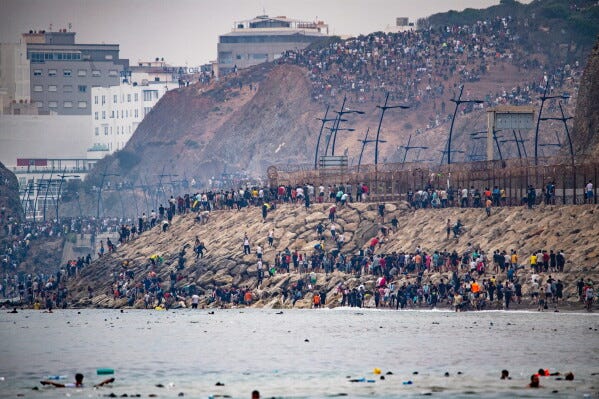
I keep returning to an image from these past weeks, and I offer it carefully, because behind it are real lives and real deaths. In late July, tens of thousands of young people crossed from Morocco toward Ceuta, the small Spanish territory on the North African coast — many swimming, many carrying almost nothing, some in little more than swimwear. Dozens did not survive the water. Around eight thousand were children. It is tempting to read such a moment only through the familiar lenses: immigration, border policy, security, diplomacy. Those conversations matter. But they do not answer the deeper question.
What has to happen inside a young person’s imagination before the uncertainty of open water becomes preferable to the certainty of staying?
That decision is never created by a single cause. Economic frustration, youth unemployment, rising food costs, narrowed opportunity, political disappointment, climate stress, a screen revealing lives elsewhere, a rumor that this is the moment to leave — each contributes; none explains the whole. Living systems almost never reorganize because of one variable. They reorganize when many forms of resilience begin disappearing at the same time.
Every migration contains two movements: one toward something, one away from something. We study the destination — the wages, the safety, the freedom — and pay far less attention to the departure.
There comes a moment when remaining begins to feel more dangerous than leaving. Not physically. Existentially. The future narrows. Possibilities contract. Time itself begins to feel smaller. The crossing becomes imaginable, then acceptable, then necessary.
That is why Ceuta stays with me — not because it predicts anything, not because it proves a political argument, but because it reveals how fast human behavior changes once hope crosses a threshold.
The same is true of civilizations, though we rarely say it aloud. An economy functions because people believe contracts will be honored tomorrow. Banks exist because depositors believe their money will still be there tomorrow. Currencies work because societies believe others will keep accepting them tomorrow. Education makes sense because students believe tomorrow will reward learning. Democracy depends on the confidence that institutions remain capable of renewal. Even investment is nothing more than hope made financial — capital moving toward futures it believes can exist. Hope is not sentimental. It is infrastructure. Perhaps the most invisible infrastructure of all.
This is why periods of systemic transition feel psychologically different. The objective conditions matter, but so do expectations.
Imagine a young farmer whose parents farmed, whose grandparents farmed, in a world where rain arrived with reasonable consistency and uncertainty stayed inside recognizable boundaries.
Now imagine that same farmer when rain no longer follows the old patterns, fertilizer prices turn geopolitical, insurance grows difficult, debt rises, and the next generation begins to wonder whether farming still has a future. Nothing dramatic need happen that year. The harvest may even be acceptable. Yet something has already changed — the future has become harder to imagine. That change rarely appears in GDP. It appears in decisions. The son leaves. The daughter chooses another profession. The land remains, but its continuity weakens. This is how reserves disappear: quietly, one decision at a time.
Systems thinkers distinguish between lagging indicators and leading ones. A bankruptcy is a lagging indicator; the fragility existed long before. A famine is lagging; the soil and institutions had already weakened. Political collapse is usually lagging; trust disappeared first.
Perhaps migration — not the migration of war alone, but the migration of shrinking possibility — belongs among the leading indicators. People begin moving before institutions acknowledge that the landscape has changed. Their bodies perceive what policy has not yet named. In that sense, migration is often not merely a humanitarian issue. It is a systems signal — a message carried by people rather than by data.
And so hope belongs squarely inside the definition of the Winter Threshold. Because hope, too, requires replenishment. Communities rebuild it. Families rebuild it. Institutions, schools, leaders, healthy landscapes, meaning itself rebuild it. Without renewal, hope becomes another reserve gradually drawn down — until one day people stop believing tomorrow belongs where they are. That may be one of the earliest moments at which winter becomes visible. Not in commodity prices. Not in climate models. In the human imagination.
History has many examples of societies becoming unstable during stretches of rising food prices, narrowing opportunity and weakening institutions — rarely because any single variable acted alone. The Arab Spring was not simply about food, nor authoritarianism, nor unemployment. It emerged from their convergence.
The pattern repeats: stress accumulates, hope declines, an event arrives, the event takes the headlines — and the accumulation is what made it possible. The last snowflake does not cause the avalanche. It only reveals that the mountain had already crossed a threshold.
We may one day develop better ways to measure social resilience — levels of trust, institutional legitimacy, community cohesion, intergenerational confidence, belonging, meaning, hope. Until then, we should remember something simple: not everything that determines the future can be represented on a balance sheet.
Some of the most important reserves are invisible until they begin to disappear. We only notice trust after it breaks. We only notice fertile soil after it erodes. We only notice biodiversity after the ecosystem simplifies. We only notice hope after people begin leaving.
There is another way to think about hope. Not as expectation, but as courage. The courage to keep planting, to keep building, to keep raising children, to keep investing, to keep restoring landscapes whose full recovery we may never personally witness. Hope is not believing everything will be fine. It is deciding that the future deserves our work anyway.
That is where hope parts from optimism. Optimism waits for favorable conditions. Hope creates them. And that distinction may matter greatly in the years ahead — because winter has never rewarded those who merely expected spring. It has always favored those who quietly prepared the ground for it.
By now we have spoken of oil, copper, natural gas, fertilizer, water, food, debt, inventories, soil, biodiversity, energy, trust. Each is a reserve on which civilization depends. Perhaps the most fragile of all is the one that tells human beings their effort still matters. Without it, economies stop investing, communities stop rebuilding, the young stop staying, and the future stops attracting the present.
If this essay has one purpose, it is not to diminish that reserve. Quite the opposite. It is to protect it. Because false optimism consumes hope just as surely as despair does. Real hope begins with seeing clearly — only then can we decide what is worth preserving, what must be relinquished, and what deserves to be built. That is why understanding winter matters. Not because fear prepares us. Because reality does. And reality, however difficult, is always a better foundation for hope than illusion.
So this is where the essay lands — not on hope, not on despair, but on stewardship. The questions become intensely practical, and intensely personal. How do you invest? Where do you live? What do you build, and what do you preserve? How do you steward land, family, capital, community — and your own consciousness, your own hope? These are not questions with a single answer. They have places, experiments, relationships, and consequences. They must be lived.
But the direction is clear, and it is the same direction the whole of this diagnosis has been pointing toward. From optimization toward resilience. From efficiency toward capacity. From extraction toward regeneration. From consuming reserves toward replenishing them. From asking how much we can produce toward asking what we must keep apart.
Everything I have described in these two essays turns out to be a single thing seen from many angles. Oil inventories are stored energy. Soil organic matter is stored fertility. Aquifers are stored water. Forests are stored biological memory. Strategic reserves are stored optionality. Trust is stored cooperation. Hope is stored future. Winter is simply the season in which all of these reserves are tested at once.
Five weeks ago I wrote that winter was coming. I no longer believe we are waiting for it. Winter is the season in which life reveals what it has been preparing all along. The question is no longer whether the world will change. The question is what kind of people — and what kind of civilization — we intend to become while it does.
This is Part Two of “Winter Has Arrived.” Part One set out the diagnosis: the ratchet, the diesel constraint, the blindness of a system optimized for a world that is disappearing.
If this piece gave you something to think about, consider planting a seed. I invite you to subscribe—or become a paid subscriber. If you’d like to support the continued exploration of these ideas, you can also buy me a coffee
Thank you Ernesto. Powerful as always. I appreciate your reflection on hope and resilience. There is so much to unpack within your writings, but one thing that stayed with me was the idea of stewardship.
"So this is where the essay lands — not on hope, not on despair, but on stewardship. The questions become intensely practical, and intensely personal. How do you invest? Where do you live? What do you build, and what do you preserve? How do you steward land, family, capital, community — and your own consciousness, your own hope? These are not questions with a single answer. They have places, experiments, relationships, and consequences. They must be lived."
I absolutely agree.
Well said !!!