
Learning to See: Walking the Path of Regeneration with Bill Reed
A Journey Into Seeing, Becoming, and Designing With Life

Bill Reed is a principal of Regenesis, Inc. — a regenerative design, living systems integrator, and education organization.
“You don’t build a building. You build capability in people who then align with the potential of place.”
— Bill Reed
I might be able to read through that now. But it took me years to truly see it.
My journey with Bill began while designing a course for the Capital Institute called Introduction to Regenerative Economics and Finance. That was when I first immersed myself in his work — not just the diagrams or definitions, but the deeper architecture of his thinking. His way of seeing.
Later, we collaborated on something even more elemental: The Ecology of Being and Becoming — a course centered on reconciliation. Reconciliation between the self and the systems we inhabit. Between being and doing. A course that quietly insisted regeneration begins not with solutions, but with presence.
Over time, in our work together, I came to recognize in Bill not just a teacher, but a companion on the path. He doesn’t hand you a framework and say “follow this.” He asks questions that break open your perception. He listens with precision. He teaches with humility. He designs for potential.
What follows is not a portrait of Bill Reed. It is a reflection of what he has learned from living systems thinking—particularly through the work of Regenesis, his partners at the Regenesis Group, Carol Sanford, and the lineage that supports them.
It is a reflection on what I’ve come to see — walking beside his ideas, shaped by his questions — about regeneration, life, and the future of place and people on a planet undergoing profound change.
The Real Project Is Not the Building
Bill doesn’t mince words.
“Sustainability,” he told me once, “is just a slower way to die.”
That sentence, a quote attributed he attributes to Bill McDonough, doesn’t just pierce. It reframes everything.
Because sustainability, in the mainstream, means maintaining the existing system while making it a little less bad. But the system itself — industrial, extractive, isolated from place — is the problem. No amount of efficiency can save a paradigm that is out of sync with life.
Regeneration, by contrast, is not a fix. It is a shift.
A shift from “less harm” to more life.
A shift from machine-thinking to living-systems intelligence. A shift from carbon accounting to consciousness.
At the center of of Regenesis’ paradigm is a deceptively simple question:
What is the potential of this place?
Whether it’s real estate, infrastructure, water systems, or agriculture, Bill always says:
“Your project is not the project. The project is life. What you’re doing is just the acupuncture point for engaging life. The real work is building capability in the people of that place to support life.”
That sentence haunted me.
What he means is that every development — every built intervention — can become a lever for activating a deeper purpose: to reweave human and ecological systems through relationship.
Not control. Not compliance. Not fixing problems from the outside.
Relationship.
To place. To community. To life.
That’s what regenerative development actually is. Not a checklist. Not a certification. Not a style.
It is the building of the capacity to participate in the co-evolution of living systems.
Let that settle in.
Three Lines of Work: Self, Group, System
One of the most powerful frameworks Bill taught me is this: regeneration unfolds along three lines of work — self, group, and system.
The self, because regeneration is a function of awareness.
The group, because coherence is a collective act.
And the system, because life operates in patterns that cannot be engineered — only aligned with.
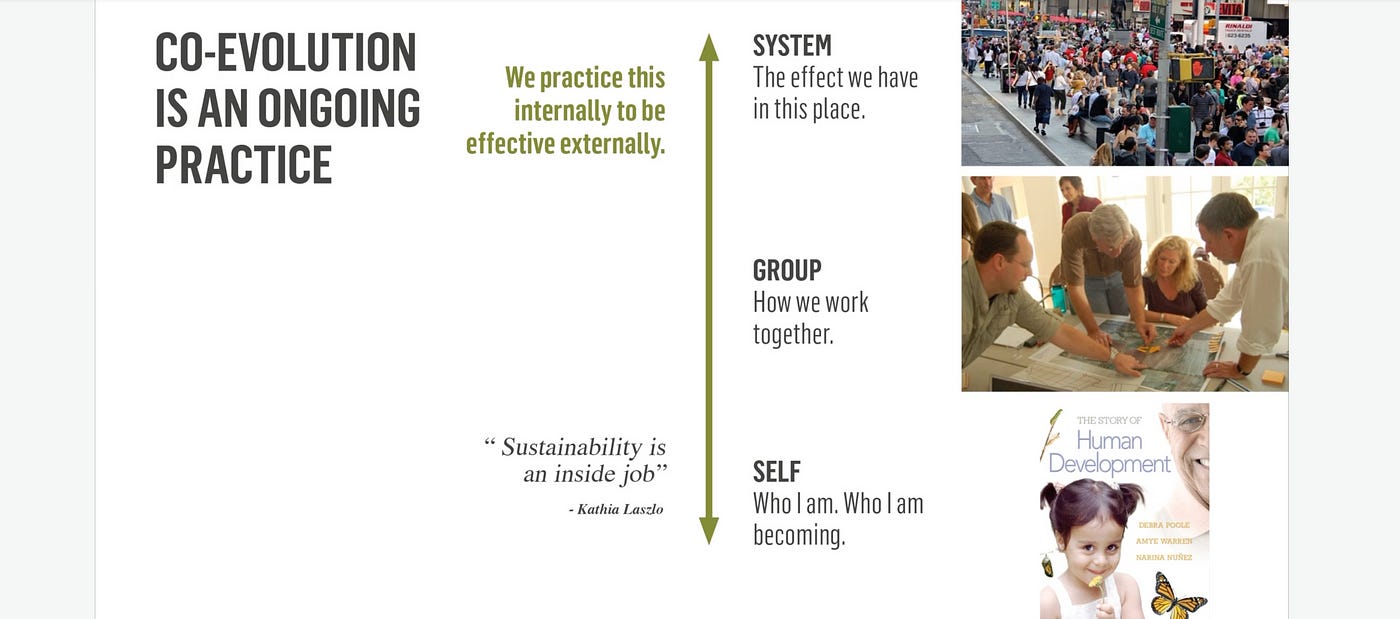
That means letting go of mechanistic thinking and surfacing what Bill calls the “essence of place.” The unique pattern, story, and potential that each place holds, if we’re humble enough to ask and to see.
Life Doesn’t Compromise — It Harmonizes
“Life doesn’t compromise. It harmonizes. That’s the law.” — Bill Reed
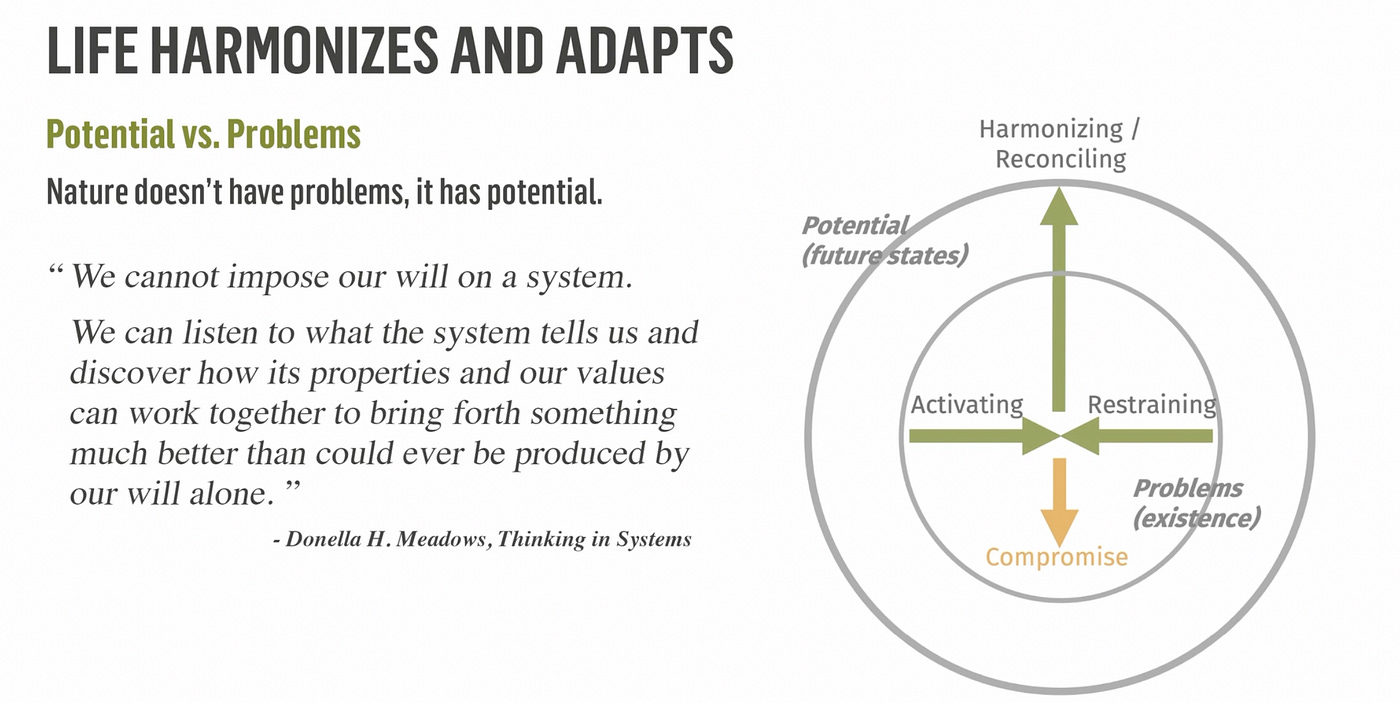
We live in a world of compromise. In our politics, our buildings, our budgets — we split the difference, dilute the edges, soften the bold for the sake of the agreeable. We reduce tension instead of working through it. But nature — life itself — never does this.
A river doesn’t negotiate with a rock. It finds a path through that honors both. A forest doesn’t vote on whether to grow. It emerges, harmonizing fungi, root, rainfall, and decay in a choreography that we still struggle to understand.
This is the difference between concession and harmony.
One collapses complexity.
The other holds it — until something more whole emerges.
Bill Reed’s adaptation of Gurdjieff’s Law of Three:
Affirming: the initiating impulse.
Denying: the reality that resists it.
Reconciling: the emergent third that transcends both.
This is not a formula. It’s a principle of life.
You don’t solve problems. You hold the polarity. You midwife the emergence.
This applies to buildings. To communities. To conflict. To love.
It is the essence of regenerative development.
Place is a Being, Not a Site
We don’t ask: “What do we build here?”
We ask:
“What does this place want to become — through us?”
It’s a radical question. One that turns developers into listeners. Turns clients into stewards. Turns architects into facilitators of potential.
To ask this question is to recognize that place is not passive. Not a blank slate or inert canvas.
Place is a living system. A being with memory, relationships, trauma, beauty, and longing.
We are not separate from it. We are expressions of it.
And the highest role we can play is to help it become more of itself.
Life Organizes in Nested Wholes
Another insight from Living system Thinking:
Life evolves through nested wholes.
The cell is part of the tissue.
The tissue is part of the organ.
The organ is part of the body.
The body is part of the family.
The family is part of the watershed.
The watershed is part of the biome.
The biome is part of the planet.
This isn’t metaphor. This is structure.
When we design without acknowledging these wholes, we fracture.
When we relate through them, we heal.
Regeneration arises through relationship.
From the inside out. From the outside in. In a dance that never ends.
Paradigms of Perception: Bill Reed and Carol Sanford
“Most people are trying to do better things inside the wrong paradigm.” — Bill Reed
“You don’t fix systems by working on the parts. You evolve the paradigm.” — Carol Sanford
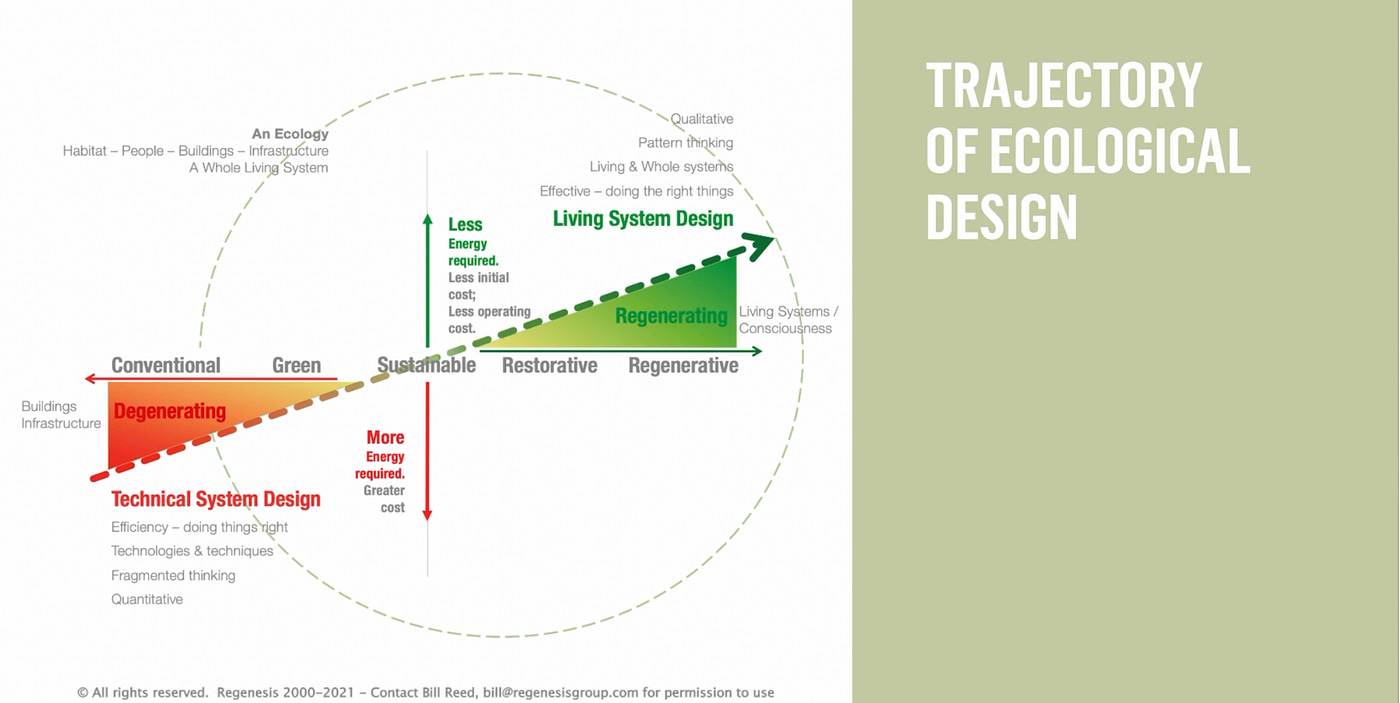
Bill and Carol — two of the most lucid thinkers I’ve Known — each offer a five-level map of paradigm evolution. Though they use different terms, their frameworks converge on a single truth: transformation begins with perception.
Bill’s Five Paradigms of Development
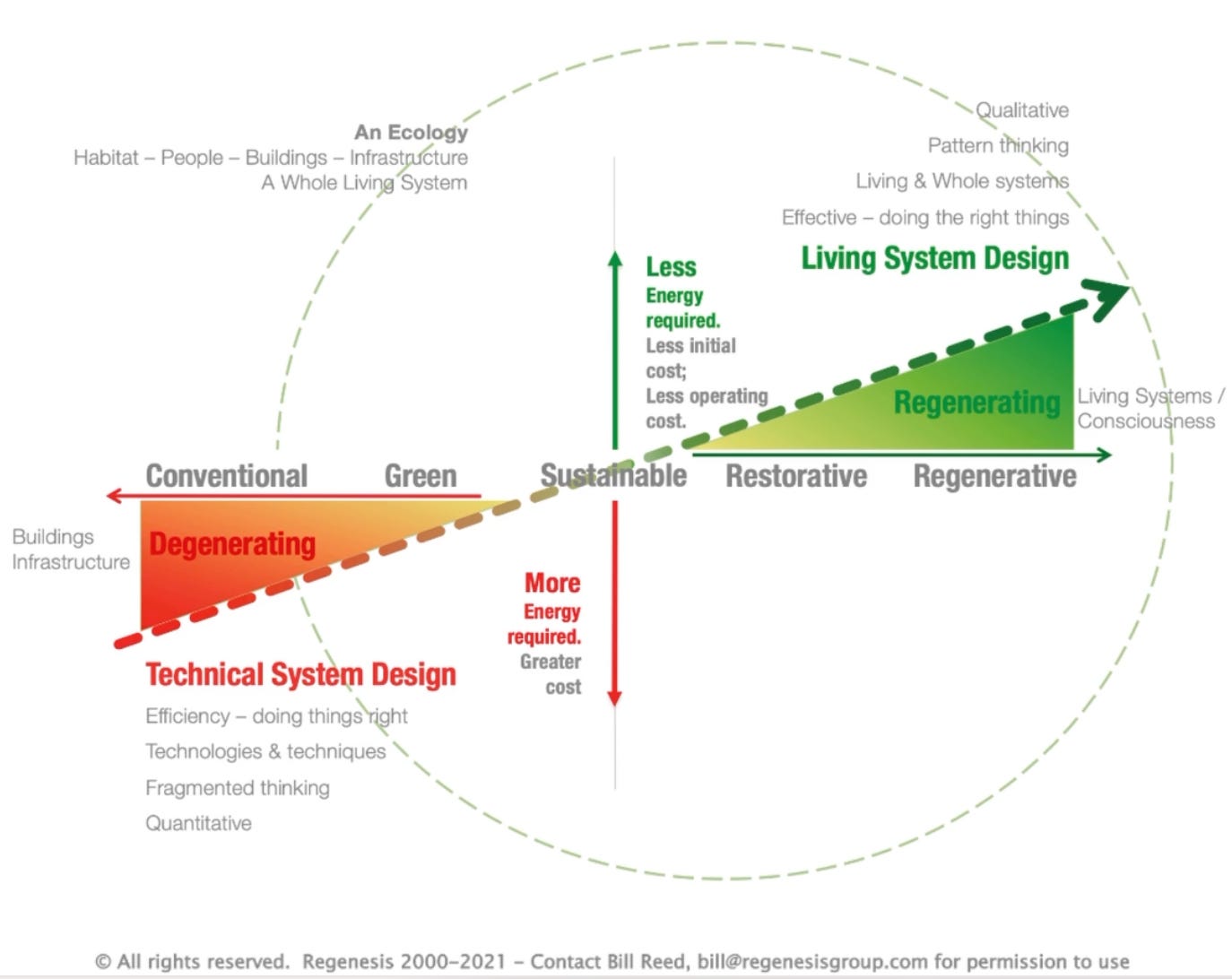
Degenerative (Conventional) — Extractive. Industrial. Disconnected from life.
Green (Less Bad) — Harm-reduction without transformation.
Sustainable (Neutral) — Maintains stasis, but stasis is death in living systems.
Restorative — Repairs damage, but looks backward.
Regenerative — Co-evolves with place. Awakens potential. A living system aligned with life.
Restoration vs. Regeneration
Restoration is reassembly.
Regeneration is evolution.
Regeneration doesn’t just fix what’s broken. It reveals what wants to emerge.
Carol Sanford’s Inner Framework
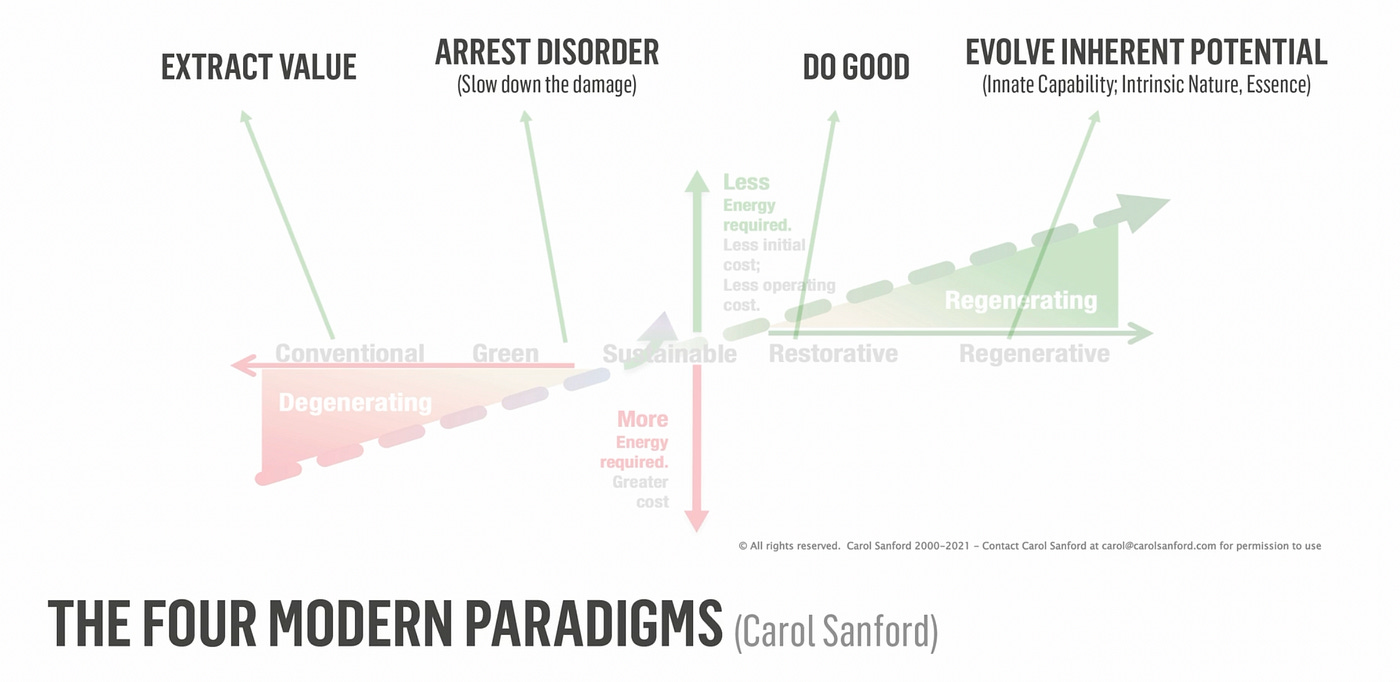
Extract Value — where knowledge and power are centralized. The powerful decide what’s valuable, and everyone else serves the system.
Arrest Disorder — where we identify problems, isolate variables, and aim for efficiency. This is the world of metrics, carbon offsets, and net-zero goals.
Do Good — where we act from moral conviction. We try to help. We plant trees, volunteer, and donate. But we still operate from a top-down mindset.
Evolve Capacity — the regenerative paradigm. Here, we stop trying to fix systems and start partnering with them. We see people, places, and ecosystems as living wholes with unique potential.
The maps that Bill Reed and Carol Sanford have drawn — each in their own language, yet deeply aligned — mark both the landscape and the mindset of regeneration. Together, they give us a multidimensional compass for real transformation.
They are not the territory. But they do offer something rare: a pathway of evolution. A way of seeing where we are, and what comes next. Not as a formula, but as a living journey. I’ve walked that path for years, and I’ve come to recognize its rhythms. In an upcoming entry in this logbook, I’ll share that journey — how these maps have helped me navigate the thresholds of doing, being, and becoming.
Becoming Worthy of the Future
Regeneration is not a checklist. It’s not a model. It’s not a carbon offset strategy.
It is a maturity.
A shift from separation to reciprocity. From fixing to becoming.
From impact to relationship. From scalability to coherence.
Bill doesn’t try to convince. He invites you to a field.
A field we create walking together.
A field of coherence.
Of shared intention.
Of humility before life.
That, above all, is what I’ve learned walking alongside Bill Reed.
And that is the future I hope we can still grow into — if we remember that life doesn’t scale. It emerges.
And when we align with it, so do we.
This body of work stands on a living systems lineage including Regenesis, Carol Sanford, and many others whose thinking continues to shape the regenerative field.
There are several interviews, podcasts, presentations, and writings — both by Bill Reed and about his work — that explore the profound depth of regenerative design and development. The graphs and images shared here are drawn from a video presentation recorded by Soprema, where Bill brings many of these ideas to life with clarity and care. I highly recommend watching it. Let his words, his diagrams, and his presence speak directly to you.
I invite you to visit, to listen, and to sit with what emerges.
https://www.soprema.ca/en/bill-reed-sustainability-and-regeneration-on-demand-conference/video
This piece represents my interpretation of the work and conversations I’ve shared with Bill and the Regenesis community. Any errors are my own.
Thank you for this thoughtful and thorough summary! I've been following Regenesis Group and Bill Reed for some time now and I find myself going back to these principles over and over again and each time, I'm unlearning and relearning something new! The ability to regenerate relationships over time and create a living system...what an vision and goal!
Thank you for the link to Bill’s video!🙏