
Seeing Through the Paradigm
Understnding the Living Architecture of Belief

Why paradigms defend themselves — and how they learn to grow
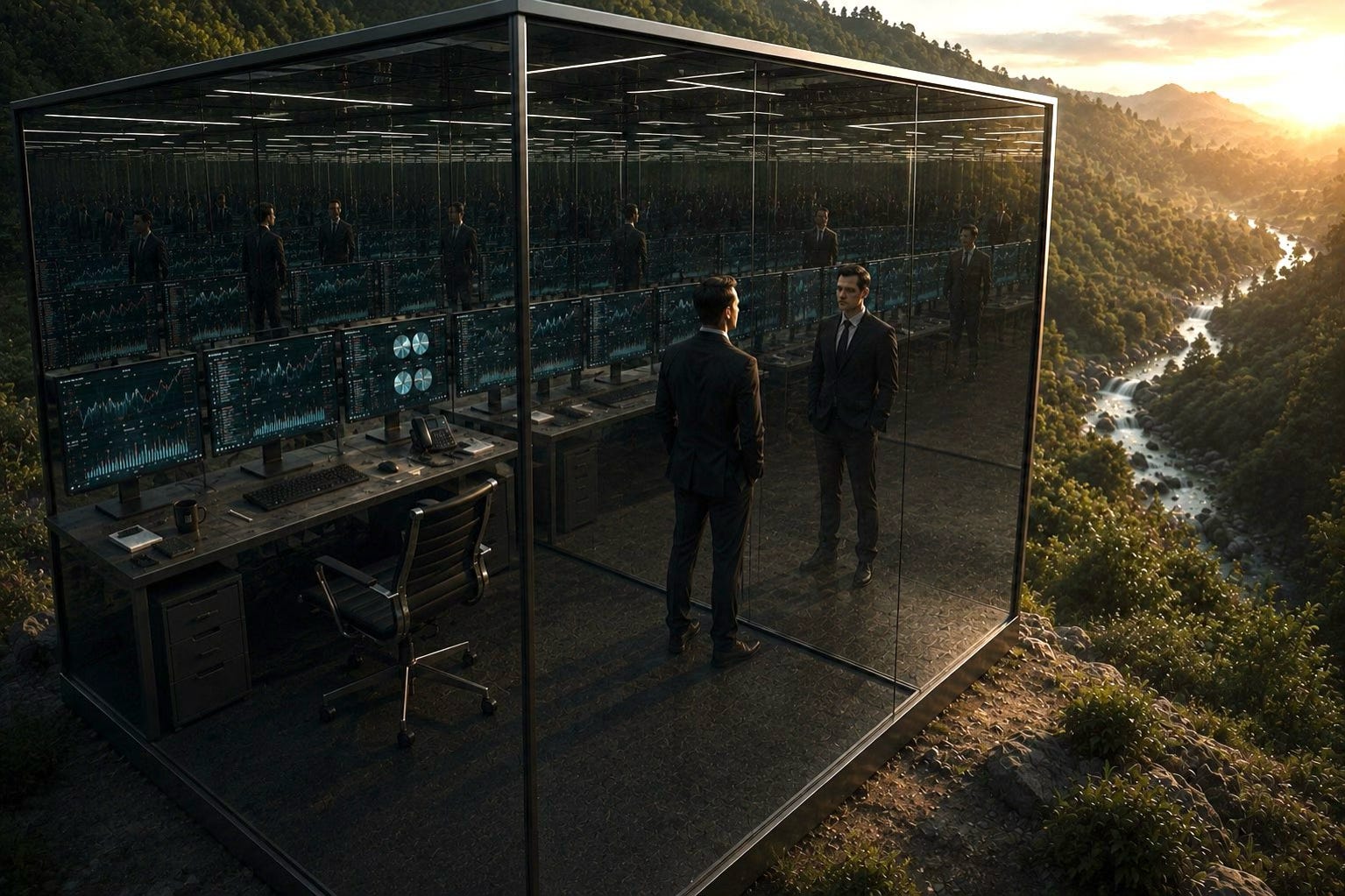
The Box We Cannot See
There is a particular feeling that comes over me when I speak with someone who lives deep inside the financial paradigm. It is a quiet frustration — not because we disagree, but because I gradually realize we are not looking at the same world. This image is the closest I have come to naming that experience.
A recent conversation brought this into sharper focus than any theory could. I was speaking with a friend whose intellectual discipline I deeply admire, someone who has spent decades understanding capital, markets, and financial value. As I explained the importance of biological infrastructure—the living soils, watersheds, biodiversity, and ecological relationships that make agriculture and food production possible—I gradually realized I was losing him. Not because he wasn’t listening. He was. Nor because he lacked the intelligence to understand the science. Rather, I began to sense that what I was describing could not easily enter the framework through which value itself was being perceived.
He listened carefully for a while, asked thoughtful questions, and then, almost inevitably, the conversation found its way back to profitability. What was the return? How quickly would it generate cash flow? Where was the financial upside? It was not skepticism, nor indifference. It was something much subtler. No matter how often we returned to the living processes that make production possible, the conversation was repeatedly drawn back into the gravitational field of financial performance, as though value itself could only become visible once it appeared on an income statement
Only later did I realize that the conversation had never really been about biological infrastructure. It had been about the boundaries of a paradigm. It wasn't that my friend refused to see another reality. Rather, the paradigm itself had already determined, before either of us spoke, what would count as value and therefore what could become visible. Inside the box everything coheres—prices, yields, returns, risk, liquidity, assets—and the screens keep reflecting that world back upon themselves until they feel less like a description of reality than reality itself. But the walls are mirrors. Whatever lies beyond them becomes almost impossible to make out, because the language spoken inside the box was never built to perceive it. And yet something does lie beyond the glass.
A whole living world falls away down the mountainside outside those mirrored walls — the forest and the river and the slow green machinery that has been holding the valley together since long before there were screens to ignore it. The man inside cannot quite see it; the mirror gives him back only his own coherent, glowing world, multiplied to the horizon. This is not a failure of his intelligence or his goodwill. It is the ordinary condition of anyone standing inside a paradigm, which is to say the ordinary condition of all of us, about something.
That is the difficulty this essay is really about. From inside one paradigm, another world does not merely look mistaken; it can go almost entirely unseen — and the strangeness only deepens when you notice that the man in the box depends, utterly and at every moment, on the very world the mirror is hiding from him.
What follows is an attempt to walk out through the glass: to understand how such boxes get built, why they defend themselves so well, and how, every so often, a person learns to see straight through the mirror to the living world that was there the whole time.
Prelude
We tell ourselves that we see the world as it is, and this may be the most confident mistake our species has ever made. What we actually see arrives already sorted, already lit, already carrying the shape of meanings we did not choose and cannot easily name.
Every civilization hands these meanings down. Every culture rehearses them until they harden into common sense. Every family and profession and congregation and institution takes its turn refining them, and by the time they reach us they have become something closer to weather than to thought — the invisible architecture inside which reality appears, at last, to make sense.
We call these architectures paradigms, and most of our conversations about them go astray from the first word, because we speak of them as though they were collections: bundles of ideas, inventories of belief, values gathered and stacked like provisions for a journey.
This essay begins somewhere else. It proposes that a paradigm behaves far less like a philosophy than like a living system — that it emerges out of relationship rather than doctrine, develops a coherence of its own, learns to defend that coherence against whatever threatens it, and, when the conditions are right and the pressure is great enough, evolves into something wider than it had been.
If that is true, then many of the tensions of our time are no longer just conflicts of opinion. Political polarization, ecological decline, the search for meaning, and the growing interest in regenerative thinking may all be expressions of something deeper: an old paradigm reaching the limits of what it is able to see, while a new one gradually learns how to perceive a larger reality.
This is not an essay about who is right. It is an invitation into a stranger and more interesting question: how worlds are made, how they protect themselves once made, and how, every so often and against considerable resistance, they learn to grow.
One
The Things That Exist Between Us
There is something quietly impossible about a forest. You can spend an entire afternoon on your knees in it, cataloguing each tree by its bark and each fern by the cut of its fronds, naming the fungi that push their pale knuckles through the damp litter and the birds that pour their announcements down through the canopy, and you can rise at dusk with a full notebook and still not have found the forest itself. It was nowhere on your list. It could not be, because the forest does not reside inside any one of the lives that compose it. It lives in what passes between them — in the exchanges too slow or too quiet for our senses to register, in the ten thousand daily acts of reciprocity by which each life is continuously shaping and being shaped by the lives around it.
The forest is the conversation, not the speakers. A river teaches the same lesson from the other direction. Take it apart, molecule by molecule, hold each one to whatever light you like, and you will never once catch the current in your hand. The motion belongs to the whole before it ever belongs to the parts, and no amount of attention paid to the parts will hand it over.
Nature keeps offering us this lesson, patiently, in a thousand different grammars. Complexity, it turns out, does not merely accumulate; past certain thresholds it begins to bring forth qualities that were nowhere present in what came before. Life arrives out of chemistry that was never itself alive. Consciousness stirs in tissue that had only ever been tissue. A flock of starlings acquires an intention and a direction that no single bird could be said to have issued. Something genuinely new enters the world — not supernatural, not a violation of anything, simply irreducible to its ingredients, and therefore invisible to any method that only knows how to divide.
We have grown comfortable recognizing this in biology and ecology, even in the deep counterintuitive rooms of physics. And then we turn to look at ourselves, and almost without noticing it we set that whole way of seeing down. We imagine that human societies are assembled the way a machine is assembled — individuals first, culture afterward, the parts logically prior to the whole they happen to form. We talk as though our beliefs were private property, our opinions filed away in the separate cabinets of separate minds, our values selected and then carried through the world like coins in a pocket, jingling, wholly our own.
But suppose culture is far more forest than machine. Suppose the convictions we defend with such heat are not, or not entirely, ours — that they are the local expression of patterns that form in the space between us, the way a current forms between molecules or a murmuration between birds.
A worldview, on this reading, is less a collection of ideas than an ecosystem of them: a living architecture of relationships that slowly acquires its own coherence, its own memory, its own reflexes, its own way of deciding what counts as real.
Seen like this, a paradigm stops being a philosophy you could argue someone out of and becomes something far subtler and more pervasive. It is the atmosphere a community learns to breathe without ever noticing that it is breathing — the medium that quietly settles what will strike us as obvious and what as absurd, what earns our attention and what stays permanently beneath it.
It does not dictate our particular thoughts. It does something more powerful and harder to see: it draws the horizon within which thought feels possible at all, and then hides the drawing. Perhaps that is why a paradigm is so nearly impossible to examine from the inside. A fish does not come to know water by contemplating the ocean; it comes to know water only in the instant something interrupts the seamlessness that has surrounded it since birth — a change in temperature, a current, the sudden shocking membrane where water ends and air begins.
Every age carries assumptions so complete that they vanish into the backdrop of ordinary experience and become indistinguishable from reality itself, and only afterward, usually in the vertigo of some great transition, do we discover that what had felt like the world was one way, among others, of seeing it.
That discovery has walked beside humanity through every real turning we have made — the passage from myth into philosophy, from the divine right of kingdoms into the improvisations of democracy, from Newton’s clockwork universe of separate masses into the relational universe now emerging through ecology and complexity science. None of those turnings was accomplished by information alone. Each of them required people to perceive differently — to feel their way into the relationships out of which reality is continuously taking shape.
Ours, I suspect, will ask no less of us. Not because our tools have grown clever beyond precedent, and not because our crises are uniquely severe, though both may be true, but because we are beginning, haltingly, to notice something we spent several centuries training ourselves to overlook. The most powerful forces shaping a civilization may not reside inside any single one of us at all. They may live, quietly and without pause, in the patterns that arise between us.
Two
The Coherence That Holds a World Together
If a paradigm were only a pile of beliefs, we could revise it the way we revise a shopping list — striking one item, adding another, and walking on largely unchanged. But anyone who has tried to talk a person out of a deeply held view, or has watched an institution absorb a devastating piece of contrary evidence and somehow emerge more certain than before, knows that this is not how it goes. Something holds. Something closes over the wound and keeps its shape. That something is coherence, and it is the first property a paradigm shares with anything alive.
Consider how a cell decides what belongs to it. It does not consult a list. It maintains a membrane, a living boundary that is forever letting the world in and keeping the world out at once, and everything it admits, it folds into a metabolism that was already running — a vast, self-sustaining conversation of molecules in which each reaction makes sense only in relation to all the others. A paradigm keeps its coherence the same way.
Every new fact that reaches it is met at the membrane and asked, in effect, a single question: can you be metabolized? Can you be told in the language we already speak?
What fits is drawn inward and made to nourish the whole. What cannot be told in that language does not so much get refuted as fail to register — it slides past unmetabolized, noticed by no one, a nutrient the system was never equipped to absorb.
This is why two thoughtful people, each of them honest, each genuinely looking, can stand in the same field and see different worlds.
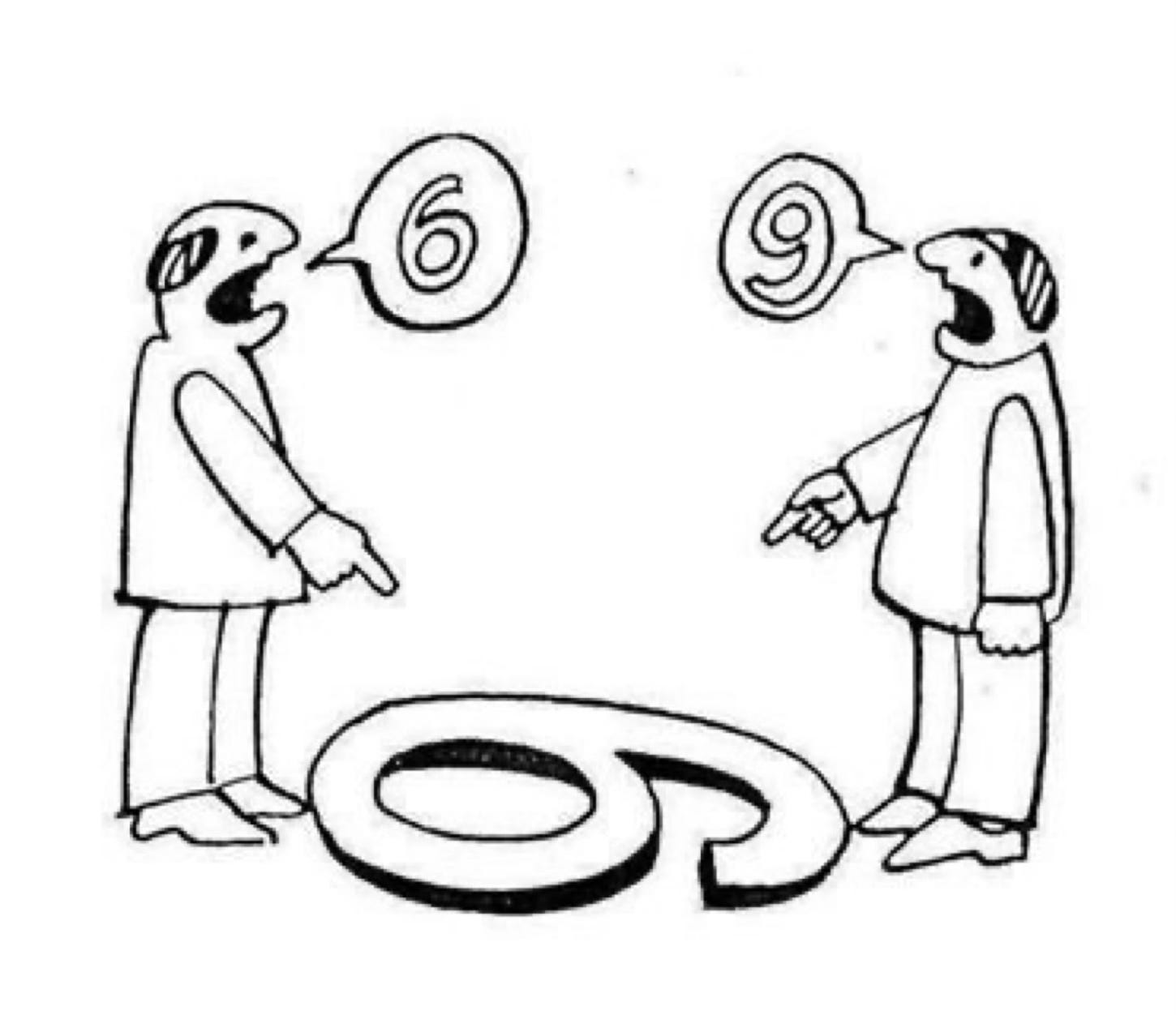
The agronomist trained inside an industrial paradigm looks at a hillside and reads yield per hectare, input costs, the efficiency of a monoculture engineered for a single harvestable trait, and every one of those readings is accurate, internally consistent, defensible in its own terms.
The farmer standing beside her, whose seeing was formed inside a living-systems paradigm, looks at the same hillside and reads the depth and darkness of the soil, the fungal threads braiding root to root beneath the surface, the return of insects as a sentence about health, the slow accrual of fertility that no single season could account for. Neither of them is hallucinating.
Each is metabolizing the hillside through the coherence that makes their world hang together, and the tragedy — if it is a tragedy — is that the coherence which lets each of them see so clearly is precisely what keeps each from tasting what the other tastes.
Coherence, then, is not a flaw we could scold ourselves out of. It is the condition of seeing anything at all. A mind with no paradigm would not be gloriously free; it would be drowned, unable to tell signal from noise, meaning from static, the relevant from the infinite.
We should be slow to sneer at the coherence of a world we happen to be leaving, because coherence is the gift that made thought bearable in the first place. And yet the same gift, held too long past its usefulness, becomes the thing that will not let us see that we are leaving anywhere at all.
Three
The Immune System of an Idea
A living body does not passively wait to be harmed. It patrols itself. It keeps a standing capacity to recognize what does not belong and to move against it before the intrusion can spread, and this immune vigilance is not a defect of the organism but one of the surest signs that the organism is alive and intends to stay that way.
A paradigm, if it is genuinely a living system, should possess something of the same. It does. Watch closely during any real contest of worldviews and you will see the immune system of an idea come awake. Its first and gentlest response is simply not to perceive.
Don’t Look Up offered a brilliant satire of something much deeper than climate denial: our extraordinary capacity to receive information that threatens the assumptions of our prevailing paradigm and somehow translate it back into something the paradigm can accommodate. The scientists are describing physical reality; the television hosts keep translating that reality into the familiar grammar of entertainment, reassurance, and normality. Nothing is hidden. The information is right there. And yet, somehow, it cannot quite be seen.
The unassimilable observation arrives and finds no receptor waiting for it, and so it is filed under noise, anecdote, coincidence, the merely subjective — set gently aside, not with malice but with the quiet confidence of a system that already knows what the real signals look like.
For decades the small farmers reporting that their living soils outperformed their chemically managed neighbors’ were heard, when they were heard at all, as folklore, sincere and unquantified and therefore safely ignorable. The data existed. The receptors did not. When an intrusion grows too large to overlook, the immune response escalates from silence into naming, and the naming is rarely kind.
The disruptive idea is labeled — romantic, unscientific, nostalgic, naïve, ideological, unrealistic — and each of these labels performs the same protective work, which is to spare the community the trouble of actually metabolizing the thing. To call an idea nostalgic is to explain, without argument, why one need not think about it.
The antibody has done its job: the threat is neutralized not by being answered but by being categorized in a way that makes an answer feel unnecessary. Should the idea keep growing despite the labels, the system reaches for its most sophisticated defense of all, and this one deserves our respect for its cunning. It absorbs the language of the challenger while leaving the challenger’s meaning at the door. The words are welcomed in; the world they came from is turned away. Sustainability enters the vocabulary of the very industries busy liquidating the future and is quietly redefined to mean sustaining present rates of extraction a little longer. Regenerative becomes a label on a package, a claim on a quarterly report, a marketing surface stretched over an unchanged machine.
This is not usually hypocrisy in the crude sense; it is immunity in its most refined form, the paradigm neutralizing a foreign meaning by keeping the sound of the word and digesting away everything the word was trying to carry. We are tempted to feel superior to all this, to imagine that our own convictions arise from clear looking while other people’s arise from defended illusion.
That temptation is worth resisting, because the immune response is not something that afflicts other people’s paradigms. It is running in each of us, right now, doing its patient work at the edge of our attention, deciding what we will be able to hear before we ever hear it. The honest question is never whether we have an immune system. It is whether we can catch it in the act.
Four
Where a New Way of Seeing Actually Comes From
If paradigms defend themselves so effectively — if they can decline to perceive, decline to take seriously, and even digest the words of their successors — then it becomes a genuine puzzle how anything new ever manages to arrive at all.
And the answer is that it almost never arrives where the defenses are strongest. New paradigms are not, as a rule, born at the center of the old one. They are not usually the achievement of its most decorated authorities, whose seeing has been most thoroughly formed by the coherence now under strain. They tend to begin at the edges, in the places and among the people for whom the old coherence was already failing to account for a lived and undeniable experience.
There is an ecology to this, and it is worth naming plainly. In a forest, the most vigorous new growth rarely erupts in the deep shade of the oldest, densest, most established canopy, where everything is already spoken for and every ray of light already claimed. It comes at the edge — the forest’s margin, the burned clearing, the fallen giant whose collapse has suddenly let light reach the floor.
Ecologists call these edges and openings the sites of the highest diversity and the fastest change, and cultures obey a strikingly similar law. The next way of seeing tends to take root among those the current paradigm has failed, overlooked, or could never quite hold: the practitioners whose direct experience keeps contradicting the official account, the young who have not yet been fully enclosed inside the inherited common sense, the outsiders standing at enough of an angle to notice the water.
This is why the emergence of a paradigm so seldom looks like emergence while it is happening. It does not announce itself with a manifesto or a single decisive experiment. It looks, from the center, like scattered noise — a handful of farmers doing something eccentric with cover crops, a cluster of scientists chasing questions that seem to lead nowhere the field values, a fringe of communities organizing their economies around principles the textbooks never taught.
Each fragment is easy to dismiss on its own, and each is duly dismissed. What the center cannot see, precisely because its coherence forbids the seeing, is that these scattered fragments are beginning, slowly, to find one another — to recognize a shared pattern beneath their surface differences, to build the connective tissue through which isolated anomalies gradually become a coherent alternative way of understanding the world.
And here the living metaphor turns from consolation into something more demanding. A seed carries the whole information of the forest, but it germinates only where conditions permit — where there is light enough, moisture enough, the right disturbance in the soil.
A new paradigm is much the same. Its seeds may already be everywhere, dormant, patient, distributed far more widely than anyone at the center suspects. What determines whether they grow is not the brilliance of the seed but the readiness of the ground: whether enough people have suffered the failures of the old coherence deeply enough to become, at last, hospitable soil.
Five
The Long Middle, Where Two Worlds Overlap
We would prefer our transitions clean. We would like the old world to finish and the new one to begin, with a clear seam between them we could point to and date. But that is almost never how a paradigm actually gives way to its successor, and the gap between the transition we imagine and the transition we get is the source of a great deal of our present bewilderment. What really happens is a long, disorienting middle in which both worlds are fully present at once — the old paradigm still structuring most of our institutions, still writing most of our laws, still holding most of the money and nearly all of the momentum, while the new one grows up through its cracks, unevenly, in patches, real but not yet dominant.
This overlap is not comfortable, and it is not supposed to be. It is a season in which the same word means opposite things to different people, in which an action that is obviously responsible inside one paradigm looks obviously reckless from inside the other, in which institutions built entirely on the old coherence are asked to steward a world their instruments can no longer accurately read. A great deal of what we experience as political dysfunction is, at bottom, this overlap made visible — not simply a fight between interests, though it is also that, but a collision between two ways of perceiving what is even at stake, two incompatible answers to the prior question of what the situation is.
I have explored this transitional space extensively through the framework of the Three Horizons. (See the article here.)
Ecosystems know this season and pass through it without panic. When a landscape shifts from one stable state toward another — grassland easing into woodland, a degraded field beginning its slow return toward forest — there is a long interval in which the community is genuinely mixed, the pioneers of the coming order growing alongside the holdouts of the old, no single logic yet in command of the whole.
Ecologists do not read this as failure or as chaos. They read it as succession: the entirely lawful, if untidy, process by which one living configuration hands the world over to the next. It cannot be hurried into tidiness, and the attempt to force it — to declare the transition already complete, or to insist it is not happening at all — tends only to prolong the disorder.
What the overlap asks of anyone living through it is a peculiar and difficult double vision: the capacity to see the old paradigm clearly enough to work within it where one still must, to keep the lights on and the harvests coming and the institutions functioning, while simultaneously seeing the new one clearly enough to feed it, to give it soil and light and one’s own daily participation.
This is not fence-sitting and it is not lukewarm compromise. It is the specific labor of a threshold, the work of people who understand that they are living in the seam between worlds and have decided to make themselves useful there rather than pretending the seam does not run straight through their own lives.
Six
What the Old Paradigm Was For
It is tempting, standing at this threshold, to treat the departing paradigm as an error — a long collective mistake we can now be relieved to be finished with, a darkness the new light will simply dispel.
That temptation should be resisted, and not only out of politeness. It should be resisted because it is inaccurate, and because a new paradigm that begins in contempt for the one it replaces tends to inherit its opponent’s worst reflex, which is the certainty that it alone can see. The paradigm now straining under its own success was, in its time, an extraordinary achievement, and it solved real problems that had genuinely afflicted human life.
The mechanical, extractive, separative worldview that we are learning to question also gave us the disciplined skepticism that pulled us out from under superstition, the standardization that let strangers cooperate across vast distances, the productive power that lifted a great many people out of the raw material scarcity that had defined nearly all of human history.
When it taught us to see the world as a collection of separate objects rather than a web of sacred relations, it was not simply committing a crime against the sacred. It was also, in the same gesture, learning to take things apart and understand them with a precision no previous way of seeing had achieved. The blessing and the wound were the same act. This is how living systems tend to work, and it is worth dwelling on, because it is the antidote to the intoxication of thinking oneself finally, cleanly right.
In biology, the very trait that lets an organism flourish in one environment is often the trait that dooms it when the environment shifts — the thick coat that is salvation in the cold and catastrophe in the heat, the specialization that is triumph in a stable niche and fragility when the niche moves.
The industrial paradigm’s genius for separation, for isolating a variable and optimizing it in isolation, was exactly the trait that let it accomplish so much so fast, and it is exactly the trait that now leaves it unable to perceive the living relationships its optimizations quietly consume.
What is failing us now is not some foreign flaw bolted onto an otherwise sound machine. It is the shadow cast by its particular kind of light.
To become good ancestors to the next paradigm, then, we will need to hold something more graceful than triumph. We will need gratitude and grief at once — gratitude for what the old world made possible, including the security and the leisure and the very education that now let us see past it, and grief for what it could not see, and for what was lost, unnecessarily and at enormous cost, inside its blind spots.
A paradigm held in gratitude and grief together can be set down with dignity, the way one closes a life well-lived rather than smashing an idol. And a paradigm set down that way is far less likely to be resurrected in a new costume, which is the fate that tends to befall the ones we imagine we have simply defeated.
Seven
The Economics of What Renews
We began outside a mirrored box on a mountainside, watching a man who could not see the valley that kept him alive. It is time to return to that image and give the missing world its name, because nowhere is the coming shift more consequential, or more concealed, than in how we answer a question so basic we rarely think to ask it aloud: what is wealth, and where does it actually come from?
The paradigm now passing gave an answer of remarkable clarity and remarkable narrowness. Wealth was what could be measured, extracted, accumulated, and exchanged. The living world entered the ledger only in the moment it was converted into product — a forest became wealth precisely when it stopped being a forest and became timber, a river became wealth when it was dammed into kilowatts, a mountain became wealth when it was opened and emptied.
Everything the forest had been doing while it stood — holding the soil, seeding the rain, breathing the air into balance, composing a community across centuries — registered as exactly nothing, because the instruments could not read a value that had not yet been severed and sold.
For a long while this way of accounting looked self-evidently true, the way a paradigm’s central assumptions always come to look once they have sunk beneath the level of things one thinks to question. And then the bill began to arrive, in the currency the ledger had declared worthless: soils exhausted past the point of easy return, watersheds that no longer hold their water, a climate destabilizing as the atmosphere is asked to absorb what the accounting never charged for.
The economists have a bloodless word for costs a system generates but does not pay — externalities — and it is worth pausing on that word, because it quietly confesses the whole problem.
To call the collapse of a living world an externality is to admit that the accounting treats the actual basis of all wealth as external to wealth. The map has mistaken itself for the territory, and the territory is beginning, undramatically and without appeal, to correct it.
A different economics is germinating in the cracks of this one, and its founding intuition is almost the reverse. It begins from the recognition that the deepest infrastructure of every economy — beneath the roads and the grids and the balance sheets, holding all of it up — is the living world itself, the soils and waters and webs of relationship that no market created and no market can replace.
From that recognition a different definition of wealth follows, one that measures worth not by how much can be extracted from a system before it fails but by how much a system can continually renew: the soil that grows deeper under good care instead of thinner, the fishery that returns more abundantly the more wisely it is left alone, the community whose social fabric thickens rather than frays with use.
Resilience, in this reckoning, stops meaning the rigidity that resists all change and starts meaning something closer to what every living thing already knows — the capacity to bend, to adapt, to keep evolving without breaking.
This is not a softening of economics into sentiment, though it is sometimes dismissed as exactly that, in a textbook case of the immune response we have already watched at work. It is a hardening of economics toward a longer and more honest accounting, one that finally includes the ground it has always been standing on.
Elinor Ostrom spent a lifetime documenting communities that had governed shared living resources across generations without either privatizing them or destroying them — that had, in other words, been quietly practicing this other economics all along, at the edges, unheard by a center whose coherence had no receptor for what they were doing. The seeds, as ever, were already in the ground.
What is changing is the readiness of the soil to let them grow.
Eight
Tending the Conditions Rather Than Forcing the Result
There is a way of trying to change the world that belongs entirely to the old paradigm even when it is aimed at the new one, and it is worth learning to recognize, because a great deal of sincere effort is quietly wasted on it.
It is the engineer’s posture applied to living things — the assumption that transformation is a matter of sufficient force correctly aimed, that if we could only design the right policy, build the right technology, win the right argument, or seize the right levers, we could install a new paradigm the way one installs a new machine.
The intention is often admirable. The underlying picture is the very mechanism the new paradigm was supposed to leave behind.
A gardener knows something the engineer’s posture cannot quite absorb, and it is this: you cannot force a plant to grow. You can pull at a seedling all afternoon and succeed only in killing it.
What a gardener actually does is far humbler and, in the end, far more powerful — she tends the conditions from which growth becomes possible and then extends to the living thing the one courtesy the engineer never learned to offer, which is trust in a process she did not design and does not control. She builds the soil, adjusts the light, sees to the water, removes what crowds, and then she waits, participating in a growth whose real agency belongs to the plant and not to her.
The whole art lies in the distinction between making something happen and cultivating the conditions under which it can happen on its own.
Everything in this essay points toward the second posture and away from the first. If a paradigm is a living system, then it cannot be installed, only cultivated — which relocates the real work of transition from the grand and distant levers we mostly cannot reach to the near and ordinary ground we touch every day.
The conditions from which a new paradigm grows are not, finally, abstract. They are the actual quality of our conversations, in which a different way of seeing is either given air or quietly suffocated. They are the design of the organizations we build, the questions we permit ourselves to ask, the relationships we choose to enter and how we choose to hold them. Each of these is soil. Each is a place where the next paradigm becomes, by some small increment, more alive or less.
This reframing is a relief and a responsibility in equal measure. It is a relief because it releases us from the exhausting and slightly grandiose fantasy that the future depends on our personally winning some decisive and total victory.
And it is a responsibility because it removes the more comfortable fantasy on the other side — that transformation is someone else’s job, happening elsewhere, at a scale too large for our small hands to matter.
If paradigms grow the way living things grow, then they grow through the daily tending of ordinary people in ordinary places, or they do not grow at all. There turns out to be no one else. There is only the soil in front of each of us, and what we are willing to do with it.
Nine
Becoming Good Ancestors to the Next Paradigm
Perhaps the greatest misunderstanding we carry about paradigms is that we imagine they change all at once — that somewhere a date is entered into a history book, a revolution or an invention or a declaration, and the world simply turns over.
Looking backward, transformation nearly always wears this false clarity, as though one world had ended on a Tuesday and another begun the following morning, the seam clean, the moment nameable. But that clarity is a trick of hindsight, the way a coastline looks like a single decisive line only from far enough away that you can no longer see the ten thousand years of water and stone that negotiated it.
Living systems are rarely so dramatic. A forest does not wake one morning and resolve to become old-growth; it grows one relationship at a time, the richness of its soil deepening almost invisibly, seeds arriving on the wind, fungi extending their slow conversations beneath the surface, species settling in long before anyone could name the moment the whole had become something fundamentally other than what it once was.
And paradigms evolve in exactly this unhurried, unannounced way. Long before the institutions change, the conversations have already changed; long before the laws are rewritten, the language has quietly shifted underneath them; long before the economies turn, ordinary people have begun, almost without noticing, to ask different questions.
A different way of seeing enters the world not through conquest but through participation, arriving so gradually that by the time anyone declares it has arrived, it has in fact been growing for a generation. There is something in this that is at once humbling and freeing, and the two feelings are worth holding together rather than choosing between.
It is humbling because none of us stands outside the paradigms we have inherited; each of us carries assumptions we cannot yet see, habits of thought so seamless they feel indistinguishable from reality itself, and there is no final clearing we could reach from which we would at last be free of culture and able to look upon the world unmediated. There is only the lifelong practice of letting reality keep enlarging the world we happen to inhabit.
And it is freeing because paradigms are not abstractions hovering somewhere above civilization, waiting to be argued into place by the clever. They live through us, and through the smallest and most concrete of our choices — every time we reduce a forest to timber or, instead, recognize it as a living community; every time we build an organization to maximize what can be extracted or, instead, to cultivate the conditions from which life can flourish; every time we ask of something only what it is worth and stop there, or go on to ask also what it makes possible.
Each of those ordinary moments becomes, without ceremony, part of the cultural ecology from which the future is slowly composing itself. The next paradigm will not arrive because someone finally writes the perfect book, or engineers the perfect technology, or wins the perfect argument at last. It will emerge the way every living system that has ever existed has emerged — relationship by relationship, practice by practice, generation by generation, in the patient accumulation of small acts that no one thought to record.
This, perhaps, is what regenerative thinking has been quietly trying to help us remember all along: not merely that the forest and the river are alive, which we are slowly relearning, but that human culture is alive in precisely the same sense, and that living things are never transformed from the outside. They grow, they learn, they adapt, they find new possibilities without wholly abandoning the paths that carried them this far — and a culture, being alive, can do no differently.
And that quiet realization changes the question we are standing in. It draws our attention away from the seductive and finally sterile contest of who is right and turns it toward something humbler and far more generative:
what kind of world becomes possible if this way of seeing is allowed to keep growing?
Every paradigm that has ever existed began as a small handful of relationships capable of imagining reality otherwise, and so did every civilization; and ours, it may be, already has begun. Not because the old paradigm has vanished — it has not, and like every living system it will go on defending the coherence that once let it thrive, for a long while yet. But underneath its familiar structures another pattern is rooting, one that measures wealth not only by what can be pulled out of the world but by what can be endlessly renewed within it, that understands resilience not as resistance to change but as the capacity to evolve with it, and that recognizes, at last, that the deepest infrastructure of every economy and every society and every future is the living world itself.
Whether that pattern grows is not, in the end, a question history will settle on our behalf. It is answered instead in a quieter register, every day, in the relationships each of us chooses to cultivate or to neglect — which means the future is not waiting somewhere ahead of us, finished and inevitable, for us to walk toward.
Like every living system that has ever come into being, it is already beginning, right now, in the space between us.
If this piece gave you something to think about, consider planting a seed. I invite you to subscribe—or become a paid subscriber. If you’d like to support the continued exploration of these ideas, you can also buy me a coffee
Well said. Reframe the meaning of the goal--wealth
Excellent.
I hope, not in the “edges”
Of this burning world too long.
A favorite quote:
“Finite players play within boundaries.
Infinite players play with boundaries.”
James Carse