

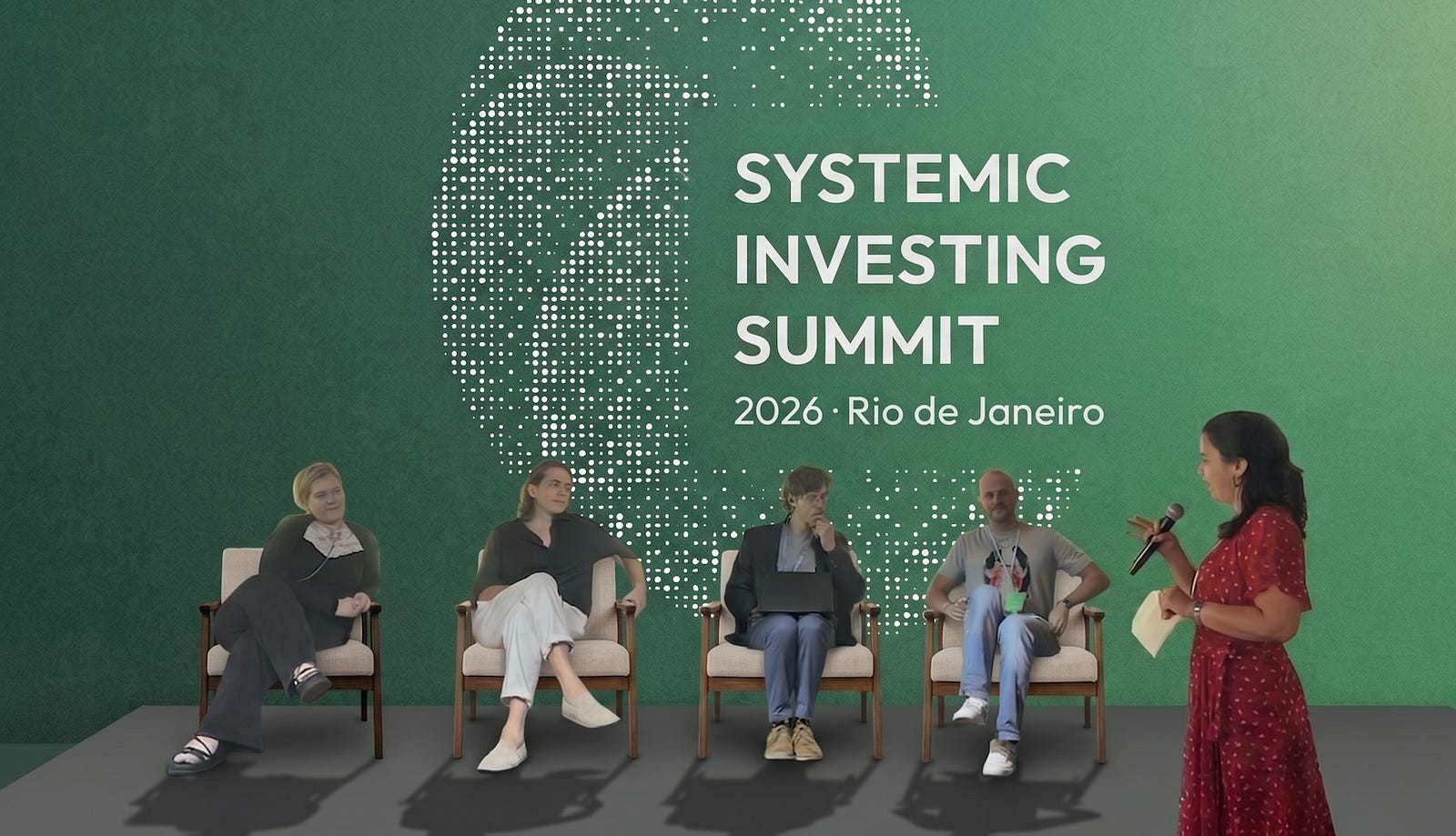
I have just returned from the Systemic Investment Summit in Rio de Janeiro, where investors, entrepreneurs, project designers, family offices, ecological thinkers, and technologists came together to explore what capital means when systems themselves become the central concern. And yet, what stayed with me most was not capital itself.
It was a word that appeared almost everywhere, often casually at first, then with increasing weight as the conversations deepened:

System is one of those words that modern discourse uses so often that it risks losing meaning. We speak of systems as if naming them were enough to understand them — economic systems, food systems, energy systems, governance systems — yet very rarely do we stop long enough to ask what a system actually is.
That question surfaced repeatedly during the summit, not always directly, but in the discomfort that emerged whenever someone tried to isolate one variable from the rest.
A system, in the most essential sense, is not simply a collection of parts. It is a pattern of relationships whose behavior cannot be understood by examining each component separately.
A river basin is a system not because water flows through it, but because geology, vegetation, climate, soil, microorganisms, animal life, and human settlements interact continuously, producing outcomes no single variable explains alone. Remove one relationship and the whole field behaves differently.
The same applies to an agricultural landscape. A pasture is not merely grass and cattle. It is microbial life, water infiltration, root depth, seed diversity, grazing rhythm, carbon exchange, insects, birds, surrounding forest fragments, human decisions, inherited knowledge, local markets, and climatic variability — all interacting in ways that either strengthen or weaken the territory over time.
What became clear in Rio was that many people coming from very different disciplines are beginning to converge around this deeper recognition:
the next frontier of investment may depend less on financing isolated interventions and more on understanding how relationships themselves become investable.
This is where the language of systemic capital began to feel less theoretical and more necessary.
Because if value increasingly depends on the coherence of relationships, then capital cannot continue behaving as if projects existed independently from the territories that sustain them.
For decades, finance has excelled at evaluating discrete units: a company, a project, a parcel of land, a production line, a carbon asset. But a system does not behave like a discrete unit. A system behaves through interdependence.
And interdependence creates a different kind of value — slower to appear, often harder to isolate, but far more decisive in determining whether a territory becomes fragile or capable of long-term regeneration.
This is what I increasingly understand by systemic capital.
Systemic capital is capital allocated with the explicit intention of strengthening the conditions through which multiple forms of life, production, and social continuity reinforce one another.
It does not look only at direct return from a single intervention. It asks whether the intervention increases the capacity of the larger field to organize life more coherently.
That distinction may sound subtle, but in practice it changes almost everything.
A regenerative farm, viewed conventionally, is an agricultural project.
Viewed systemically, it may be part of hydrological restoration, local employment continuity, biological diversification, food resilience, reduced chemical dependency, and territorial learning.
An agroforestry system is not only a productive design.
It may also be a biodiversity corridor, a humidity regulator, a seed bank, a cultural practice, a soil builder, and a long-term stabilizer of local economic possibility.
Holistic grazing, when properly understood, is not merely a better livestock technique.
It is often a way of reintroducing movement, timing, rest, biological pulse, and nutrient cycling into landscapes where ecological metabolism has been interrupted.
In other words, these practices begin to matter not because each one individually solves a problem, but because together they alter the developmental direction of a place.
And that developmental direction is where the conversation on bioregions becomes unavoidable.
Because systemic investment, if taken seriously, is almost always place-based.
Not place-based in the superficial sense of geography, but in the deeper sense that every living territory already carries a structure of relationships that cannot be imported from elsewhere.
A bioregion is not simply an area on a map.
A bioregion is a territorial coherence shaped by watershed behavior, ecological continuity, soil structure, biodiversity patterns, climatic conditions, productive history, and human settlement over time.
Its logic is ecological before it is political.
Its boundaries often become visible first through water, vegetation, altitude, and cultural adaptation rather than through administrative lines.
That is why bioregions matter so much to the future of systemic investment: they are one of the few scales at which ecological reality and human organization can still meaningfully meet.
And once one sees a bioregion clearly, another idea follows naturally: a bioregion behaves very much like what Elinor Ostrom described as a common pool resource.
Not because everything within it is collectively owned, but because many of the most decisive functions inside it are shared whether ownership structures acknowledge this or not.
Water tables are shared.
Pollination systems are shared.
Biodiversity corridors are shared.
Flood regulation is shared.
Soil resilience across a watershed is shared.
Even social trust, in many territories, behaves as shared infrastructure.
This is why purely fragmented intervention so often fails.
A common pool resource cannot be strengthened permanently through isolated action alone.
It requires governance.
It requires relational intelligence.
And above all, it requires a form of investment capable of seeing beyond immediate extraction.
Ostrom’s principles remain extraordinarily relevant here because they remind us that long-term stewardship depends less on abstract ownership than on the quality of rules, feedback loops, participation, boundaries, monitoring, trust, and adaptive capacity through which communities relate to shared resources.
When translated into bioregional design, this means that systemic investment cannot be reduced to ecological restoration alone.
A bioregion becomes viable only when ecological regeneration co-evolves with community capability, cultural continuity, productive dignity, and forms of local governance able to hold complexity without collapsing into fragmentation.
This is why I have increasingly resisted speaking only of regenerative agriculture as if production were the center.
Production matters, but production alone does not create a living territory.
A living territory emerges when regenerative production, agroforestry, grazing systems, biodiversity restoration, social cohesion, and local meaning begin reinforcing one another as parts of a larger field.
In regenerative design, one of the central principles is wholeness.
Wholeness does not mean perfection or harmony. It means understanding that every intervention enters an already existing field of relationships and that the quality of those relationships determines whether change deepens life or merely rearranges symptoms.
From that perspective, systemic impact is not simply bigger impact.
It is impact that modifies the coherence of the whole.
The white paper I had been working on arrived in Rio as an effort to translate regenerative design into a language legible to finance. It left Rio altered — strengthened by a deeper systemic perspective that became impossible to ignore during the conversations there.
What became clearer is that a bioregion, understood not as geography but as a living field of interdependent relationships, behaves much like a common pool resource: a system whose value does not reside only in its individual assets, but in the quality of the relationships that allow ecological, social, productive, and cultural life to co-evolve.
And if that is true, then the question is no longer simply how capital enters a territory, but whether capital is capable of understanding the systemic nuances through which its own presence either strengthens or weakens the larger field.
A system can only attract systemic capital if systemic capital learns first to read systems.
That means understanding that impact cannot remain an external consequence measured after investment decisions are made. Systemic impact must be braided into systemic investment itself — into the very logic by which capital interprets potential, resilience, and long-term value.
This requires more than better instruments. It requires an upgrade in how we understand living systems: how coherence emerges, how vitality accumulates, how viability is sustained, and how developmental potential quietly expands long before conventional metrics fully detect it.
This is why the white paper I carried to Rio has gradually become less about measurement alone and more about interpretation.
Measurement remains essential. Soil, water, biodiversity, vegetation, acoustic signals, biological indicators — all matter.
But what matters even more is whether those signals reveal strengthening coherence.
Whether vitality is increasing.
Whether viability is deepening.
Whether developmental potential is expanding.
Because a bioregion, ultimately, is not a static ecological object.
It is a living developmental field.
And systemic investment, if it is to deserve that name, must learn to invest not only in what a territory is today, but in what that territory is becoming.
That may be the most demanding shift now before us:
not simply learning how to finance nature,
but learning how to participate, with enough humility and intelligence, in the co-evolution of places where life itself remains the deeper architect.
Ernesto’s Substack is a reader-supported publication. To receive new posts and support my work, consider becoming a free or paid subscriber.
Thank you for accompanying this reflection all the way to the end.
.
Thank you Ernesto. This really resonates, especially the way you bring the focus back to relationships rather than isolated interventions.
What stands out to me is how clearly this challenges the dominant approach of trying to solve systemic issues through fragmented, project-based thinking. The idea that value emerges from coherence, not just individual outputs, feels critical, particularly as we think about regeneration and long-term resilience.
In my own work, I keep running into similar dynamics. Efforts can be well-designed in isolation, but without alignment across governance, infrastructure, and community systems, they struggle to shift outcomes in a lasting way. That’s where your framing of bioregions as living, interdependent fields feels especially useful.
It also raises an important question about readiness, not just whether capital can enter these systems, but whether institutions and decision-makers are capable of thinking and acting at that level of complexity.
There’s something here about moving from intervention to participation, and from extraction to relationship, that feels essential to where this work is heading. And perhaps also a shift in how we relate to place and to each other, not just as systems to be managed, but as living relationships we are part of.
Great blog! Thanks for these insights. Deep coherence, wholeness and emergence “That means understanding that impact cannot remain an external consequence measured after investment decisions are made. Systemic impact must be braided into systemic investment itself — into the very logic by which capital interprets potential, resilience, and long-term value.
This requires more than better instruments. It requires an upgrade in how we understand living systems: how coherence emerges, how vitality accumulates, how viability is sustained, and how developmental potential quietly expands long before conventional metrics fully detect it”
After decades working to support human centred systems work embed developmental evaluative practice amidst complexity, I walked away from Rio convinced there is an opportunity to bring some of this thinking and practice to systemic investing.