
The Event
Preparing Ourselves for a Civilization in Transition

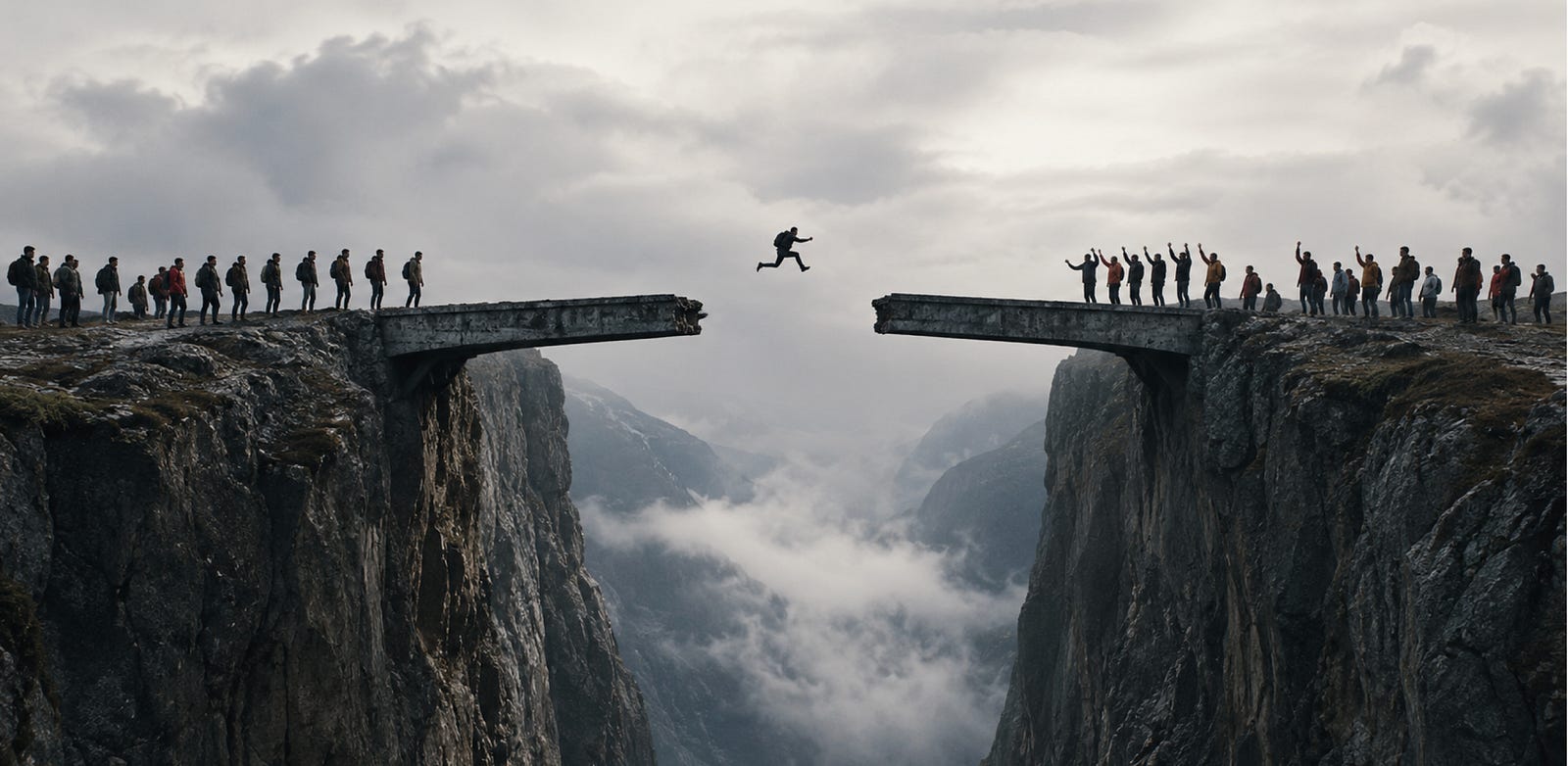
Part One of Two
Something is changing, and the hardest part of saying so is that it is changing faster than the stories we have on hand to explain it. We go on speaking the language of yesterday — the vocabulary of separate crises, separate disciplines, separate problems to be solved one at a time — while some quieter part of us has already noticed that this language no longer maps the ground we are standing on.
What follows is not an argument that collapse is coming, and it is not a promise that it isn’t.
It begins from a less dramatic and more useful question:
how a person prepares for real uncertainty without folding into fear.
That question leads down out of the atmosphere and into the grain markets, and then further down still, past the chokepoints and the supply chains, into something older than any of them — the human capacity to belong to a place and to tend it.
The deepest preparation, it turns out, is not a bunker. It is a set of capacities we mostly forgot we had, cultivated in ourselves, in the people around us, and in the watersheds that have been quietly keeping us alive the whole time.
Act One — The Event
There are stretches of history when the world rearranges itself faster than the stories we use to explain it, and the people living through those stretches tend to keep narrating the old world long after their feet have left it.
I think we are in one of those stretches now, and the reason is not that any single crisis has grown large enough to swallow the others. Humanity has always lived through wars and crashes and plagues and droughts; turbulence is not the new thing.
The new thing is subtler and, once you see it, harder to look away from — the crises have stopped behaving as though they were independent of one another.
A drought edits the harvest, and the harvest edits the politics, and the politics edit the price of energy, and energy edits inflation, and inflation edits an election, while in another register entirely a new machine intelligence edits the meaning of work and a shifting climate edits the routes of migration that then edit the maps of geopolitics.
We are no longer watching a sequence of events. We are watching a set of interactions, each disturbance reaching across the usual boundaries to become the cause of the next.
What convinces me this is real is that the intuition keeps arriving on its own, unprompted, from people who share almost no vocabulary — climate scientists and military strategists, ecologists and complexity theorists, investors and the practitioners who spend their days putting carbon back into soil.
Their disciplines barely speak to one another. Their sense of the terrain is nearly identical. Each describes a different face of the same mountain, and the mountain is the suspicion that the system has crossed into a region where its parts amplify one another faster than its institutions can answer.
Years ago I had the privilege of long conversations with Douglas Rushkoff, and one of them has stayed lodged in me ever since.
He had been invited to what he expected would be a talk for a room of technology investors, and instead found himself at a table with a handful of very wealthy men who wanted to discuss exactly one subject, which they referred to, without ornament, as “The Event”.
None of them asked whether it would happen; they took that as settled, and what they wanted to work out was logistics. Where to build. Whether New Zealand was remote enough. How a person keeps a private security detail loyal in a world where the money used to pay them has stopped meaning anything.
Rushkoff wrote this encounter in a The Guardian article titled
How tech’s richest plan to save themselves after the apocalypse , updated later in his book, whose title says most of what needs saying — Survival of the Richest — and what has held my attention all these years is not the wealth at that table but something underneath it, which is that no one in the room could actually define the thing they were preparing for.
For one man it was runaway climate. For another, war between great powers. For others it was financial collapse, or pandemic, or cyberwar, or the machines, or some unrehearsed combination of all of them at once.
“The Event” stayed deliberately undefined, and over time I came to think that the vagueness was not a failure of analysis but the most honest part of it.
Perhaps the Event is not one event. Perhaps it is the name we reach for when several of them arrive close enough together that they begin to feed on one another, and the most telling detail in Rushkoff’s story is what those men had decided to do about it — to wall themselves off, to convert the consequences of the world that made them rich into someone else’s problem.
The bunker is separation taken to its logical endpoint, the dream of finally seceding from the web of relationships that holds everyone, and it is worth noticing that the people with the most resources to attempt it were the ones who believed in it most.
Set the table aside and the underlying picture is the same one the scientists describe, only stripped of the fantasy that anyone gets to escape it.
A planet that has been quietly accumulating heat for two centuries is approaching thresholds that make every other system twitch.
A geopolitical order that looks, to the strategists who study it for a living, more brittle than it has in a generation.
Researchers building intelligences they freely admit they do not fully understand.
Agronomists watching the resilience drain out of food systems that were optimized, with real brilliance, for efficiency rather than for surprise.
Economists noting debt and leverage and financial complexity at levels with few precedents.
A single one of these is survivable; civilizations have survived each of them before. The difficulty is the arithmetic of their interaction — climate stress meeting fertilizer scarcity, fertilizer scarcity meeting food prices, food prices meeting fragile politics, fragile politics meeting the next conflict — until the system begins, in a phrase I cannot improve on, to feed upon itself.
So the useful question was never whether one particular forecast comes true. It is whether the modern world has quietly made itself the kind of thing in which disruptions reinforce rather than cancel one another, and whether that happens next year or in two decades is almost beside the point, because the conditions that make it plausible are already arranged around us.
Which leaves a far more interesting problem than prediction.
If the Event is better understood as a convergence than as a catastrophe, then preparing for it is not a matter of choosing the right disaster to brace against. It asks something of our science and our technology and our institutions, and underneath all of those, it asks something of us — of who we are willing to become while the systems we built grow turbulent.
That is the journey this essay is trying to walk.
Act Two — The First Signal
If the Event is a convergence rather than a single blow, then the first honest question is where to look first, and for me the answer starts with climate — not because climate outranks geopolitics or technology or money, but because it is the medium all of them are dissolved in.
Everything we have built, from the cities to the grids to the food system to the financial instruments layered on top of the food system, quietly assumes a climate that holds reasonably still, and we rarely notice the assumption because it has kept us company for so many generations that it feels less like an assumption than like the floor.
The triumph of modern agriculture did not come from genetics and machinery alone. It came from laying an extraordinary productive apparatus on top of a climate predictable enough that a farmer could plan against it, because a farmer does not, in the end, cultivate an average.
A farmer cultivates a season — rain inside a narrow window, heat arriving on time, cold withdrawing when it should, the flowering and the grain-filling and the harvest each cued to the one before — and modern civilization has synchronized itself to those rhythms so thoroughly that we forget we are dancing to them at all.
The danger, then, was never really that the average climbs another degree. The danger is that the rhythm itself starts to lose its coherence, that the cues stop arriving in their old order, and a system tuned to a tempo begins to stumble when the tempo turns erratic.
This came into focus for me listening to Earth-systems scientist Tad Patzek in conversation with Nate Hagens, because Patzek refuses to describe climate change as a string of unfortunate weather events and insists on describing it as thermodynamics, which is a far less comforting frame.
The planet now carries roughly a degree and a half of warming above its pre-industrial baseline, a number that sounds almost too small to bother with and is anything but, because of where the heat goes.
Land warms faster than ocean while the ocean absorbs nearly nine-tenths of the excess, becoming a vast reservoir of stored energy that the atmosphere then has to negotiate with; the air holds more moisture, the glaciers pull back, the retreating ice reflects less of the sun than the dark water that replaces it, and the whole arrangement acquires a kind of memory.
Even if every emission stopped tomorrow, most of that accumulated heat would stay with us for decades and likely centuries. The system remembers what we have done to it, and it will go on responding to that memory long after we have changed our minds.
This is why El Niño deserves more attention than it usually gets, and why it deserves to be understood correctly.
El Niño is not an aberration; it is one of the Earth’s oldest rhythms, a periodic loosening of the trade winds that lets warm water pooled in the western Pacific slide eastward, nudging the jet streams and rearranging where the rain falls, drowning some regions and parching others, and it has been doing this for as long as there have been people to notice.
What has never happened before, not once in the history of the oscillation, is an El Niño unfolding on a planet already carrying the thermal inheritance of two hundred years of burning. The rhythm is still entirely natural.
The baseline it now plays against has moved, so that every future El Niño begins from a warmer ocean and a warmer atmosphere and warmer soils and a thinner cryosphere, from an air column capable of holding more water and dropping it harder, of building hotter heat and pushing the extremes further out.
The question is no longer whether the climate changes — that argument is over — but whether the institutions we built were ever designed for volatility, and agriculture plainly was not, and neither were the insurance markets, nor the electrical grids, nor the river navigation that moves the grain, nor the public-health systems that catch us when the rest gives way. The climate does not have to destroy any of these. It only has to make them unpredictable enough, often enough, that the slack runs out.
Picture it concretely, the way it would actually arrive.
A strong El Niño, not unprecedented in its own right but amplified now by the warmer floor beneath it, landing during the Southern Hemisphere’s growing season. Drought settling over one breadbasket while floods delay the planting in another and heat shaves the yield off a third, all in the same months.
One poor harvest a country absorbs without much trouble; several correlated harvest failures, arriving together because the same warmed system is driving all of them, expose something the single failure never could — not the vulnerability of a crop, but the vulnerability of the whole interdependent arrangement that the crop sits inside.
This is the threshold at which climate stops being an environmental matter and becomes a systems matter, where the disturbance climbs out of the field and into food and water and insurance and migration and inflation and politics, travelling the same dense network on which everything else depends.
And the moment you start seeing through that network, the next fragility is already in view, because the climate does not grow food by itself. Modern agriculture rests on another invisible foundation, one most people never think about, and that foundation turns out to lead somewhere uncomfortable — to one of the most fragile chokepoints on the planet.
Act Three — The Invisible Molecule
We carry a cinematic idea of how civilizations end — a city in flames, an empire toppling, a currency vanishing overnight — and history, when you read it closely, tells a much quieter story than that.
Societies usually become fragile long before they become visibly unstable. The reserves thin out, the margins narrow, the capacity to absorb a shock quietly evaporates, and by the time the collapse is finally legible on the surface, the resilience underneath it has often been draining away for decades while everyone congratulated themselves on how efficient the machine had become.
This was the thread I followed in mi recent post Winter Is Coming, not as a forecast of doom but as an observation that we have optimized ourselves for efficiency with genuine and dazzling success, and that in doing so we steadily removed the very redundancies that let complex systems survive surprises.
Inventories came to look like liabilities. Storage came to look like waste. Globalization came to look like simple optimization and just-in-time logistics like common sense, and capital applauded every ounce of slack we managed to wring out of the system.
For a long stretch it worked beautifully, right up until the world itself stopped being predictable — until the climate turned volatile and the supply chains fractured and the wars interrupted the trade and the shipping turned uncertain and the energy prices began to swing — and we discovered, a little too late, that a great deal of what we had been calling efficiency was really resilience we had quietly borrowed and not yet repaid.
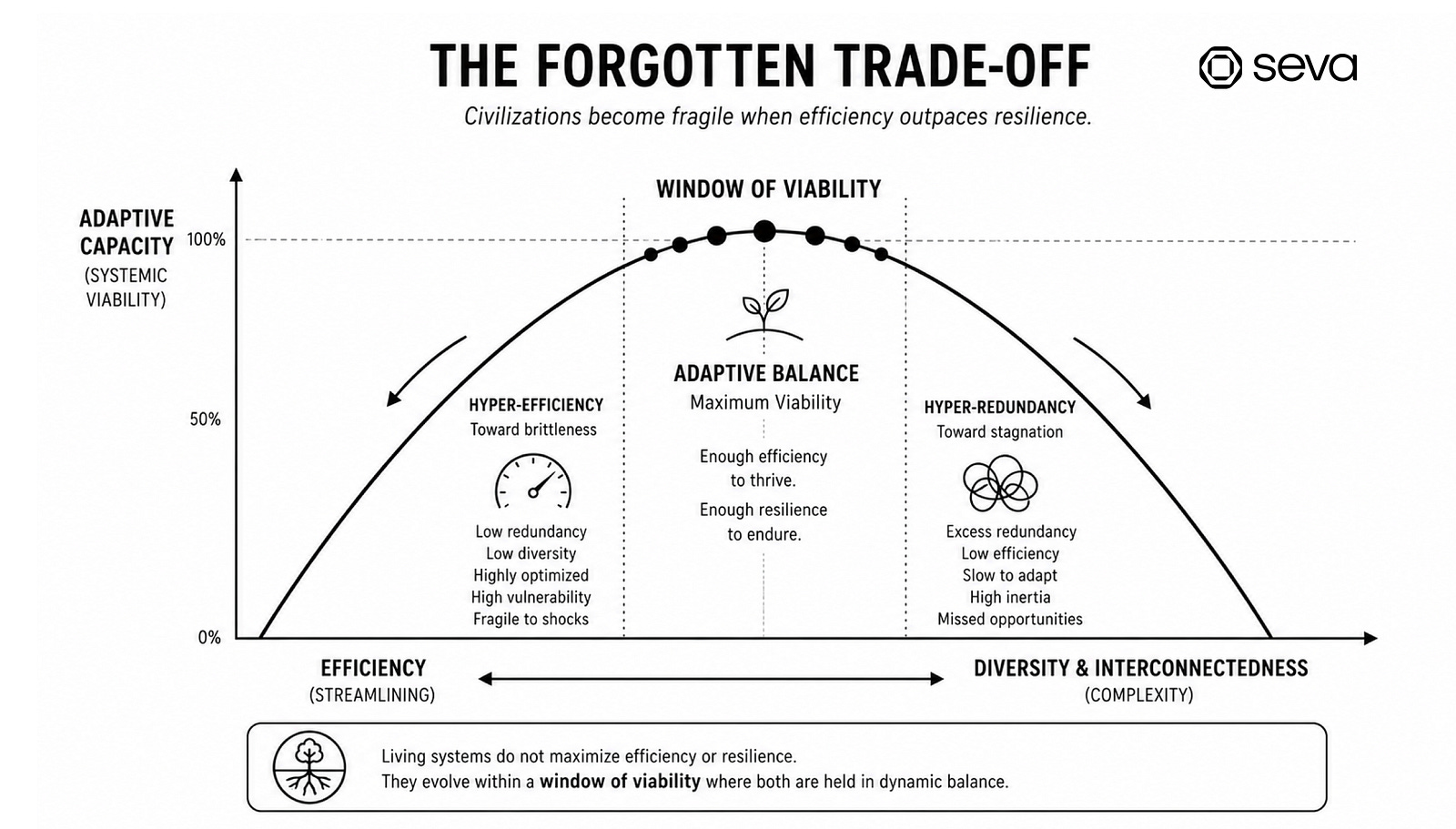
This insight is deeper than economics. It is a property of living systems. Forests, coral reefs, immune systems, financial networks, civilizations and food systems all survive because they preserve enough diversity, redundancy and optionality to absorb shocks without losing coherence.
Nowhere is this clearer than in food, and food does not begin where we imagine it begins. We picture a field, but the field begins with nitrogen, and the story of how nitrogen became available to us is one of the most consequential and least told stories of the modern age.
The Haber-Bosch process, by learning to pull ammonia out of the air, released humanity from one of its oldest hard limits, and the Green Revolution that followed was, beneath the talk of improved seeds and machines, fundamentally a nitrogen revolution.
Roughly half of everyone alive is fed, directly or indirectly, by synthetic nitrogen, which makes this invisible molecule one of the load-bearing walls of the entire civilization. And nitrogen carries a dependency of its own, because manufacturing ammonia demands enormous energy, and natural gas supplies both that energy and much of the hydrogen the ammonia is built from, so that the food system rests, quietly, on a marriage between agriculture and fossil energy that almost no one outside the trade ever thinks about.
Which is how one narrow stretch of water comes to matter far beyond the oil markets that usually monopolize its name.
The Strait of Hormuz is described, reflexively, as an energy chokepoint, and it is equally a fertilizer chokepoint — a meaningful share of the world’s traded ammonia and urea and sulphur and liquefied natural gas threads through that single maritime corridor. When tension rises around Hormuz the energy traders react inside the hour; the farmers, for the most part, do not, and yet agriculture feels every ripple eventually, on its own slower clock.
Imagine the tension simply persisting, short of any clean dramatic closure — partial disruption, higher insurance, occasional delays, restricted exports, longer delivery times, nothing that makes a headline, everything just slightly slower than it used to be. Complex systems rarely fail from one enormous interruption. They are worn down by the accumulation of small ones, and the trouble here is not even the price of fertilizer, because farmers are remarkably adaptable people.
The trouble is timing, because agriculture answers to biology and not to the financial calendar, and nitrogen applied after the planting window cannot reach back and recover the yield already lost. A delayed shipment becomes, months later, a smaller harvest; the smaller harvest becomes a tighter inventory; the tighter inventory becomes a volatile price; the volatile price becomes an export restriction as governments move to feed their own first; and the export restriction becomes political instability somewhere downstream — and the event reaches the newspapers only near the very end of that chain, long after the disruption that set it moving has done its quiet work.
Now lay the climate back over the top of it.
The same strong “Super” El Niño arriving in the same season, rain where drought was planned for and drought where the rain was assumed, the harvests turning less legible just as the fertilizer markets turn constrained. Neither one, on its own, necessarily makes a crisis. Together they begin reinforcing each other, the one cutting the yield while the other strips away the means to compensate for the cut, and in that moment agriculture stops being a local affair entirely.
The Cerrado is suddenly tied to Qatar. The Argentine Pampas is tied to Hormuz. The Mississippi is tied to the monsoon over Southeast Asia, and everything is tied, in the end, to everything else. This may be the deepest misreading of our age — that we go on describing the world in separate columns, climate here and energy there, food and finance and technology and nature each in its own ledger — when there are no longer separate systems to put in separate columns.
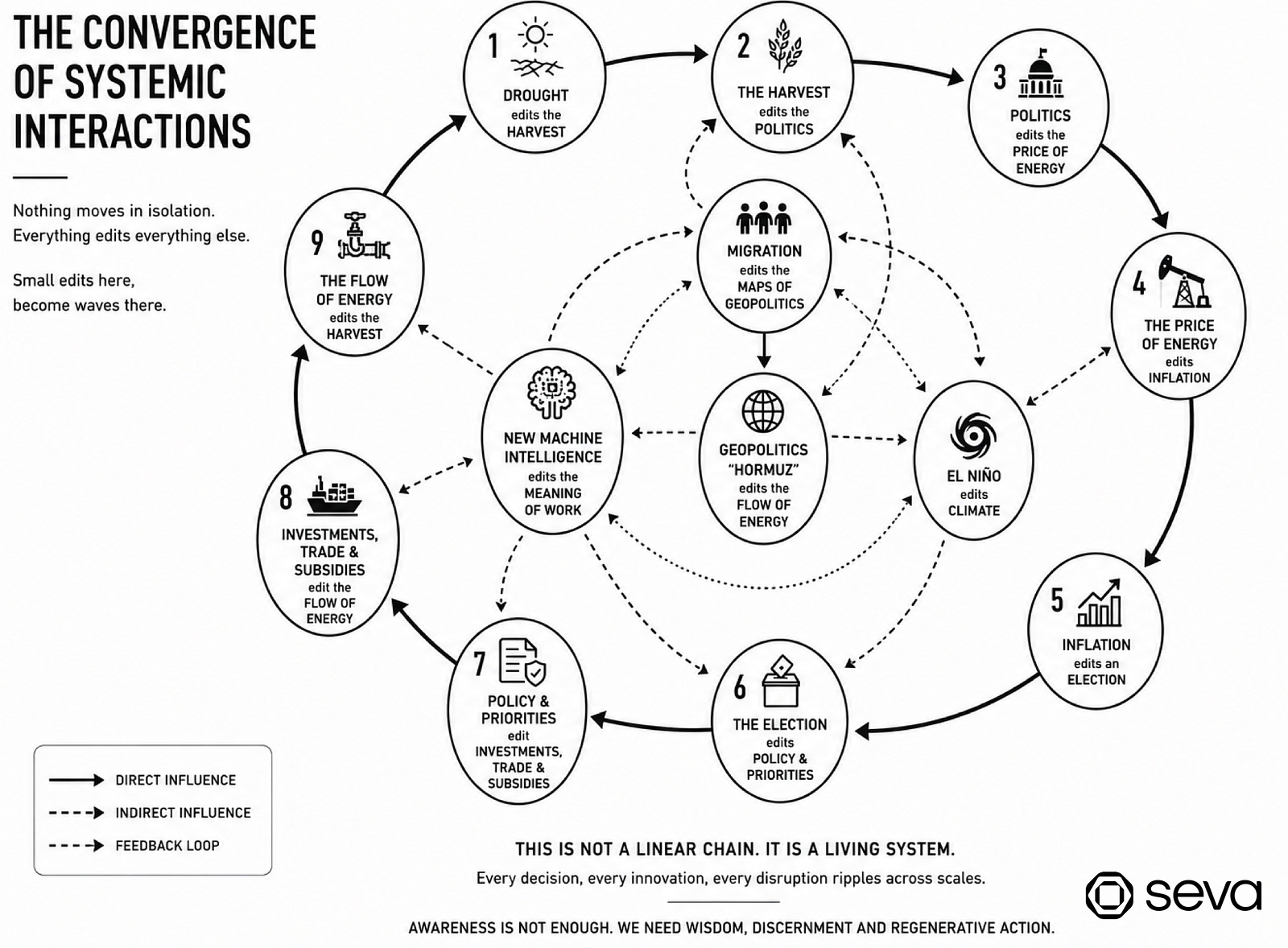
The Event is what happens when all of them begin amplifying one another faster than our institutions can respond, and once that pattern comes into focus, the question quietly changes shape.
There is one system. The Event is not the climate, and it is not the war, and it is not the machines, and it is not Hormuz; it is what happens when all of them begin amplifying one another faster than the institutions built to steady us can respond.
And once that comes into focus it is hard to unsee, because the assumption the whole modern world runs on — that these are separate problems, each awaiting its own separate solution — quietly stops matching what is in front of you. We are no longer watching a sequence of events. We are watching a system beginning to reorganize itself.
If this diagnosis is correct, a different question emerges. The challenge is no longer to predict the next disruption, but to learn how to inhabit a world where disruption itself has become the normal condition.
That is where Part Two begins.
If this article resonated with you, consider subscribing — or even better, becoming a paid subscriber — to help sustain and expand this work. Your support allows these conversations to reach further, nurturing the awakening, awareness, and acceptance that may help us move from isolated insight toward a shared, collective consciousness.
Ernesto, this is a thoughtful and compelling essay. I especially appreciated how you frame today's challenges not as isolated crises but as interconnected dynamics that reinforce one another. That systems perspective feels essential for understanding the world we are navigating.
As I was reading, I found myself reflecting that preparing for this transition is not only about strengthening our infrastructure and institutions, but also about strengthening our relationships with one another, with the places we call home, and with the living world that sustains us. Resilient communities grow from trust, local stewardship, and a shared sense of responsibility for the wellbeing of the whole.
Thank you for sharing this. I'm looking forward to Part Two.
Just thinking Hormuz is the idea of interdependence of things made flesh. As always, I like following your thoughts. Very cogent.