

On the civilizational transition we are living through — and what it asks of anyone learning to tend the light at the scale of a whole world.
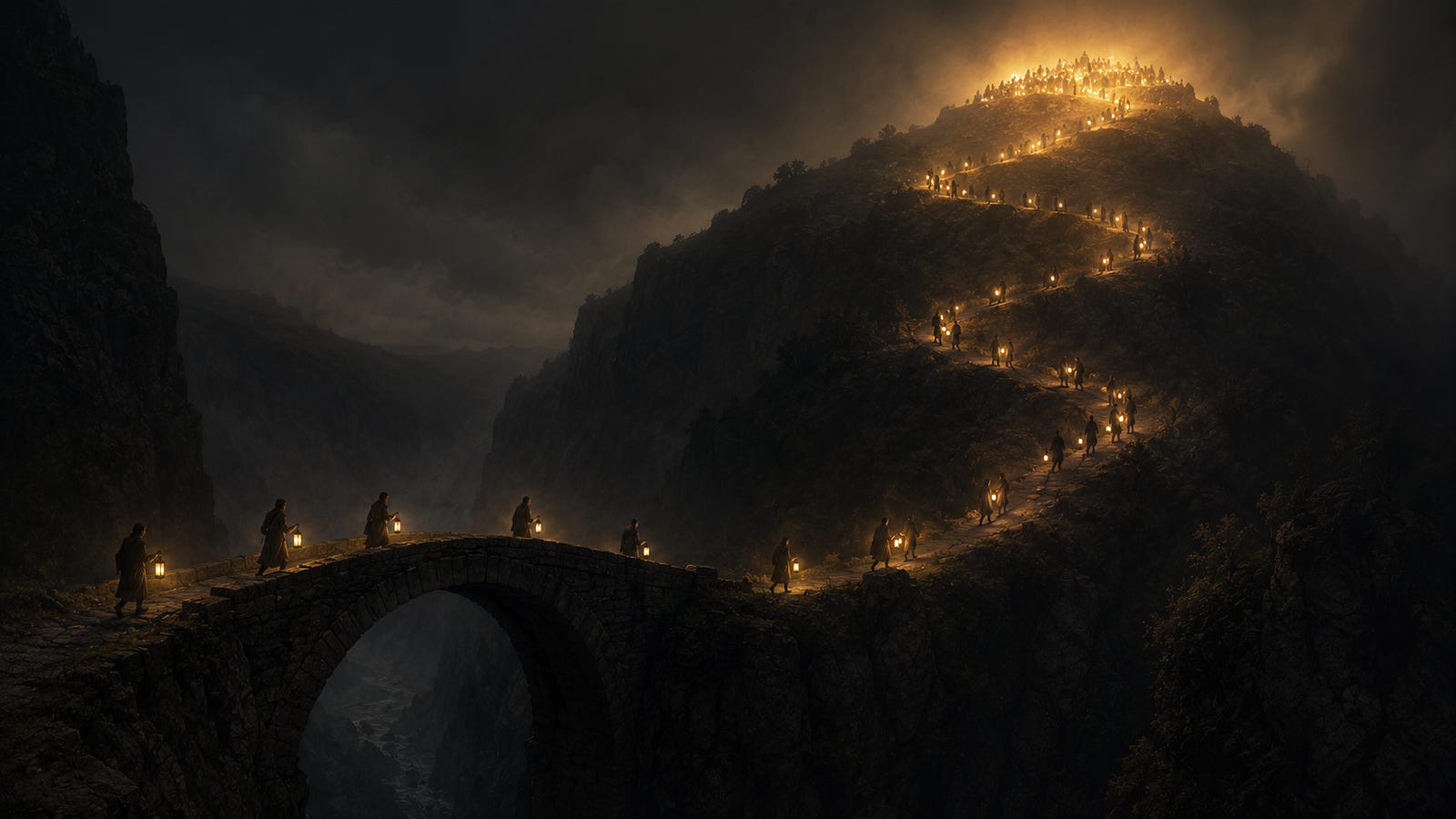
You reach the end of the inward journey bent over a single low fire — your own, or the one burning in the dark beside you. And then, without quite meaning to, you lift your eyes from it.
There comes a moment in any long walk when the inward and the planetary stop being two different things. You have been crossing memory and myth, the caretaker and the ember, the degraded fields and the viability traps and the quiet people tending what is still alive inside systems that are eating themselves. Then you look up, and the country you have been traveling on the inside turns out to be the same country you are standing in. The story was never only yours. It was never only any single person’s. Underneath all that personal texture it was always about something moving at a scale that dwarfs one life — and that somehow, maddeningly, needs each single life to answer it.
We are living through a civilizational transition.
I want to say it plainly, because the plain saying is dramatic enough on its own.
The word that carries the weight is transition.
A crisis is something a civilization moves through and survives more or less intact; this reaches further down, into the founding story that decides what the world is for, and whom it serves, and what is allowed to count as success inside it.
Transitions of this kind come rarely in human history. They stay nearly invisible to the people living through them, because they unfold at a scale wider than any single span of perception — and they shape the conditions of life for everyone who comes after, more than any election or invention or swing of a market ever will.
What I want to sit with here is not whether the transition is real. I think it is, and the evidence gathers with every passing year in ways that grow harder to look away from.
The question is what it asks of us — of those who have found their way to the orientation we have been calling regenerative. What does it mean to tend the light at the scale of a civilization, a whole world moving between stories?
For making sense of this hinge, I have leaned for a while now on a framework called the Three Horizons. Bill Sharpe developed it, and I have found almost nothing better for holding the whole weight of a civilizational transition without sliding into despair on one side or false comfort on the other.
It is simple to describe and takes years to inhabit.
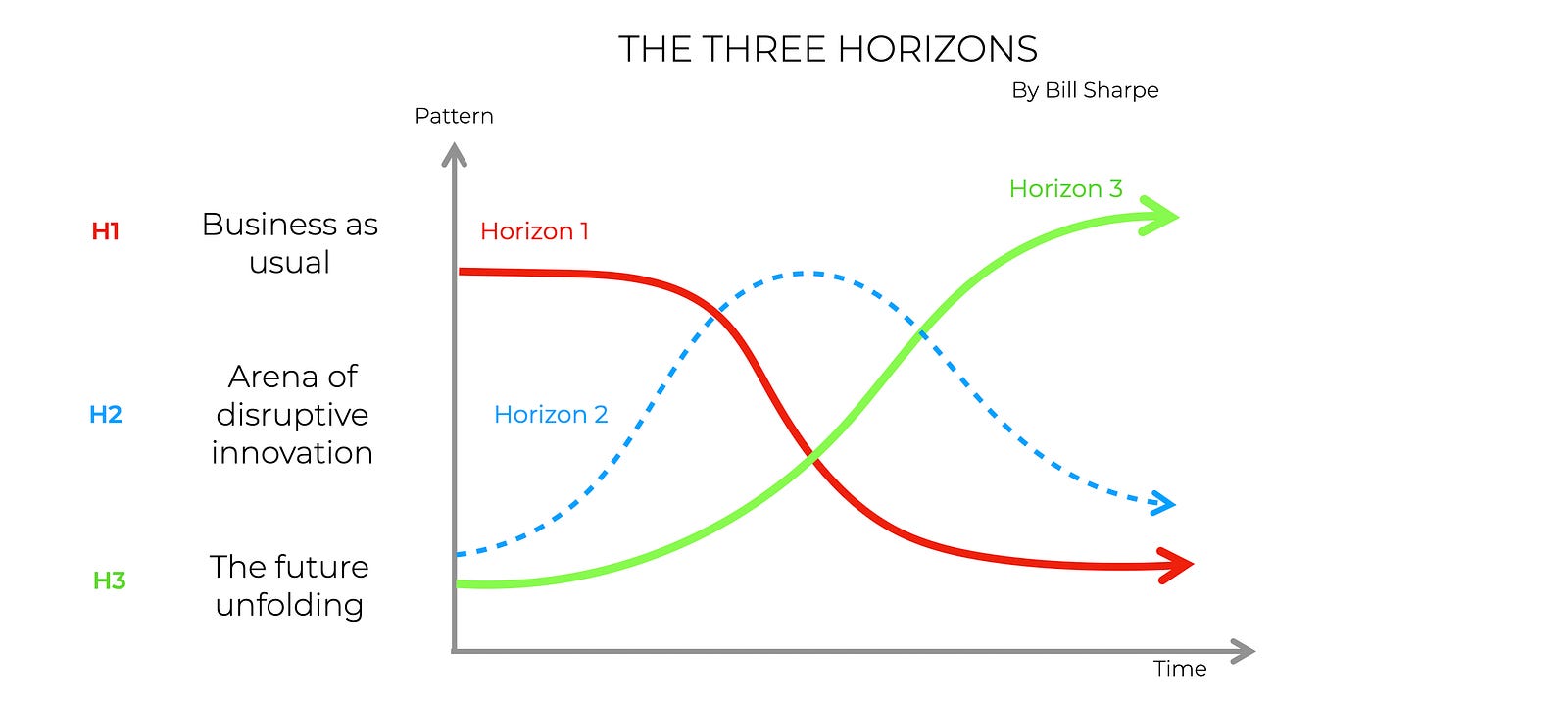
Horizon One is the world that made us. The institutions and economies and infrastructures, the stories and the machinery of extraction and production and consumption and growth that have organized modern life for the better part of three centuries. The world of quarterly reports and electoral cycles, of GDP standing in for the wellbeing of whole peoples, of efficiency as the highest virtue and growth as the obvious purpose of economic life. Its founding story, as we traced back in Chapter 02, is the Promethean one — the seizure and conversion of the living world into human wealth, at ever greater scale, at ever greater speed.
Horizon One was never simply a collection of bad ideas held by bad people; it generated extraordinary things. It pushed back extreme poverty. It lengthened human life. It carried literacy and knowledge to people who had been kept from both. In many places it ended forms of bodily suffering that had walked beside human beings since the beginning. To look at it honestly is to hold two truths in the same hand: that it produced real goods, and that the very logic which produced them has, past some threshold, begun to devour the conditions that made them possible.
The fire has grown too large.
The system keeps itself alive now by burning what it depends on. And the people most faithful to its logic — the most successful, the most optimized, the most thoroughly adapted to its rewards — are often the last to see this, because for them the logic of the system has become indistinguishable from the logic of reality.
Horizon One does not end with an announcement. It ends the way every viability failure ends: gradually, and then all at once, in ways that look obvious in hindsight and stay deniable until the moment they cannot be denied.
Horizon Three is the world trying to be born.
It will not be a utopia. Call it that and you have already misread it, because utopia is itself a Promethean dream — the faith that the right design, pressed down with enough force, yields the perfect result. What is coming, if it comes, will be more organic than that, and less certain, and in some ways more demanding of us.
A civilization organized around life instead of extraction. Around reciprocity, the oldest economy there is, the one the forest has always run on. Around participation in place of domination. A civilization that understands itself as a part of the living world rather than a project carried out upon it, and measures its success by the health of the conditions that let wealth — in the fullest sense, the sense that holds belonging and meaning and ecological vitality and the capacity of those not yet born to flourish — keep regenerating itself.
Jeremy Lent names this an Ecological Civilization. Others, Glenn Albrecht, call it the Symbiocene, a planetary age built on symbiosis. Others say the Regenerative Era, or the age of interbecoming, or simply the world in which the caretaker has come back to the center of the story.
The name matters less than the turn it points to. Every one of these framings rests on the same recognition: that the next chapter of human civilization, if there is to be one worth living in, asks for a change not only in what we do but in how we understand ourselves in relation to everything else. A move from separation toward participation, from control toward relationship — away from the question of how to take more from life, and toward the question of how to live well inside it.
Horizon Three is less a place you arrive at than a direction you move in. No one alive now will see it whole. What we can do, in this particular hinge of time, is make the choices that leave it more possible — tend the fires that throw light toward it, guard the embers it will grow from.
Between the world that made us and the world being born lies Horizon Two.
The space between worlds. The space we are standing in now.
I want to stay here a while, because Horizon Two is where we actually live, and it is the hardest of the three to hold, defined as it is by its own in-betweenness.
The old world is exhausting itself and has not yet let go. The new world has not yet cohered. What fills the gap is disruption and uncertainty and emergence — old structures going soft, new patterns straining to become visible, the loudest signals usually those of collapse and the quietest usually those of the future finding its first foothold.
The temptation, living here, is to keep your eyes only on the collapse.
The institutions failing. The trust leaching out of the ground. The ecological systems signaling, with mounting urgency, that the terms of the old arrangement no longer hold. The political cultures splintering. That widespread and not unreasonable sense that the ground beneath the familiar world is thinner than it looked, and that no one in charge has an honest map of what comes next.
These things are real, and they deserve a steady gaze. But they are only half of what is happening — because in the very same moment that Horizon One is burning itself down, something quieter is underway, not yet organized enough to read as a movement, and in some ways more important than anything in the visible landscape of politics and markets.
New fires are being lit.
I have spent years moving between the communities and initiatives that are, each in their own register, working at the frontier of what Horizon Three might look like in practice. Farmers rebuilding the broken courtship between agriculture and living soil, learning again that soil is not a substrate but a community — the most densely populated place on Earth. Economists trying to measure and govern for wellbeing rather than growth alone. Town-scale efforts redrawing who owns a local economy, so the value a place makes stays rooted there instead of being drawn off to distant shareholders. Indigenous-led recoveries of land governance, restoring relationships with territory that were never fully severed, only driven underground. New democratic practices making room for people to think together again, rather than perform their tribe at one another.
None of it is finished. None of it is certain. Many of these will fail, the way first attempts at anything genuinely new tend to fail. But they share something I have come to value more than any single outcome: they are organized around a different question than the one that organized Horizon One.
The old world asked how to grow, how to extract, how to win. These ask how to flourish — how to become the kind of participants a living system needs in order to keep living, what it would take for everyone present, human and more-than-human, to come into the fullness of what they are.
These are regenerative questions. They are Horizon Three questions arriving in Horizon Two bodies, in Horizon Two institutions, in the minds of people who were shaped by Horizon One and are now in the slow, difficult labor of becoming something else.
There is a particular disorientation that belongs to this moment, and it is worth naming, because it falls hardest on the regenerator.
The disorientation of living between worlds.
Horizon One is still the dominant reality. Its institutions still set the terms, its logic still shapes most of the available choices, its story still defines what most people mean by success or progress or the future. So the regenerator inside Horizon Two is always doing two things at once: taking part in the existing world, because that is where the people and the resources and the leverage are, while working toward conditions that the existing world’s logic actively resists.
It is an uncomfortable place to stand. It asks you to hold a tension the dominant culture does not even recognize as a tension — between adapting to what is and orienting toward what could be; the pragmatism it takes to move through Horizon One set against the imagination it takes to feed Horizon Three; the short term, urgent and real and unwilling to wait, pulling against the long term, which matters more and will not arrive on its own.
This demands another capacity as well: the ability to make sense of Horizon Two. It requires seeing disruption not merely as crisis, but as signal. To recognize that the forces destabilizing Horizon One are simultaneously opening pathways toward Horizon Three. To distinguish noise from emergence. To understand that collapse is transformation and adjacent genuine possibility. Horizon Two is where old structures lose coherence and new patterns first become visible. Those able to navigate it learn to braid the realities of the present with the possibilities of the future, finding meaning not in certainty, but in the relationships beginning to form between what is breaking and what is trying to be born.
The people I have watched carry this most gracefully share a quality I have struggled to name. Optimism is too light a word; most of them hold the gravity of the situation without illusion. Stoicism is too cold; they feel the difficulty keenly and never pretend otherwise.
What they carry lies closer to the Māori word “Ora”— a rootedness in life’s own power to regenerate, which lets them meet the difficulty clear-eyed without being swallowed by it. A faith grounded not in any certainty about the outcome but in the direct experience of what becomes possible once the conditions for life are restored: that the ember is worth tending whether or not you live to feel the warmth of the fire it becomes.
The old caretaker did not know the ember she carried between camps would one day light a civilization. She knew the tribe needed warmth tonight, and that letting the fire die was not a thing she was willing to do.
Our task may be no different. Only the scale has changed.
From a certain altitude — Galeano’s altitude, the view from high above the noise and the urgency and the daily evidence of exhaustion — humanity stops looking like a mass of failing systems and struggling institutions.
It looks like a sea of small lights.
Some burning bright. Some barely flickering. Some only just lit, small and unsure, in places where the dark has lain heavy for a long time. Each one carrying something that exists nowhere else — a particular quality of attention, a particular thread of relationship, a particular knowledge of what life in that one place is asking for. Each illuminating a small reach of the dark that no other light falls on in quite the same way.
No single one of them is enough. All of them together are something.
The work of the transition was never to build one great fire bright enough to light everything at once. That impulse — the Promethean one, the faith that the right design at sufficient scale will finally solve the thing — is part of what we are leaving behind. The work is humbler than that, and deeper: to tend your own light well enough that it stays available to the whole, and to make the conditions in which the lights nearest you can burn a little steadier.
To be, in the oldest sense of the word, a caretaker.
The campfire has become a civilization. The ash you kneel in is the ash of a whole world at the edge of its own exhaustion — and it carries, if you are willing to kneel low and look closely, the ember of something that has not yet fully been.
There is a question that has begun to surface at the end of the gatherings I go to, in the loose conversations after the sessions, when people stop performing their expertise and start speaking from wherever they actually are.
It is not the question they walked in with. The question they walked in with was some version of what should we build — what institution, what policy, what technology, what investment.
The one that surfaces late, in the honest hours, is different.
Who must we become?
That turn — from what to who, from the engineering of outcomes to the cultivation of the people capable of generating them — may be the most important movement of our moment. It does not replace the building. It comes before it, and the building grows up out of it.
Because Horizon Three is not, in the end, a destination of technology or policy or economics. It is a relational one. A world held together by a different quality of relationship: among human beings; between humanity and the living systems that carry it; between this generation and the ones not yet here; between what we were handed and what we will hand on.
And relationship, as this whole series has been circling from the start, does not begin with a plan or a policy or a funding mechanism. It begins with a person. With a quality of attention. With the willingness to be present to what is actually here.
With a breath.
Offered slowly, gently, into the ash.
Until the light begins to return.
This is the final chapter of Series One. If you have walked all the way here, thank you — you are part of why the light keeps finding its way back.
A second series is gathering, and will begin when the embers are ready.
If this article resonated with you, consider subscribing — or even better, becoming a paid subscriber — to help sustain and expand this work. Your support allows these conversations to reach further, nurturing the awakening, awareness, and acceptance that may help us move from isolated insight toward a shared, collective consciousness.
The Regenerative Light Series A path of self-enlightenment, told through fire
Series One · The Fire and the Forgetting — Six chapters diagnosing the world we have built, the story that built it, and what we have lost along the way.
Chapter 01 · The Fire We Forgot We Were Carrying On embers, inheritance, and the ancient caretaker who kept civilization alive not by stealing the fire but by refusing to let it go out.
Chapter 02 · The Story That Built the World On Prometheus, the gift of fire, and the warning hidden inside the myth that created modern civilization.
Chapter 03 · The First Landscape Before we can regenerate a forest or an economy, we must regenerate the ground closest to us — the one inside.
Chapter 04 · What a Regenerator Actually Does Not fixing things. Creating the conditions under which life remembers how to heal itself.
Chapter 05 · At the Edge of Viability Why intelligent, well-intentioned people participate in systems they know are failing — and what it costs them when they do.
Precisely: Who do we become? Thank you. I have been contemplating this for at least 10 years and, little by little, altering my mind. It is, as you say, necessary before a lot of the doing so that that doing may be 'right action.'
Beautifully written. I especially appreciated the movement from asking what should we build? to who must we become? That feels like one of the defining questions of our time.
As I read this, I found myself reflecting that the outer world will inevitably mirror the inner one. As we cultivate deeper awareness, compassion, and a sense of shared purpose, we also begin to create communities, economies, and institutions that express those same qualities. Regeneration becomes more than ecological restoration, it becomes the ongoing alignment of consciousness, culture, and the systems through which we live together.
Thank you for another thoughtful contribution to this series.