
The Future, Unfolding
A field guide for the descent and what waits on the other side

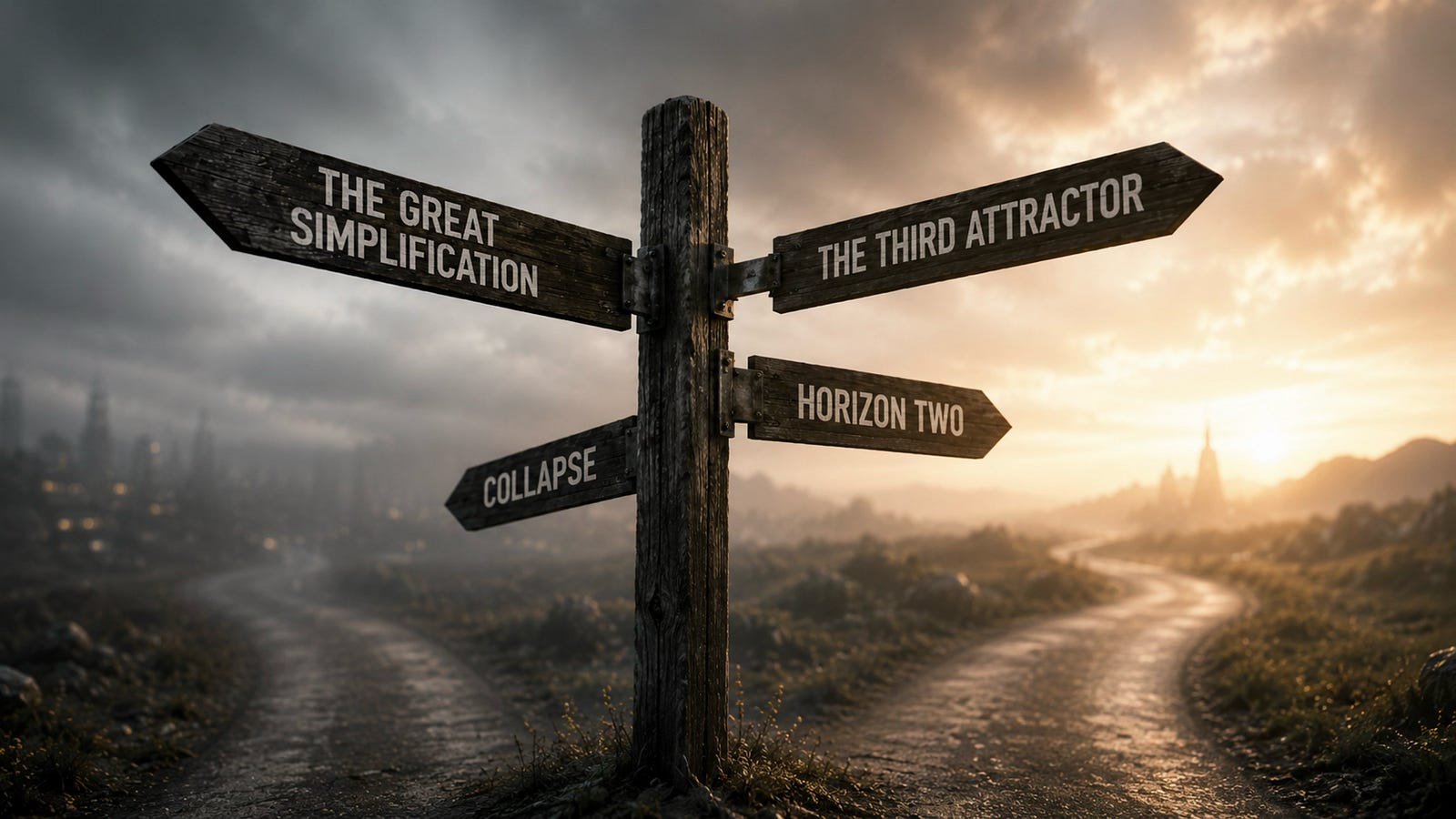
This essay is the first panel of a three-part meditation organized around the Three Horizons framework — a way of seeing civilizational transition not as a single event but as the overlapping movement of worlds dying, worlds disrupting, and worlds becoming.
Now Part One — Collapsing into the Great Simplification. We begin where we must: with honest seeing. As energy gradients narrow, ecological buffers thin, and the material foundations of industrial complexity tighten simultaneously, the civilization built on perpetual growth enters an age of simplification. This first chapter walks the perimeter of Horizon One — the dominant industrial paradigm — and traces the quiet logic of its unraveling. It is an essay about acceptance, because acceptance is the threshold at which agency becomes possible.
Upcoming Part Two — Bioregionalism as a Horizon Two Disruption. When the global thins, the local thickens. As planetary supply chains lose their elasticity and abstract systems lose their coherence, resilience migrates back into living territories — watersheds, foodsheds, soils, communities of place. This second chapter explores the bioregion not as ideology but as anticipatory design: a way of metabolizing disruption through ecology, agriculture, governance, and the patient rebuilding of relational depth. Horizon Two is the bridge space where new structures must be prototyped before the old ones finish falling. Link to Part Two
Finally Part Three — The Third Attractor: An Attempt to Imagine and Design. If collapse marks the slow decline of one civilizational attractor, what could possibly pull humanity toward another? The final chapter steps beyond critique and into imagination. Drawing on regenerative design, systems thinking, and the principles of living systems, it attempts to sketch — tentatively, humbly — what a Horizon Three future might actually look like. Not as prediction. Not as utopia. But as the disciplined exercise of imagining a world worthy of inheriting. Link to Part Three
Read together, the three chapters move from diagnosis to disruption to design — from learning to see, to learning to act, to learning to dream again.
The Long Descent: Notes from the Edge of a Civilization
There is a moment, just before dawn in the high country, when the night animals have already gone to their dens and the day animals have not yet stirred. The world is suspended in a kind of grammatical pause. Anyone who has spent time in mountains knows this hour. The air holds its breath. The light has not yet decided what to become.
I have come to believe we are living, civilizationally, inside such an hour.
The old creatures of the industrial night — the supply chains, the sovereign debts, the just-in-time logistics, the planetary commodity flows, the financialized abstractions of value — are still moving, but with less confidence than before. Something in them senses what is coming. And the new creatures of whatever day is approaching have not yet found their voices. We are between songs.
For most of two decades, I made my living inside the machine that built the night. Private equity. Harvard MBA. The architecture of capital deployment at the scale where forests became inventories and aquifers became line items and the slow patience of soil became, on the spreadsheet, an “underutilized asset class.” I was good at it. I learned the most valuable skill in that world, which is not arithmetic but pattern recognition — the capacity to see the bend in the river before the water arrives at the bend. Trends converging beneath the surface. Demographics meeting technology meeting energy meeting policy meeting culture. The investor’s craft is not, despite the iconography, about numbers. That is simply the language I was taught to identify. It is about reading the wind — the way an Indigenous tracker senses invisible shifts in the forest long before the storm arrives.
What I did not understand for many years is that the wind I was reading was the exhalation of a finite world.
I. The Metabolism Beneath the Economy
Begin with a strait of water in the Persian Gulf, roughly thirty-four kilometers wide at its narrowest, that most people on earth could not locate on a map. Through this seam between Iran and Oman flows somewhere near a third of the world’s seaborne oil and a comparable share of its fertilizer trade. Tankers, ammonia carriers, container ships threading the eye of a geopolitical needle. A closure there — even a credible threat of closure — does not merely raise the price of gasoline in Houston or Hamburg. It alters the nitrogen budget of the Brazilian cerrado. It changes the planting calendar in Punjab. It silently reshapes the calorie supply of regions whose populations will never know the name Hormuz.
This is the part Thomas Friedman would tell well: that the world is not flat, despite the famous claim, but extraordinarily lumpy and tightly coupled, and that the lumpiness has become more consequential than the flatness. Globalization optimized for cost rather than redundancy, for throughput rather than slack. It built a civilization with the metabolic profile of a hummingbird — extraordinary capacity, almost no reserves. A hummingbird that misses one meal dies. A civilization that loses one critical input begins, somewhere in its tissues, to fail before anyone notices.
The economy, we like to say. As if economy were a thing separate from soil and sunlight, from the depth of the water table beneath Iowa, from the half-life of phosphate reserves in Morocco. The word itself comes from the Greek oikos, household. The household. The dwelling place. Somewhere along the way we forgot that an economy is not a number generated by quarterly accounting but a pattern of exchange within a living dwelling. And the dwelling is finite. The dwelling has weather. The dwelling has seasons. The dwelling has, at its center, a sun whose photons cascade through chlorophyll and chloroplast and rumen and root before they ever reach the part of the system we have agreed to call wealth.
What Nate Hagens and Art Berman are both trying to explain in this highly recommended dialogue is that the current crisis is not merely geopolitical, economic, or energetic. It is civilizational. Beneath the visible surface of markets and headlines, they are describing the early stages of a systemic simplification already underway. Joseph Tainter said decades ago in different language, is that energy is not a sector of the economy. Energy is the economy. Everything else is bookkeeping.
When you understand this, you begin to see the present differently. The persistent inflation that economists keep treating as a monetary phenomenon looks more like a metabolic signal — the body of industrial civilization beginning to register the cost of harder-to-reach energy and thinning ecological margins. The geopolitical tightening looks less like a return of history and more like the predictable behavior of complex systems when surplus contracts. Even the artificial intelligence boom, which arrived with such operatic certainty about productivity gains, begins to look stranger when you notice it requires data centers drinking rivers and burning coal at precisely the moment when the energetic foundations of the host civilization are losing their elasticity.
We are running the most computationally intensive experiment in human history on a grid that is, in physical terms, in the middle of its own quiet crisis.
II. What the Forest Knows
I want to slow down here, because what follows cannot be said only in the language of systems analysis. It must be said also in the older language, the one the forests still speak if you are willing to be quiet long enough to overhear them.
A forest does not grow by extraction. This seems an obvious thing to say, and yet our entire civilization has been organized as if the opposite were true. A forest grows by reciprocity. The mycorrhizal networks beneath your feet — and they are beneath your feet, almost anywhere you stand on land that has not been recently bulldozed — move sugars from canopy trees to seedlings, move water between species that, in our taxonomies, do not even belong to the same family. The mother trees, as Suzanne Simard taught us to call them, feed their kin. They also feed strangers. They do not appear to distinguish.
I think about this often now. About what it means that a Douglas fir will share carbon with a paper birch, two species, two kingdoms of habit, and yet across that distance there is something that operates like generosity, or perhaps something for which we do not yet have a word because generosity implies separateness and what happens in the forest floor implies something more interesting than separateness.
Robin Wall Kimmerer writes about how the Potawatomi language has a grammatical form for what is alive — not just animals but mountains, rivers, songs. English has only it, the pronoun of the thing, the pronoun of the inventory. To say it of a river is already to have lost the argument. To say it of a forest is to begin the chainsaw before the chainsaw exists.
The collapse we are entering, the Great Simplification, the Great Whatever-We-Decide-To-Call-It — this is in part the long bill arriving for centuries of saying it. For treating the living world as a warehouse rather than a relationship. For organizing entire economies, entire careers, entire empires around the proposition that the more efficiently we could convert thou into it, the wealthier we would become.
And we did become wealthier, by certain measures, for a certain time. The trick worked. The trick worked spectacularly. But the trick was always borrowing against a balance sheet we did not own and could not see.
Now the lender is calling.
III. The Strange Geography of Collapse
Collapse, when it comes, does not arrive where the cameras are pointed.
This is one of the strangest things about the present moment, and one of the hardest things to explain to people whose intuitions about catastrophe have been shaped by film. Most people imagine that if industrial civilization were truly entering some kind of involutionary phase, the evidence would appear in the supermarket. Empty shelves. Long lines. The visible iconography of scarcity we associate with old footage from Caracas or Sarajevo.
But complex systems do not collapse at the point of consumption. As a former agricultural engineer, I began understanding this years ago: systems fail first in the invisible metabolic layers that sustain the visible world. They collapse far upstream, in places almost no consumer can see. They collapse in the fertilizer market six months before they collapse in the bread aisle. They collapse in the diesel logistics of harvest combines two seasons before they collapse in the price of cereal. They collapse in the ammonia plants of the Gulf and the sulfur byproduct streams of Alberta refineries and the credit terms extended to farmers in Iowa long before any of it appears in the part of the system the public has been trained to monitor.
A modern food system is, in essence, a vast temporal shock absorber. Inventories, futures contracts, warehousing agreements, retailer subsidies, government strategic reserves — these are not merely commercial instruments. They are the buffers that smooth metabolic shocks into invisible inflation. A fertilizer disruption in spring 2026 may not appear as a price signal at the grocery store until autumn 2027. By the time the signal arrives, the underlying disturbance is already eighteen months mature.
This is the part of collapse that is most counterintuitive and therefore most dangerous: by the time it becomes visible to ordinary perception, it has already been happening for years.
And the asymmetry is brutal. A fertilizer shortage that produces inconvenience in Iowa produces famine in the Sahel. A drought that lifts wheat prices in Chicago closes schools in Cairo. The global food system, like the global financial system before it, has been so optimized for efficiency that its fragility now propagates along the same channels that once propagated its abundance. The plumbing that delivered cheap calories everywhere now delivers fragility everywhere.
There is a haunting phrase in agricultural science: nitrogen delayed is yield destroyed. Crops do not negotiate with quarterly earnings calls. The corn plant has its own calendar, written into chromosomes older than agriculture, older than writing, older than the wheel. It needs what it needs when it needs it, and if the nitrogen does not arrive on time, no amount of monetary policy will make the kernels fill.
This is what it means to say that the crisis is metabolic. The body does not care about the discourse.
IV. What Was Sold to Us as Permanent
Every civilization mistakes its temporary conditions for the structure of reality.
The Romans believed the aqueducts would always flow. The Maya believed the rains would always come. The Soviets believed planning could outmaneuver biology. We have believed that growth was the natural order of things and that whatever we needed could be summoned, eventually, through some combination of innovation, financialization, and rearranged molecules.
What we did not see, or did not permit ourselves to see, is that the postwar miracle — the long boom, the great acceleration, the doubling and redoubling of nearly every metric of human material throughput — was not a triumph of cleverness alone. It was a triumph of cleverness plus an extraordinary one-time inheritance of concentrated, ancient sunlight. Fossil fuels were not merely fuel. They were buried summers. Three hundred million years of photosynthetic patience compressed into liquid form and burned, on the geological timescale, in an instant.
We did not earn that surplus. We found it. And finding is not the same as making.
The question now is not whether the inheritance is gone. There is still oil. There will be oil for a long time. The question is whether the return on extracting it — the energy returned on energy invested, the famous EROEI— continues to support the kind of civilization that was built on a return ten or twenty or fifty times greater than what we extract today from tar sands and tight oil and ultra-deepwater plays.
A civilization built on an EROEI of fifty is not the same civilization at an EROEI of ten. It cannot do the same things. It cannot afford the same complexity. It cannot sustain the same hierarchy of specialists, the same global logistics, the same density of abstraction layered upon abstraction. Somewhere in the descent from fifty to ten, certain forms of complexity simply stop being affordable. The system does not announce this. It does not hold a press conference. It just begins, quietly, to shed.
This shedding is what Hagens calls the Great Simplification, and the word simplification is important, because it carries no moral charge. A forest after fire is simpler than the forest before. A river that has carved itself a new channel is simpler than the meander system it abandoned. Simplification is not failure. Simplification is what living systems do when conditions change.
The question is whether we simplify with intelligence or whether we are simplified by force.
V. The Compression of the Horizons
Bill Sharpe and the practitioners around the International Futures Forum gave us a framework called Three Horizons, and it has been one of the more useful instruments in the toolbox of anyone trying to think about transition. Horizon One is the dominant system. Horizon Three is the emerging possibility. Horizon Two is the messy, contradictory in-between where the old is dying and the new is being born and almost everything visible is some kind of hybrid, some kind of negotiation, some kind of attempt.
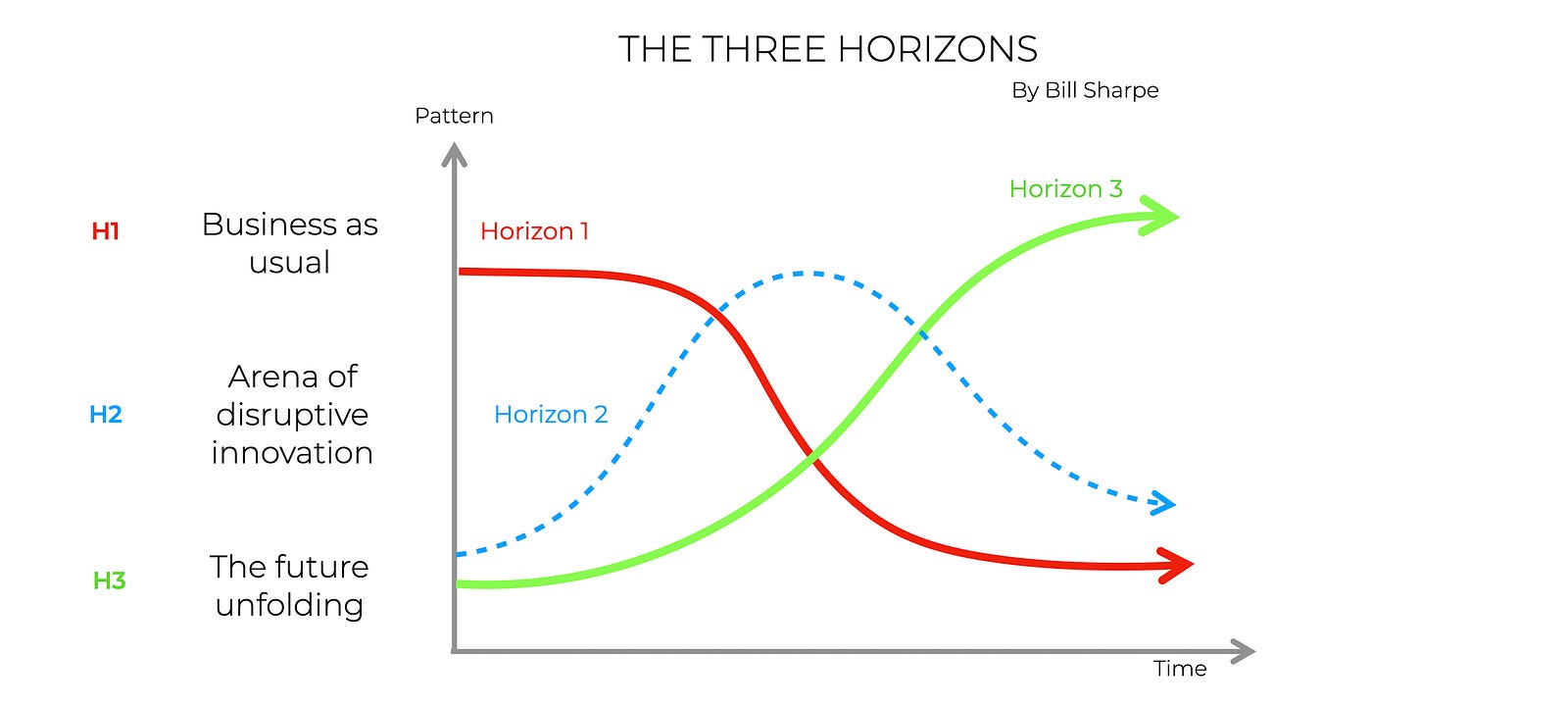
The framework was always meant to be read sequentially, like the acts of a play. But something has happened in the last few years that the original framework did not anticipate.
The horizons have collapsed into one another.
Horizon One is still institutionally dominant — the central banks still target growth, the universities still teach extraction in the language of optimization, the political class still campaigns on prosperity defined as more. Horizon Three is visible everywhere in fragments — regenerative agriculture in the Loess Plateau, cooperatively governed watersheds in Costa Rica, mycelial economies in the Iberian dehesa, the slow return of traditional ecological knowledge to forestry policy in British Columbia and New Zealand.
But the lived experience for most people on earth is now Horizon Two. Volatility as background condition. Contradiction as the texture of every day.
You wake up to news from a war that exists because of pipelines and pivot to a conversation about an AI model that exists because of data centers that exist because of pipelines, and over breakfast you read about a drought in the Horn of Africa and a flood in central Europe and fertilizer plants idled in India, and the through-line is invisible only because the through-line is the metabolism itself, and we have not been taught to see metabolisms. We have been taught to see headlines.
This is what compression feels like. Not the cinematic version. The actual version. A world in which the surface continues to operate while the substrate quietly reorganizes. A world in which the orchestra is still playing on the upper deck.
VI. Hospicing What Is Dying
There is a phrase that has been moving through certain conversations in recent years — hospicing modernity. It comes most clearly from Vanessa Andreotti and the network around her, and it captures something that ideological collapse-mongers and ideological techno-optimists both tend to miss.
The dying system cannot simply be abandoned. Hundreds of millions of people depend on its hospitals, its grids, its pharmaceutical supply chains, its grain shipments, its diesel pumps. The infrastructure of Horizon One is, for now, the only thing keeping much of humanity alive. To smash it in the name of accelerating Horizon Three would be a form of violence indistinguishable from the violence it claims to oppose. The transition cannot be a revolution in the old sense, because the old sense of revolution assumed there would still be a functioning substrate to inherit on the morning after.
There may not be.
So the work, the strange and uncelebrated work, is to hold two intentions at once. To keep the dying system functional enough to prevent unnecessary suffering, while simultaneously cultivating the emerging system patiently enough that something coherent has time to root. This is not compromise. This is metabolic intelligence. It is what mature forests do, when an older generation of trees begins its long descent and its decay feeds the seedlings rising in the light gaps. Nothing wasted. The whole cycle held within a single field of relationship.
Hospicing is not nostalgia. A good hospice nurse does not pretend the patient is not dying. She also does not hasten the death. She tends to comfort, to dignity, to the conversations that need to happen before the end. She makes space.
The question is whether our institutions, our governments, our financial systems, our universities, our media, our families, are capable of this kind of holding. Whether we can be honest about the dying without lapsing into nihilism. Whether we can be tender with the patient without falsifying the diagnosis.
I do not know the answer. I suspect the answer will vary enormously by place, by culture, by the relational depth that has or has not been preserved in particular communities. Some places will hospice well. Others will not. The geography of the descent will be, in part, a geography of how much love and skill and accumulated wisdom each region brings to the work of letting go.
VII. The Edge Where Acceptance Begins
There is one more thing to say, and it is the thing I find hardest to write.
For most of my adult life I believed, with the unthinking confidence of someone trained at a place like Harvard Business School, that the future was a problem to be solved. That sufficient intelligence applied with sufficient capital and sufficient leverage could pry open almost any constraint. That collapse was something that happened to other civilizations, in other centuries, because they lacked our analytical tools.
I no longer believe this. Or rather, I believe it in a more complicated way. I believe intelligence matters. I believe capital can do good. I believe certain constraints will yield to certain technologies. But I have also come to believe that the deepest problem is not a problem of intelligence at all. It is a problem of worldview. And worldviews do not yield to intelligence. They yield to grief.
What is dying is not only an energy regime or an economic order. What is dying is the story — the metaphysical story that taught us we were separate from the world we inhabited, that the more thoroughly we could extract from it the wealthier we would become, that progress was a vector pointing in one direction and the direction was up and the up was infinite. That story is a few hundred years old in its industrial form and a few thousand years old in its philosophical scaffolding, and it is dying because the world has begun to refuse to confirm it.
The forests are refusing. The rivers are refusing. The atmosphere is refusing. The aquifers are refusing. The soils are refusing. Each in its own grammar, each in its own register, but all saying versions of the same sentence:
this is not what we are.
To accept this is not to despair. Acceptance is not surrender. Acceptance is the threshold at which actual work becomes possible. As long as we are denying, we are spending our energy holding up an exhausted edifice. The moment we accept, that energy becomes available for something else. For building. For tending. For learning the names of the trees on the watershed where we live. For finding out where our water comes from and where our food comes from and who our neighbors are and what they know. For the small, slow, deeply unglamorous work of becoming useful to a place.
The next chapter will turn to that work — to bioregionalism, to the slow recovery of territorial intelligence, to the question of what kinds of structures can be built on the downslope. The chapter after that will reach further, toward what Daniel Schmachtenberger calls the Third Attractor — a possibility-space beyond the false polarity between collapse and techno-industrial dystopia. A civilizational pathway in which humanity begins aligning its economies, cultures, and governance systems with the patterns and principles of the living world it spent centuries pretending to transcend.
But here, in this first chapter, the only work is to look. To let the eye adjust to the dawn light. To stop pretending that the night is permanent and stop pretending that the day has already arrived.
The hour is still suspended. The animals are still between shifts. The light has not yet decided what to become.
But it is becoming.
And how it becomes — how gently, how violently, how wisely, how blindly — will depend on whether enough of us are awake at this hour to notice that something is being asked of us. Not to save the old world. Not to engineer a perfect new one. Just to be present, attentive, and humble enough to learn, again, the older grammar.
The one that says thou to a river.
The one that knew, all along, that the household was alive.
If this article resonated with you, consider subscribing — or even better, becoming a paid subscriber — to help sustain and expand this work. Your support allows these conversations to reach further, nurturing the awakening, awareness, and acceptance that may help us move from isolated insight toward a shared, collective consciousness.
Ernesto, what I appreciated most about this piece was its attempt to move beyond both techno-optimism and collapse fatalism toward a more relational and systems-aware understanding of transition.
The framing around metabolism, simplification, and “hospicing modernity” resonates strongly with many of the themes emerging in current conversations about ecological crisis, social fragmentation, and the need to rethink how human societies relate to the living world.
I especially appreciated the emphasis on bioregional resilience, reciprocity, and the recognition that economies and governance systems ultimately exist within ecological realities rather than outside of them.
Most importantly, you appear to avoid easy answers. Instead acknowledging grief, contradiction, and uncertainty while still leaving space for responsibility, imagination, and the slow work of rebuilding deeper forms of community, meaning, and connection. Thank you.
Wow! I love the way you wove the ideas of several thinkers (who I follow) into one concise, coherent piece. You capture the weight and urgency along with the beauty and opportunity of this moment. I will share widely and look forward to chapter 2!