
The Land Will Outlive the Algorithm
Why Land Banking May Become the Quiet Infrastructure of the 21st Century

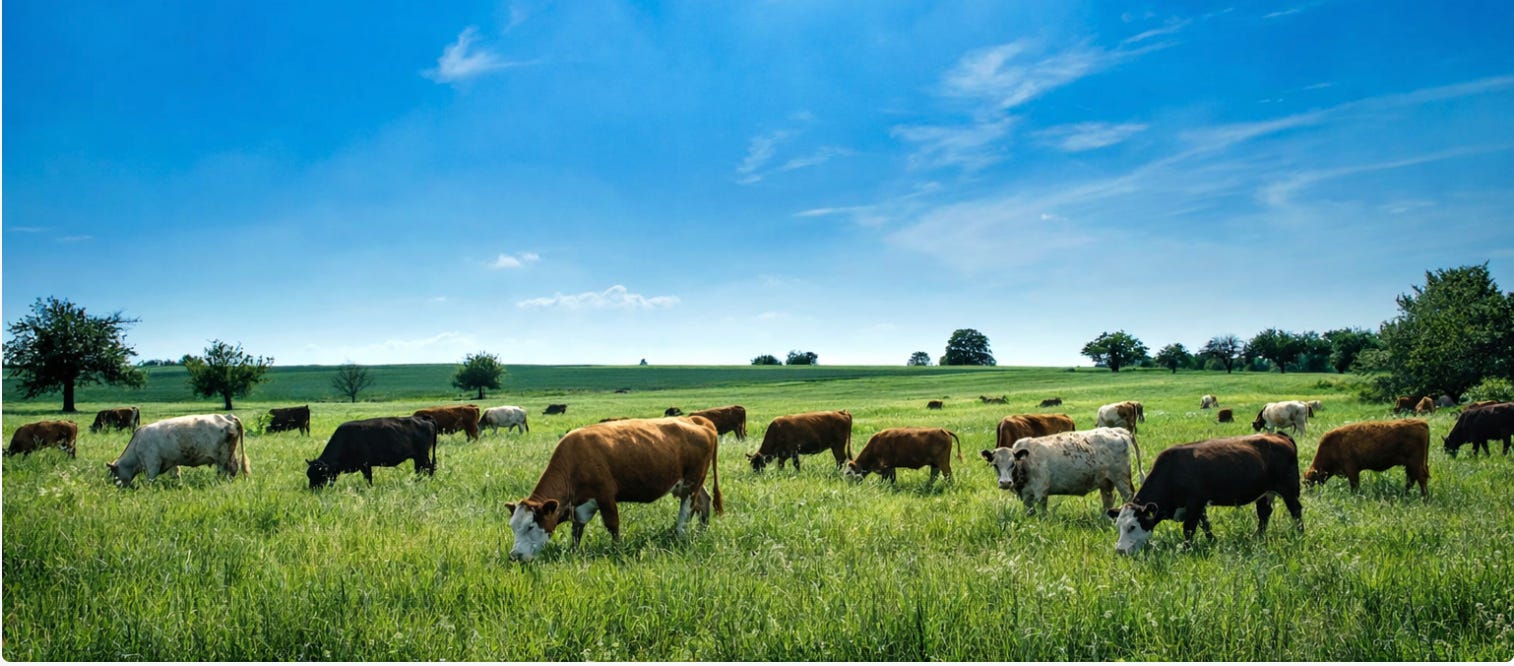
The Thesis: When Soil Becomes Strategy
We are financing two futures at once.
One glows inside server farms, humming day and night, promising to optimize our decisions, predict our behaviors, and perhaps even write our essays.
The other lies under our boots, mostly unnoticed.
Topsoil.
For most of the last century, land was treated as a production surface. Flatten it. Drain it. Irrigate it. Fertilize it. Scale it. Move more volume through it. If yields rose and prices held, the system was working.
And for a long time, it did work — if “working” meant calories per acre and commodities per quarter.
But quietly, something else was happening. Hedgerows disappeared to make wider turns for larger machinery. Fields merged. Diversity narrowed. Soil organic matter — the quiet architecture of fertility — thinned. Water ran off instead of sinking in. Rural communities hollowed out as efficiency replaced people.
None of this showed up on a balance sheet.
In finance, we call that an externality.
In ecology, it is something closer to a drawdown of living capital.
Today, volatility is rising in ways that feel less cyclical and more structural — climate instability, input price swings, water stress, geopolitical fragmentation. The system we built on cheap energy and frictionless logistics is still enormous, still impressive, but less forgiving.
And in this atmosphere of uncertainty, a reframing has begun to circulate in places one might not expect — boardrooms, investment committees, consulting reports.
The idea is deceptively simple:
What if land is not just property, but infrastructure?
What if soil health is not an environmental issue, but a strategic asset?
What if regeneration is not a moral gesture, but a form of upgrading capital?
Land banking, in its traditional sense, meant buying land and waiting. Appreciation was the thesis. Time did the work.
The emerging version is different. It is more active, more ecological, more patient in a different way.
Instead of waiting for land to become valuable, the new approach seeks to make it more alive.
Increase soil organic matter. Improve water retention. Reintroduce biodiversity. Stabilize yields through diversity rather than inputs. Strengthen the relationships between farmers, landscapes, and communities.
The language shifts subtly — from extraction to capacity, from output to resilience.
And resilience, in uncertain times, has a way of becoming the most valuable return of all.
This is not a romantic return to the past. It is an acknowledgment that land, unlike many financial instruments, does not disappear when sentiment turns. It either regenerates or degrades. It either gains capacity or loses it. It holds memory.
The question quietly forming beneath the noise of markets is whether we are ready to treat that capacity as capital.
The Facts: When Regeneration Enters the Spreadsheet
In 2025, Boston Consulting Group published a report that did something unusual. It spoke about regenerative agriculture not as aspiration, but as allocation.
The firm mapped 325 major food-producing landscapes — regions responsible for roughly 80 percent of global food production — and identified the thirty with the greatest potential for transition by 2030.
Their modeling suggested that if these landscapes shifted toward regenerative practices, several things could happen over time:
Available soil water might increase by around 15 percent.
Soil organic matter could rise between 8 and 15 percent.
Biodiversity might expand by 20 to 60 percent.
A meaningful share of agriculture’s carbon sequestration potential could be realized.
These are ecological metrics, but they were framed in financial language.
Under certain conditions — blended finance, supportive policy, credible measurement — the report suggested internal rates of return in the range of 15 to 30 percent for commercial investors in selected landscapes.
It estimated a $310 billion commercial opportunity, assuming public and private capital shared the risk and catalytic funding reduced early uncertainty.
In Brazil’s Cerrado and Amazon regions, the numbers were more concrete:
24 million hectares of degraded pasture targeted for productive transition
9 million hectares of cropland for regenerative adoption.
A potential $55 billion opportunity, with modeled average returns near 19 percent.
These are not small figures. They are not philanthropic rounding errors. They represent the kind of scale that pension funds and sovereign wealth funds recognize.
But the report was also candid about the barriers.
Financing remains fragmented.
Policy alignment is uneven.
Land tenure can be uncertain.
And perhaps most importantly, measurement systems are still insufficiently standardized and trusted.
Capital, especially institutional capital, moves when it can see.
If increases in soil vitality, water retention, biodiversity, and yield stability can be measured, verified, and underwritten, then regeneration begins to look less like a cause and more like an asset class.
This is where land banking takes on new meaning.
Not speculation on urban sprawl.
Not passive appreciation.
But landscape-scale stewardship backed by blended finance, supported by credible measurement, and designed to increase the long-term capacity of land to produce food and stability.
At a time when trillions are flowing toward digital systems designed to predict the future, there is something almost countercultural in turning attention back to the biological systems that make any future possible.
The land does not trend on social media.
It does not go viral.
It does not scale at the speed of software.
But it compounds.
Slowly. Quietly. Relentlessly.
And in an age of volatility, that kind of compounding begins to look less like nostalgia — and more like strategy.
This stayed with me.
“We are financing two futures at once” feels painfully accurate. So much capital is flowing toward prediction and abstraction, while the living systems that make any future possible remain under-accounted for. Your reframing of soil as infrastructure shifts the conversation in a way that feels both strategic and deeply necessary.
Through a Neohumanist lens, what you are naming goes even further. Land is not only an asset class or a stabilizing hedge against volatility. It is part of a larger web of life in which human economies are nested, not dominant. When soil organic matter increases, when biodiversity returns, when water sinks back into the ground, it is not just resilience being built. It is relationship being restored.
I appreciate how you translate regeneration into the language of allocation and return. That bridge matters. If financial systems can begin to recognize living capacity as capital, we may be witnessing not just a market shift but a worldview shift, from extraction toward mutualism.
The land does compound quietly. And perhaps the deeper opportunity is to remember that we, too, are part of that compounding system, accountable to it rather than separate from it.
Thank you for articulating this so clearly.