
The Murmuration
What a week at LARIS in Bogotá taught me about money, flocks, and the architecture of belonging.

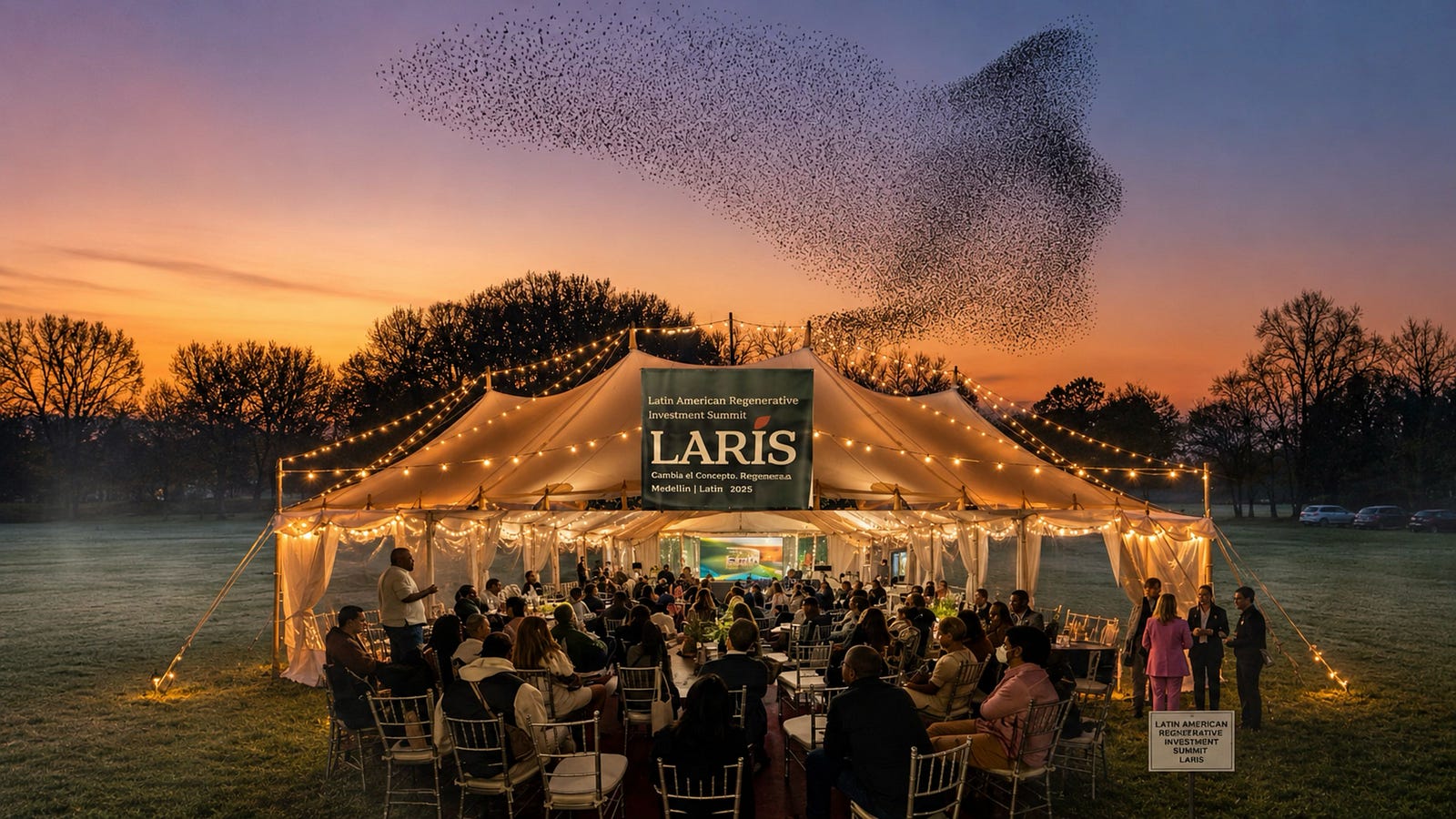
BOGOTÁ — I went to Colombia last week for a conference about money. I came home thinking about birds.
The conference was LARIS — the Latin American Regenerative Investment Summit organized by SVX Mexico — and on paper it was exactly the sort of gathering you would expect: panels on blended finance, carbon methodologies, biodiversity markets, ecological indicators, governance frameworks, the architecture of emerging nature markets. Important, technical, useful work. The kind of work that turns a planetary emergency into something a spreadsheet can hold.
And yet a week after coming home, when I close my eyes and try to recall what actually happened in Bogotá, almost none of those panels return to me.
What returns is a feeling I have no convenient column-inch language for: that beneath the agenda, another agenda was quietly being run. Not by anyone in particular. Not against the visible one. Just underneath it, the way a river runs underneath a city it does not know about.
If you have spent any time around the conversation we have started calling the metacrisis — climate, biodiversity, democratic decay, the loneliness epidemic, the strange brittleness of nearly every institution we built in the twentieth century — you have probably noticed that the smartest people in the room keep arriving at the same uncomfortable suspicion. The problem is not, fundamentally, a problem of technology. It is not, fundamentally, a problem of policy. It is a problem of relationship. A civilization that has spent four centuries proving how cleverly it can separate things has finally hit the limit of what separation can do.
That is the thesis. The rest of this essay is about what it felt like, at the LARIS Even tent in Bogotá, to watch that thesis briefly come alive.
✦ ✦ ✦
There is an idea in the Andean cosmovision that I have been turning over since I came home. The world, the elders say, has more than one floor. There is the tonal — the named world, the world of categories and institutions and metrics, the world that fits on a slide. And there is the nagual — the felt world, the relational world, the world beneath language, where intuition and synchronicity and unseen coherence live.
Modernity, by and large, has chosen to live on one floor. We have become very skilled tenants of the tonal. Our maps are exquisite. Our dashboards are bright. Our quarterly reports are punctual. And almost no one I know is doing well.
The Taoists put it more bluntly: the Tao that can be spoken is not the eternal Tao. Whatever is most worth saying refuses to sit still on the page. You feel this every time you try to describe a person you loved who has died, or the precise quality of light on a particular afternoon in childhood, or what your grandmother smelled like. The words arrive, and the thing itself slides away.
Bogotá, increasingly, feels like that. Vivid at the edges, dissolving at the center. A dream trailing away from memory. Which I am starting to think is not a failure of my memory. It is information about what kind of event it was.
✦ ✦ ✦
The people in that room were not, mostly, what a Bloomberg terminal would call stakeholders. Some came from indigenous lineages whose ceremonies are older than the Spanish language. Some came from forests and rivers and mountains that they spoke about not as assets, not as resources, not even as ecosystems, but as kin. When one woman talked about a river she had spent her life defending, she did not say which river. She said who.
That small grammatical move — who, not which — is the kind of thing financial analysis cannot pick up and yet may be the most important data in the room. It is the difference between a world made of objects and a world made of beings. Indigenous elders have been trying to teach English speakers this for years: that our language is a near-total commitment to the inanimate, and that our crisis may be downstream of our grammar.
So there was a kind of code-switching going on in Bogotá that the simultaneous translators could not help with. The slides were in tonal. The hallways were in nagual. And the real work — I am increasingly convinced — was happening in the hallways.
Over Colombian coffee. Over silence. Over a personal story someone suddenly began sharing, unprompted, in a resonance that sounded deeply inspiring, while the rest of us simply stopped speaking and listened — not to the words themselves, but to the frequency of consciousness moving through them. Over a long embrace between two strangers who, only minutes earlier, had been passionately defending different approaches to regenerative frameworks — each carrying, perhaps unconsciously, the banner of their own project, their own certainty, their own fragment of truth — and who now seemed to have forgotten the argument entirely.
The way a forest forgets a fire.
✦ ✦ ✦
The Andean traditions, again, are useful. They speak of three realms. Kay Pacha, the world of embodied existence — the territory of the jaguar, where we live our human lives. Ukhu Pacha, the underworld of roots and memory and gestation — the territory of the serpent, what lies beneath appearances. Hanan Pacha, the upper world of vision and spirit — the territory of the condor.
Regenerative work, as I had understood it before Bogotá, was a Kay Pacha project. Restore the soil. Replant the watershed. Re-stitch the food system. Honest, necessary, measurable work.
What I saw in Bogotá was something larger. The deepest layer of this work is not ecological at all. It is the reconciliation, inside each of us, of those three worlds — embodied life, ancestral memory, and the upper currents of consciousness. Modernity convinced us they were separate floors of separate buildings. Most of the suffering I have witnessed in my own life, and most of the suffering I see in the headlines, traces back to that single act of architectural malpractice.
Charles Eisenstein has a phrase for the era we are leaving: the Story of Separation. A civilization-scale narrative in which the self is bounded, the world is dead, and meaning has to be manufactured because the universe forgot to include any. The metacrisis, in this reading, is not a series of unrelated emergencies. It is the exhaustion of a single, very old story finally running out of road.
And the people I met in Bogotá were, almost without exception, in some quiet stage of authoring its replacement. Not by writing manifestos. By living differently.
✦ ✦ ✦
There is a thing that happens, sometimes, when a group of people sits together long enough without performing. The masks soften. The nervous system, which spends most of modern life in a low hum of threat assessment, exhales. The ego loosens its grip on the steering wheel. And something else becomes perceptible — a field, an atmosphere, a kind of weather between people.
Mycologists have spent the last twenty years documenting the fungal networks that connect trees underground — the so-called wood-wide web through which sugars, warnings, and nitrogen pass between organisms that, aboveground, look like separate individuals. Suzanne Simard’s old mother trees feeding their seedlings through the dark. The forest, it turns out, is not a collection of trees. It is a single living conversation expressed through many trees.
Something similar, I am suggesting, happens between humans when the conditions are right. There is an underground relational intelligence that connects us beneath profession and ideology and nationality and the curated identities we wear into rooms. Most of the time it is buried under our defenses. Once in a while — in a long meal, in a death vigil, in a particular hallway in Bogotá — it surfaces, and we remember, briefly, what we are.
Thích Nhất Hạnh called it interbeing. The recognition that nothing exists independently — that every breath, every ecosystem, every economy, every self emerges through relationship. The Spanish speakers have a word, integralidad, that gets closer to the English concept of wholeness — not totality as accumulation, but coherence as relationship. The forest is not the trees. The river is not the water. The self is not the ego. Everything alive is alive through everything else.
✦ ✦ ✦
There was a panel, I shared on the second day, that I will spend a long time trying to describe accurately. It was a conversation I shared with two Colombian philosophers and thought leaders — Bernardo Toro and Josefina Klinger — two of the country’s quiet giants, the sort of people whose names you do not encounter on the international circuit because they have chosen, deliberately, to belong to a place.
On paper it was a panel about Natural Capital, from extraction to regeneration. In practice it was a small, polite seismic event.
Somewhere in the middle of it, Josefina said a sentence she did not appear to think was extraordinary. She said that “we are not human beings occasionally having a spiritual experience. We are spirits, briefly, having a human one”.
It is the kind of sentence that, written down, can sound like a bumper sticker. Spoken in that room, by that woman, in that moment, it did something else. It granted a permission. You could feel it move through the audience like a change in air pressure. Permission to stop performing the secular professional self that the conference circuit usually requires. Permission to admit, out loud, in a event tent funded by impact capital, that we had come there for reasons we did not entirely have language for.
And the frequency of the room shifted. I mean that almost literally. Anyone who has spent time in groups knows that rooms have temperatures the thermostat cannot read. The temperature changed. The conversation lifted, the way starlings lift, all at once, from a field. We were no longer in Kay Pacha — the floor of agenda and argument. We had stepped, briefly, into Hanan Pacha, into the territory of the condor, into the nagual — that place where what is most true refuses to be said and resonates instead at the level of the heart, the soul, the spirit.
This is the part of the essay that my left brain half wants to argue with. The columnist in me knows how this reads to a skeptical reader and would like to insert a defensive paragraph. I am going to refuse the columnist. Some things are true that do not survive being defended. You were either in that room, or someone you trust was in a room like it once, and you know what I am describing — or you weren’t, and the description will sound like indulgence, and there is nothing I can write to bridge the gap.
Bernardo and Josefina, between them, opened a door that most of us spend our adult lives forgetting is there.
✦ ✦ ✦
No one embodied this for me more quietly than Laura Ortiz Montemayor, who held the summit together. She did not appear to be doing it. That is the point. There are people who organize events, and there are people who hold fields, and the difference is invisible from across the room and unmistakable from inside it.
The Taoist tradition has a word for what she was carrying: Shen.
It is usually translated as spirit, but it is closer to the quiet radiance that appears in a person when action is no longer driven by ego, by grasping, by the need for recognition. It is not charisma. Charisma asks to be looked at. Shen simply makes the room safer. People feel seen. Nervous systems relax. Conversations soften. And something else, underneath, becomes possible.
I do not know how to build that quality. I am not sure it can be built. I suspect it is what happens to a person who has spent a long time refusing to make their work about themselves.
✦ ✦ ✦
Which brings me, finally, to the birds.
If you have ever stood in a winter field at dusk and watched a flock of starlings turn the sky into a single moving organism — tens of thousands of small bodies banking and rippling and folding through the air without a leader, without a hierarchy, without a single bird in charge — you have seen a murmuration.
Ornithologists have modeled it. Each bird tracks roughly seven of its neighbors. From that local attention, that simple act of paying attention to whoever is closest, an almost unbearable global coherence emerges. The flock thinks. No one in particular is thinking.
I have come home from Bogotá convinced that human beings can do this too. Not metaphorically. Not as a corporate-retreat slogan. Actually. We have done it before — every traditional society in human history was, in some sense, a murmuration — and we have spent four hundred years industriously forgetting how.
Murmuration only happens when separation softens. It only happens when relationship becomes more primary than identity. It is what is left when each bird stops trying to be the lead bird.
The investment summit was, on paper, about how to move capital toward life. The deeper thing it was about — the thing I am still trying to find words for a week later — is how to move ourselves toward life. The real collapse, it turns out, may not be ecological first. It may be relational. And the real regeneration may begin the moment a critical mass of us remembers that we were never separate to begin with.
The future, in other words, may not be engineered into existence. It may be murmured into being. By people willing, for whole seconds at a time, to stop performing the loneliness their century taught them, and to track instead the seven souls closest to them — and the soul of the river, and the soul of the soil, and the soul of whoever is sitting across the table.
✦ ✦ ✦
Let by Tomas, the summit ended, on the last afternoon, with a fishbowl.
If you have never been inside one: a small ring of chairs is placed at the center of a much larger ring. Anyone who wants to speak walks into the inner circle and takes a chair. When they are finished, they leave, and the chair waits for whoever is next. There is no moderator. There is no agenda. There is only the open chair, and the question of who, in this moment, has something the room needs to hear.
What happened in that final hour I will not be able to describe to anyone who was not there, and I am going to try anyway, because the alternative is to leave it on the floor of that Tent where it would slowly evaporate. One by one, people walked into the center.
A close friend from Costa Rica — an elder who has spent decades as a quiet warrior in the regenerative realm.
A young woman working with children in forgotten territories, carrying hope where institutions had long ago disappeared.
An exile from Venezuela who sat before nearly a hundred people and admitted, trembling, that he had spent years grieving the system he once believed he could change.
One of the organizers of the gathering suddenly breaking into tears, sitting down in silence, no longer speaking in arguments or concepts, but resonating at another frequency altogether.
A Colombian woman speaking not as an activist, but as territory itself.
And a young man who had spent most of the week in silence, as if listening for something deeper than the conversation taking place in the room.
And somewhere in the middle of it — I cannot tell you exactly when — the field that had been hovering all week finally came down into the room.
The murmuration we had been circling around — speaking about, sensing, intuiting through fragmented words and shared silences — suddenly became embodied among us, as if a deeper layer of relationship had finally emerged through the spirits inhabiting these brief human experiences together.
You could feel it the way you feel a temperature change. Spirits lifted. Souls lifted. Not metaphorically. The room itself became, for an hour, a single moving organism — turning, banking, holding, tracking — and every person in it was, briefly, one of the seven neighbors each of the others was paying attention to.
We had become a collective murmuration. The thing we had come to Bogotá to talk about, sitting in a circle, talking with itself.
I do not know how long it lasted. I know that when it ended, no one quite stood up at the same time, the way people usually do at the end of conferences. We stayed, for a while, in the chairs. Some of us cried. Some of us did not. Everyone, I think, understood that something had been deposited in us that we would now have to carry home and find use for.
That is what I went to Colombia to learn. I did not know it when I got invited as a speaker. I am not sure I knew it when I boarded the plane home. I think I am only learning it now, writing this down, while somewhere outside a window I cannot see, a few thousand birds are quietly rehearsing the only future worth having — and a few hundred humans, scattered now across three continents, are quietly rehearsing it too.
If this article resonated with you, consider subscribing — or even better, becoming a paid subscriber — to help sustain and expand this work. Your support allows these conversations to reach further, nurturing the awakening, awareness, and acceptance that may help us move from isolated insight toward a shared, collective consciousness.
Ernesto, this is the most profound piece I've read on "investment". Like you said, I thought I'd read about regenerative finance and I found myself thinking about Carlos Castaneda and the theory of death as our best advisor and reflecting on psilocybin and its powerful impact on humanity. Beautiful insights but more importantly, insights I thought I'd never read on an investment summit. I can say one thing for sure, next year I WILL BE THERE.
Beautifully composed. You get better and better. I hope the murmurings scale and travel.