

Don’t you feel that something is really off.
Not broken exactly. Just thin. Flattened. As if life were happening, but at a distance.
We keep moving, keep producing, keep succeeding — yet a quiet question follows us around:
What is all this for?
This post does not start with answers.
It starts with that question.
What follows is not a method, nor a promise of arrival. It is a record of movement — of how a life shaped by separation begins, slowly, to re-enter relationship, and with it, a renewed sense of purpose and wholeness.
The path does not begin in clarity.
It begins in unease.
From Disembeddedness to Belonging
I didn’t leave my old life as a Wall Street–trained investment banker because I discovered something better.
I left because what I was doing stopped making sense.
From the outside, everything worked. I was rewarded, respected, surrounded by people who knew how to win. The world I inhabited was coherent — efficient, disciplined, internally consistent. It knew how to grow money, how to extract value, how to move fast and exit cleanly.
And still, something began to fray.
It wasn’t outrage.
It wasn’t guilt.
It was quieter than that.
A feeling that whatever I was building no longer pointed toward anything beyond itself. The systems I worked inside were powerful, but thin. They explained how things functioned while remaining oddly silent about why any of it mattered — or who it was ultimately for.
That silence followed me longer than I expected.
I didn’t yet have language for what was wrong. What I sensed was that I was living inside a worldview that treated life as something external — something to be measured, managed, optimized. Useful, yes. Profitable, often. But increasingly detached from the living world that made it all possible.
Only later would I learn the word for this condition.
Disembeddedness.
Where I Was Standing
Disembeddedness isn’t a personal failure. It’s a position.
It’s what happens when your work, your values, and your daily decisions drift out of direct relationship with their consequences. When feedback arrives late or not at all. When success can be counted in money and possessions alone — without reference to land, people, or the future — it becomes a game with no finish line.
There is always a better car, a bigger house, a faster plane, a more exclusive club. Accumulation replaces direction, and “enough” quietly disappears.
I was deeply situated there — professionally, culturally, emotionally. The financial world I came from wasn’t absurd or cartoonish. It was sharp, demanding, highly intelligent. It rewarded clarity and punished hesitation.
But it also trained a particular way of seeing.
A way of seeing where value could grow while the foundations beneath it slowly thinned. Where accumulation replaced sufficiency. Where speed mattered more than continuity. Where life itself became a background condition rather than an active participant in the equation.
At some point, I realized I couldn’t keep digging.
That wasn’t an epiphany.
It felt closer to exhaustion.
The Search
What followed wasn’t a conversion. It was a search.
Not for meaning in the abstract, but for orientation — for a way out of the mental enclosure I had been living inside. I began questioning assumptions I had once taken for granted: what success meant, what growth was for, what intelligence actually looked like when measured over time.
Slowly, something else came into view.
The beliefs I held weren’t just ideas. They were nested inside larger systems — economic systems, cultural systems, systems of thought. To change direction, it wasn’t enough to swap opinions. I had to learn to see the structure that was shaping me.
This is where systems thinking entered my life.
Not as theory, but as relief.
For the first time, the world began to appear less like a machine with broken parts and more like a set of relationships constantly shaping one another. I started noticing how paradigms reproduce themselves, how people can be intelligent and well-intentioned while remaining trapped inside a narrow frame.
Understanding this didn’t hand me answers.
It gave me sense-making.
And sense making changes how you stand in the world.
At some point in that search, something quietly clarified for me. Not as a plan or an ambition, but as a direction.
My purpose was no longer to predict outcomes or secure certainty, but to align my life with the living flow of things — with the way life itself tends toward coherence, resilience, and renewal, even as conditions remain uncertain.
That doesn’t mean knowing where the path leads. It means staying in relationship while walking it.
Interbeing rather than controlling.
Inter-becoming rather than arriving.
I’m not suggesting this as a model or prescription for anyone else. Only as a possibility. In my experience, the shift doesn’t require conviction or belief. It begins the moment the search itself becomes honest enough to be followed.
When Belief Softens
As my understanding widened, something unexpected happened.
The pressure to accumulate eased.
Not because desire disappeared, but because it changed shape. The old hunger — the need to secure, to prove, to extract — began to lose its urgency. It no longer felt like the thing that would set everything right.
What replaced it wasn’t renunciation.
It was sufficiency.
Sufficiency isn’t about having less. It’s about no longer needing more in order to feel oriented.
When you begin to sense that nothing exists independently — not wealth, not identity, not success — the drive to accumulate starts to loosen on its own.
Belief returned, but quietly.
Not belief in a system or an ideology.
Belief in relationship.
And belief, once it settles, brings something else with it.
Belonging.
Belonging as Movement
Belonging isn’t a feeling you decide to adopt.
It’s a condition you step into.
To belong is to recognize that you are not standing outside life, trying to manage it. You are inside it — shaped by it, responsible to it, entangled with it. Nothing stands alone. Everything participates.
Belonging, in this sense, is interbeing with the flow of life.
It is the recognition that life is not something happening around you, but something moving through you and with you. To belong is to be in relationship with that movement — to act in a way that stays responsive to feedback, consequence, and context as they unfold. You are no longer positioning yourself against the current, trying to dominate or outpace it. You are learning how to move within it, adjusting, listening, and participating in its direction.
Once that becomes visible, action begins to change.
You stop trying to control outcomes and start paying attention to conditions. You stop asking how to win and start asking how systems stay alive. You move a little less against the current, a little more with it.
This is what I mean by interbeing.
And from interbeing, inter-becoming follows.
Not an endpoint.
A direction.
When Wholeness Becomes a Question
By the time you begin to look for wholeness, something has already shifted.
You don’t arrive here out of curiosity. You arrive because fragmentation has become tiring. Because managing pieces no longer explains the whole. Because the effort required to keep things separate — work from life, means from ends, success from consequence — has started to cost more than it gives back.
At first, this shows up as a loss of orientation. Purpose feels thinner, harder to locate inside the systems you inhabit. You may still function well, even excel, but the sense that everything belongs to something larger begins to fade.
And then, almost by contrast, something else becomes visible.
Not a solution, and not an idea — but the outline of a different way of being in the world. A dimension where things are not fragmented and managed from the outside, but held together through relationship. Where actions, consequences, and meaning are not separated into compartments, but integrated.
The search for purpose is what draws us toward this shift. It is the first signal that another orientation exists — one in which belonging is possible again.
As purpose reappears, even faintly, we begin to sense wholeness not as an abstraction, but as something we can step into. Something we can belong to.
Wholeness enters, then, not as an answer but as a question shaped by experience rather than theory:
what would it mean for life, work, and consequence to make sense together again?
Not as a return to simplicity, but as a way of holding complexity without fragmentation. Not as something to manage from the outside, but as something to participate in from within.
Wholeness Is Not Unity
The word itself can be misleading.
Wholeness does not mean everything blending into one. It does not mean harmony without tension, or systems without conflict. Life doesn’t work that way. Forests are full of competition. Bodies are full of friction. Cultures are full of disagreement.
And yet, when they are healthy, they hold together.
Wholeness is not sameness.
It is coherence.
It is the condition in which distinct parts remain in relationship — where difference doesn’t fragment the whole, and tension doesn’t tear it apart. A system is whole when its elements can disagree, adapt, and even fail without losing their capacity to belong.
This is not a moral ideal.
It is a living condition.
How Life Holds Itself Together
In living systems, nothing exists in isolation.
A tree is not just a tree. It is soil, fungi, water, sunlight, time. A body is not an assembly of organs. It is circulation, communication, response. A community is not a collection of individuals. It is memory, trust, shared practice, and future imagination.
What makes these systems whole is not control, but relationship.
Relationship is where information moves.
Relationship is where feedback appears.
Relationship is where meaning forms.
Remove relationship, and systems don’t just weaken — they lose their identity.
Wholeness, then, is not something added to life.
It is what remains visible when relationships are allowed to function.
The Emergent Nature of Wholeness
Wholeness cannot be designed directly.
This is one of its most counterintuitive qualities.
You cannot assemble wholeness from parts. You cannot mandate it through rules. You cannot scale it by copying forms. Wholeness emerges when conditions are right — when relationships are tended, boundaries respected, and feedback allowed to circulate.
This is what systems science calls emergence.
Not magic. Not mystery.
Emergence is what happens when interaction itself becomes creative. When qualities appear that do not exist in any single element, but only in the way elements relate over time.
Life itself is emergent.
So are intelligence, culture, trust, and meaning.
Once you see this, the impulse to force outcomes begins to soften. You start paying more attention to conditions and less to control. You stop asking how to make systems behave and begin asking what they need in order to stay alive.
Wholeness and Scale
One of the quiet misunderstandings about wholeness is that it belongs to the small and the intimate.
In fact, wholeness operates across scales.
Cells coordinate within bodies. Bodies coordinate within ecosystems. Ecosystems coordinate within the living Earth. Each level has its own integrity, its own rhythms, its own limits. None can be optimized independently without harming the whole.
Wholeness across scale requires attunement, not dominance.
It asks us to act locally while listening globally. To recognize that what strengthens a part at the expense of the whole eventually weakens both. To accept that health cannot be exported from one scale to another — it has to be grown in place.
This is why wholeness resists simple solutions.
It is contextual.
It is relational.
It is alive.
Why Wholeness Feels Difficult Now
If wholeness is so fundamental to life, why does it feel so distant?
Because modern systems trained us to break things apart in order to understand them — and then forgot to put them back together. Because specialization replaced relationship. Because abstraction made it possible to act without feeling consequence.
Disembedded systems are not failures of intention. They are successes of a particular way of seeing.
Wholeness asks us to see differently.
Not by abandoning reason, but by allowing reason to rejoin life. Not by rejecting analysis, but by situating analysis within relationship. Not by going backward, but by widening the frame.
This is not a return to innocence.
It is a return to participation.
Wholeness as Orientation
Wholeness is not a destination you reach.
It is an orientation you learn to hold.
You can be more or less aligned with it. You can move closer to it, or drift away. You can strengthen it in one domain while undermining it in another. There is no permanent arrival — only ongoing relationship.
This is why wholeness pairs naturally with belonging.
Belonging is how wholeness is lived.
Wholeness is what belonging reveals.
Once you begin to sense this, the question is no longer whether wholeness is possible.
The question becomes: what helps it arise?
The Patterns Life Repeats
Once you begin to see wholeness, a strange thing happens.
You start noticing that life is not improvising endlessly. It is repeating itself — not mechanically, not rigidly, but rhythmically. Certain ways of organizing show up again and again, whether you’re looking at a forest, a community, a body, or a culture.
At first, this feels like recognition rather than discovery.
You don’t learn these patterns so much as remember them.
They appear wherever systems endure. And when they are missing, systems may function for a while — but they don’t last.
This is what regenerative design has tried to articulate: not a new ideology, but a shared language for patterns that life itself keeps returning to.
These Are Not Rules
We’ve been calling these principles, but that word can mislead.
They are not rules to follow or steps to apply. They don’t tell you what to build.
They describe conditions — conditions under which living systems tend to remain coherent, adaptive, and alive.
Conditions under which life tends to thrive. Conditions under which systems remain capable of learning, adapting, and continuing.
When these conditions are present together, systems develop resilience. When they are absent or weakened, systems slowly lose coherence — even if they appear successful on the surface.
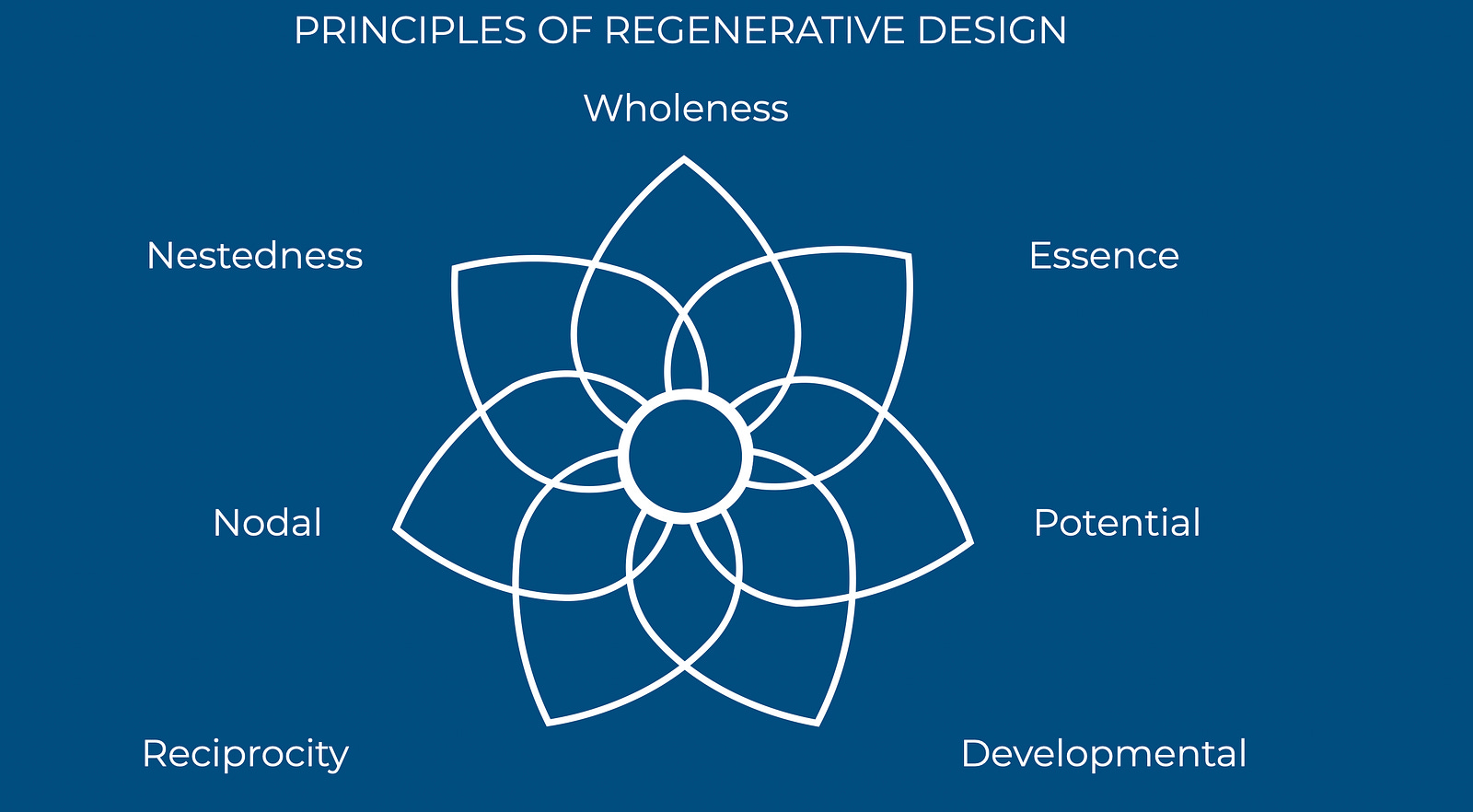
The principles do not stand in a line. They work as a field.
You can’t isolate one without affecting the others. You can’t optimize one without distorting the whole. Life doesn’t work that way.
The Principles as a Living Field
What follows are not separate ideas.
They are not steps, levers, or best practices. They are ways life organizes itself when it is allowed to remain alive. Each principle expresses a different dimension of that organization. None can stand on its own. What matters is not their individual presence, but their interplay.
Out of that interplay, something else arises.
That something is coherence.
- Wholeness, Revisited
Wholeness shows up here again — not as an idea, but as an outcome.
A system is whole when its parts remain in relationship, when nothing essential is pushed outside the boundary in order to make the system appear efficient. Wholeness allows tension without fracture. Difference without disintegration.
It does not mean everything fits neatly.
It means everything still belongs.
When wholeness weakens, systems rarely fail all at once. They fragment quietly. Value is extracted in one place and counted somewhere else. Harm is deferred. Feedback is delayed. Over time, the system begins to forget what it is connected to — and eventually, what it is for.
Wholeness is never imposed.
It emerges when the other principles are held in relationship.
- Essence: Why
Every living system has an essence.
Essence is not branding or intention statements. It is the system’s intrinsic reason for being — the unique role it plays within the larger whole it belongs to. When essence is clear, direction emerges naturally. When it is obscured, systems compensate with growth, control, or extraction.
From essence arises potential.
- Potential: What
Potential is not prediction. It is the system’s capacity to become more fully itself over time. It reflects the range of futures that remain possible given current relationships, constraints, and conditions. Systems with degraded potential may still perform, but they cannot evolve. Systems with living potential retain adaptability, learning capacity, and resilience.
Essence without potential becomes static.
Potential without essence becomes scattered.
Together, they orient development without fixing outcomes.
- Nestedness: Life Inside Life
Nothing alive exists at only one level.
Cells live inside organs.
Organs inside bodies.
Bodies inside ecosystems.
Ecosystems inside the living Earth.
Each level has its own needs, limits, and intelligence. None can be treated as a mere subsystem without consequence. What strengthens one scale while weakening another creates instability that appears later — often far from the original decision.
Nestedness teaches restraint.
It reminds us that local success detached from larger contexts is temporary. That no part can be healthy inside a system that is not.
Reciprocity: The Long Memory of Exchange
Life runs on exchange.
Not transaction, but relationship over time.
In healthy systems, what is taken is eventually returned — sometimes directly, sometimes indirectly, often across generations. Reciprocity creates trust. Trust allows complexity. Complexity makes adaptation possible.
When reciprocity erodes, extraction takes its place. Systems may continue to grow, but they hollow out from within. What is gained in speed is lost in continuity.
Reciprocity is not sentimental.
It is structural.
Diversity: How Life Avoids Collapse
Life never places all its bets on one solution.
Diversity is not decoration. It is insurance. It allows systems to respond when conditions change, when disturbances arrive, when assumptions fail. Uniform systems are easy to manage — and easy to break.
Diverse systems are harder to control.
They are also harder to kill.
Diversity creates redundancy.
Redundancy creates resilience.
Resilience allows learning.
This is how life stays alive.
Without diversity, reciprocity becomes fragile.
Without diversity, development stalls.
Without diversity, potential collapses into optimization.
Nodes and Relationships That Matter
In every living system, some relationships carry more weight than others.
Certain places, people, or functions act as connective tissue. They are not centers of command. They are points of convergence — where information flows, where trust accumulates, where coordination becomes possible without force.
When nodal relationships are healthy, systems organize themselves. When they weaken, fragmentation spreads — even if formal structures remain intact.
Strengthening nodes strengthens the whole.
Development: Staying Capable Over Time
Living systems do not grow by getting bigger alone.
They grow by becoming more capable.
They learn. They adapt. They expand their range of possible responses. Development unfolds in stages, each with its own logic. What works at one stage often fails at the next.
When systems stop developing, they compensate by extracting more energy from their surroundings. This can look like growth for a while. Eventually, it looks like exhaustion.
Development is what allows continuity without stagnation.
It is how potential remains alive.
Coherence: The Quiet Achievement
Coherence is not a principle alongside the others.
It is what emerges when they are held together.
Coherence is what allows complexity to function without collapse. It does not require uniformity. It requires intelligibility. Parts need to be able to “read” one another. Feedback must arrive in time. Purpose, structure, and behavior must remain in conversation across scales.
Without coherence, even well-intentioned systems burn themselves out. Energy is spent correcting internal contradictions instead of responding to the world.
With coherence, effort drops and effectiveness rises.
You cannot design coherence directly.
You can only create the conditions — through essence, potential, nestedness, reciprocity, diversity, nodal strength, and development — under which it arises.
When those conditions are present, systems do more than function.
They regain coherence. They remember how to be alive.
They become whole.
What These Patterns Ask of Us
These principles don’t demand belief.
They invite attention.
Once you begin to recognize them, you start noticing where systems are alive and where they are quietly degrading. You see when something sounds progressive but behaves extractively. You sense when a small initiative carries more life than a large, well-funded program.
This isn’t intuition set against reason.
It’s reason brought back into relationship with life.
The principles don’t tell you what to do next. They don’t offer instructions or guarantees. They sharpen perception. They help you notice what strengthens wholeness and what slowly undermines it.
And once perception changes, action follows.
Not because you decided to change — but because it no longer makes sense to act the old way.
A Language for What We Are Sensing
We now have a language for what we are sensing.
Not a doctrine.
A compass.
The question that remains is no longer what are the principles?
It is what does it mean to live, design, govern, and invest as if these patterns were real?
That question is not theoretical.
It is where this path becomes demanding.
Acting From Within Life
At some point, understanding stops being enough.
You can see the patterns. You can sense where wholeness is present and where it has thinned out. You begin to recognize when something is alive and when it is quietly draining the life around it.
And then a more demanding question appears:
What does it mean to act from here?
Not to comment.
Not to critique.
Not to optimize from a distance.
But to participate.
Yet participation does not begin with action.
It begins with how we stand inside the system we are acting within.
The Old Reflex
Most of us were trained to move directly from analysis to action.
We diagnose problems, design solutions, roll them out, measure results. We intervene. We manage. We control. Even when our intentions are good, the posture remains the same: we stand here, the system stands over there.
This reflex is deeply ingrained. It shows up in planning meetings, investment strategies, policy frameworks, and even well-intentioned social innovation. We are rewarded for clarity, decisiveness, and speed. Uncertainty is treated as a flaw. Slowness as inefficiency.
This way of acting works — briefly.
Then systems respond.
Not out of resistance, but because living systems respond to pressure differently than machines do.
They adapt. They reroute. They absorb shocks until they can’t.
Collapse often arrives not as a sudden failure, but as the delayed consequence of interventions that bypassed relationship.
A Shift Before Action
What becomes clear is that the problem is not action itself.
It is acting before developing the capacity to be inside the system being acted upon.
Acting from within life requires a shift in posture — from external intervention to internal participation. This is not a rejection of responsibility, but a refinement of it.
You are no longer positioned as the author of outcomes.
You become a participant in emergence.
This requires a pause — not to hesitate, but to orient. To develop the capacity to read the system, to understand its rhythms, constraints, and latent directions before attempting to influence it.
Instead of asking What do we want to build?, the question becomes:
What is already taking shape here — and what conditions would allow it to develop well?
This question slows things down at first. It introduces friction into timelines built for speed. But over time, it proves more precise.
Because living systems do not need to be invented.
They need to be understood.
Design as Relationship
From this posture, design changes meaning.
Design is no longer about imposing form. It becomes about shaping conditions — creating contexts in which relationships can strengthen, feedback can circulate, and learning can occur.
Good design does not force coherence.
It makes coherence possible.
This holds whether one is designing a building, an organization, a governance structure, or a financial instrument.
The measure of success shifts: not elegance or efficiency alone, but whether the intervention increases the system’s capacity to remain alive over time.
Design becomes less about mastery and more about attentive engagement.
Governance Without Illusions
Governance is where this shift becomes unavoidable.
We often treat governance as control: rules, enforcement, authority.
Living systems operate differently. They rely on feedback, trust, shared norms, and the ability to adapt as conditions change.
Healthy governance grows from participation.
Unhealthy governance compensates with force.
When governance aligns with living patterns, responsibility distributes rather than concentrates. People act not because they are compelled to, but because they recognize themselves as part of the system they are shaping.
This form of governance is slower. It is less predictable. It cannot be frozen into static rules.
But it holds.
Finance as a Test
If design reveals our assumptions, finance exposes them.
Few domains display disembedded action as clearly as capital. In systems detached from life, money circulates without memory. Returns are counted, while costs drift elsewhere — into landscapes, communities, and futures not yet born.
In living systems, resources behave differently.
They circulate like nutrients.
They reinforce growth where life is already present.
They return value to the whole.
When finance aligns with living systems, it stops being the objective and becomes an instrument. It supports continuity instead of extraction. It reinforces reciprocity rather than concentration. It accepts limits — not as constraints, but as guidance.
This is not about moral purity.
It is about viability.
Systems that exhaust their foundations do not persist.
Living With Tension
Acting from within life does not eliminate tension.
It increases it.
You act without certainty. You commit without guarantees. You make decisions knowing they will evolve. Responsibility does not end with implementation; it continues through relationship.
This is uncomfortable — especially in cultures trained to equate responsibility with prediction and authority with control.
But this discomfort is not a flaw.
It is the signal that action is occurring inside a living system rather than upon it.
From Orientation to Practice
By now, the path has shifted.
We are no longer asking how to fix the world.
We are learning how to remain in relationship with it.
Understanding has moved toward practice.
Principles have become orientation.
Action has begun to resemble becoming — not as ideology, but as consequence.
What remains is the hardest question of all:
How do we sustain this posture over time — personally, collectively, institutionally — without collapsing back into control, ideology, or extraction?
That question does not have a single answer.
It has a practice.
Returning the Path
If you’ve stayed with this path to the end, you may notice something unexpected.
Nothing has been resolved.
There is no final clarity, no steady ground that holds forever. The world has not simplified. The tension between living and extracting, belonging and control, has not disappeared. If anything, it may feel more present now — closer, harder to ignore.
That is not a failure of the path.
It is the path.
Wholeness, as you have seen, is not something you reach and then possess. It is something you stay in relationship with. It appears, recedes, reappears — depending on attention, care, and context. Like any living thing, it asks to be tended, not mastered.
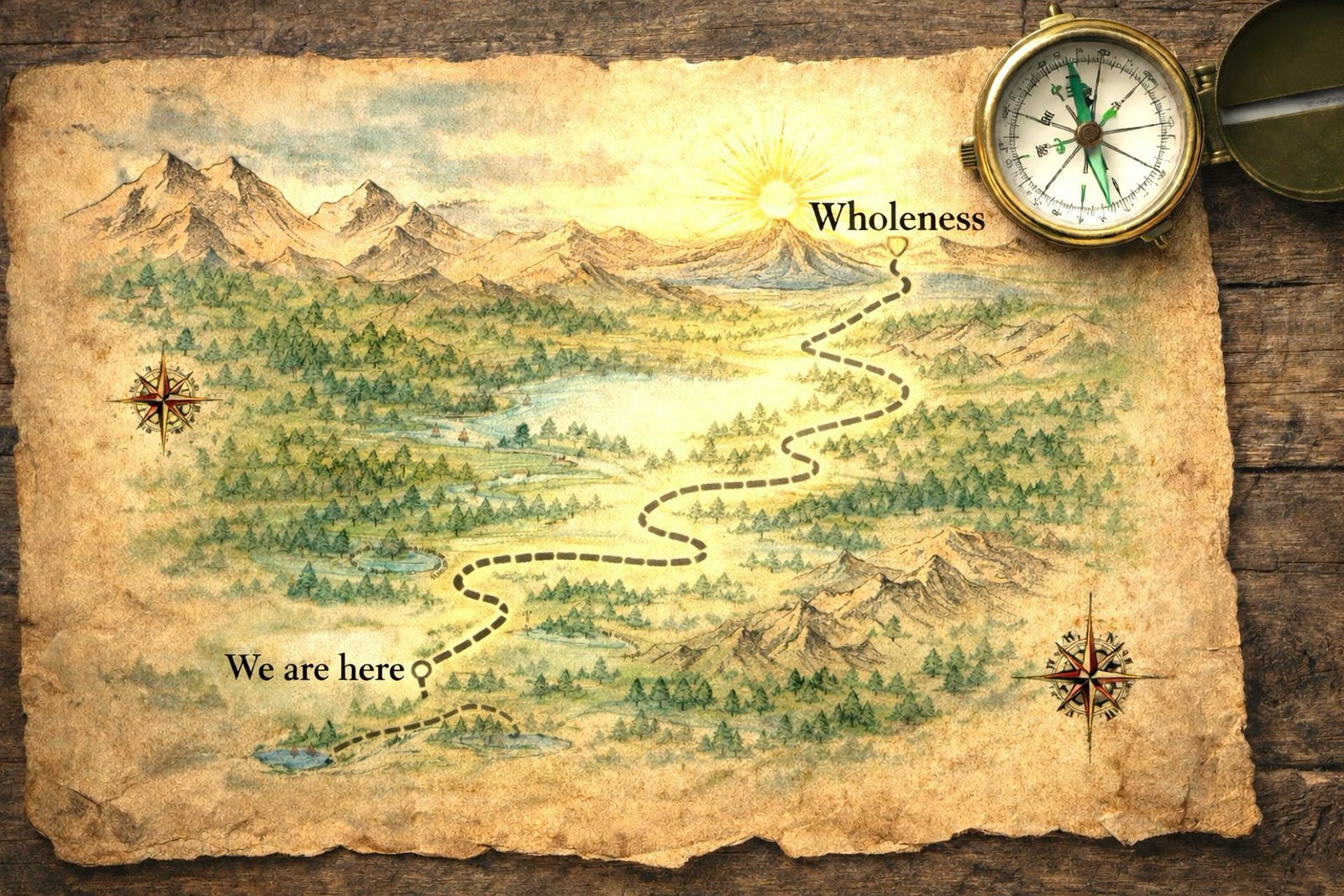
This text offers a map, not the territory it points toward. It can suggest direction and relationship, but the ground beneath your feet remains the only place the path unfolds.
Nothing you’ve read here is meant to be carried as belief.
Only as orientation.
At some point, the language must fall away. The frameworks loosen. The words stop helping. What remains is not an idea, but a posture — a way of standing in the world that notices relationship before outcome, continuity before speed, life before abstraction.
From here on, the work cannot be done in theory.
It happens where you live. In the choices that don’t announce themselves as important. In the moments when you could act quickly, but choose to listen instead. In the relationships you refuse to externalize. In the systems you participate in, knowing they will shape you as much as you shape them.
There will be times when you drift back into disembeddedness. Times when control feels easier than care. Times when the old metrics return, offering certainty in exchange for distance.
That, too, is part of the work.
The path does not ask for purity. It asks for return.
Again and again.
If this post has done anything, let it be this: not to tell you what to do, but to help you notice where you already are. To recognize that belonging is not something you need to earn, and wholeness is not something waiting at the end of effort.
You are already inside it.
The rest is practice.
And now, the path is no longer mine to walk.
Thank you Ernesto. I feel what you’re describing feels less like a rupture and more like a gradual thinning. Systems still function, lives still move forward, success is still counted, but meaning no longer travels with the consequences of our actions.
The shift you trace, from accumulation toward sufficiency and from control toward relationship, doesn’t feel like withdrawal. It feels like transition. Like stepping back inside the web of life rather than standing apart from it, measuring and managing from a distance.
Wholeness, as it appears here, isn’t about harmony or sameness. It’s about coherence. About difference held in relationship, and action remaining accountable to what it shapes over time. That kind of coherence can’t be imposed. It emerges when systems are allowed to stay responsive and alive.
What stays with me is the posture this invites. Not certainty or solutions, but a way of standing that notices connection, honors limits, and remembers that belonging isn’t something we arrive at. It’s something we return to, again and again.
Thanks for this Ernesto! The map is not the territory; one of my favorite mantras!
Absolutely love the notion that there is no destination and only that there is ever-changing nuance and movement of systems. While it can seem exhausting on the surface (the constant calibration into systematic harmony), it really does enliven reality and makes you feel a sense of stewardship in every dynamic, seeking to maintain and nurture them so that the system(s) can continue providing benefit to all.
Also - really love the call out about tension being necessary and encouraged for sustaining, and hopefully evolving, systems. This line of thinking, in my opinion, invites people to be empathetic to difference and see the benefit of diversity in all forms.
Thanks again!