
The Regenerative Path
Our deepest transformation begins not with changing the world, but with learning to see it

The path of discovery continues.
A Note Before Beginning
For a while I believed the Dharma series ( Part One, Two, Three and Four) had reached its natural end. I had followed the thread through impermanence, renewal, living systems, and the possibility that life carries within it the intelligence of its own becoming. I set down the series believing the arc had closed.
Then, as happens whenever we mistake a resting place for a destination, the river moved again.
I returned to the story of Narcissus and discovered I had misunderstood it. What I had taken as a warning about vanity began to reveal something more unsettling: the difficulty — perhaps impossibility — of seeing the paradigm while standing inside it.
That insight opened a door and once that door opened, everything I had been writing walked through it. McLuhan’s invisible environments, the Three Horizons, developmental consciousness, living-systems thinking, and the Dharma suddenly appeared not as separate inquiries, but as different faces of the same question.
So this is not a conclusion. It is the next bend in a path I thought had ended — an invitation to keep walking when the trail disappears from sight.
Let us begin, then, where every genuine awakening begins — not with an answer, but with a reflection on still water.
ONE
The Reflection
Why is it so difficult to see the world that contains us?
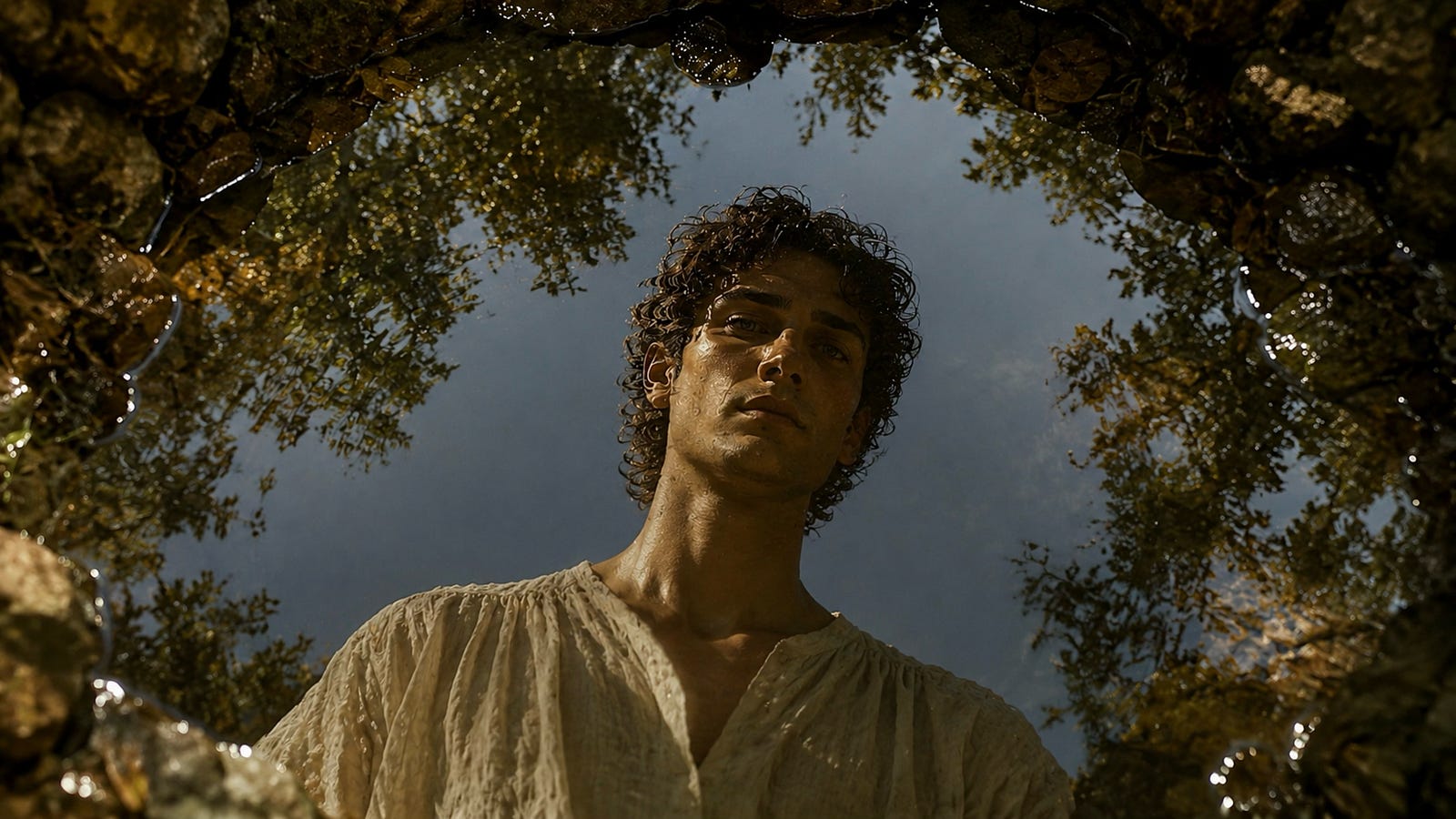
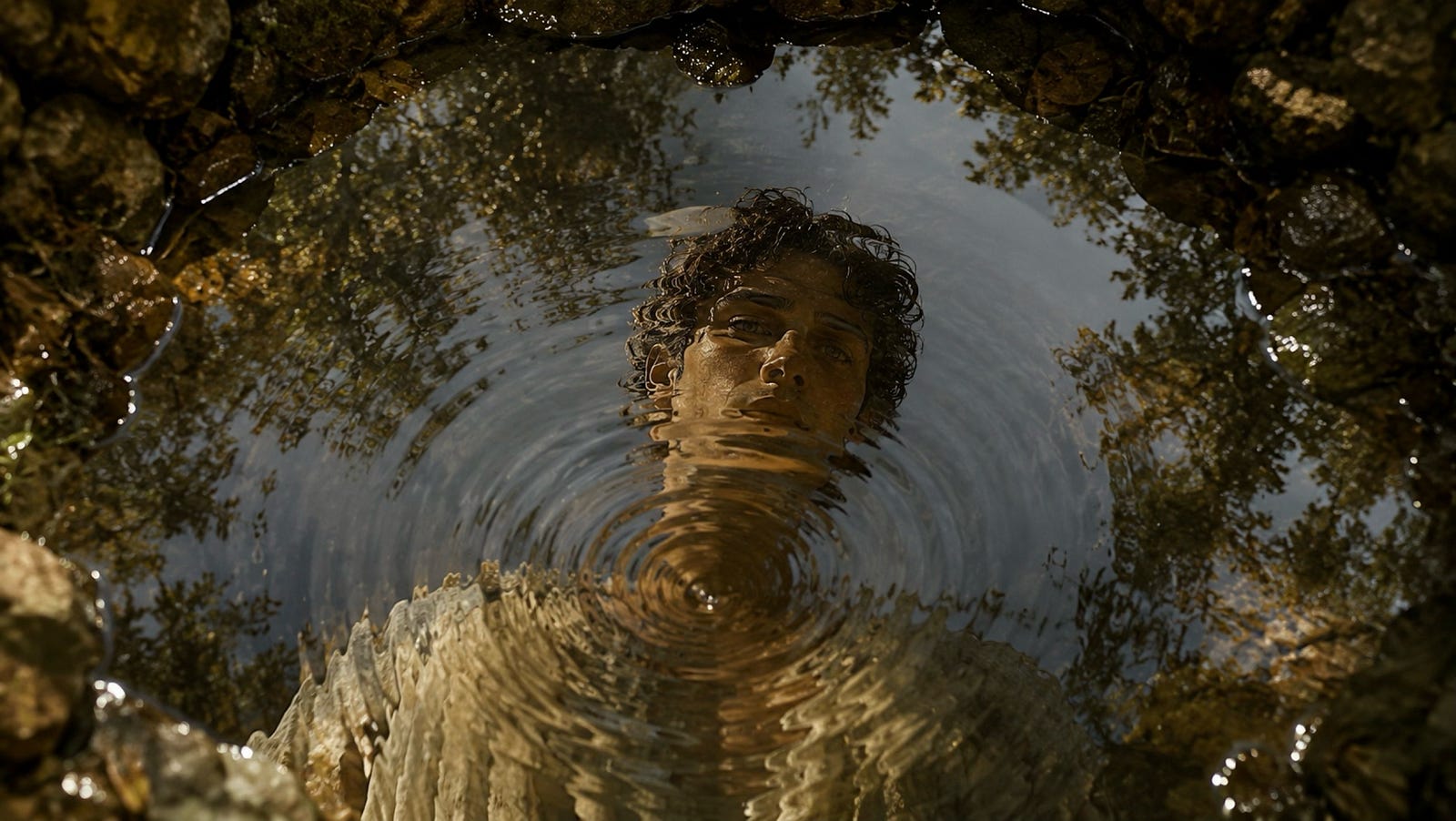
There are stories that survive for thousands of years because they continue to describe us long after the civilizations that first told them have crumbled into the soil. The story of Narcissus is one of these. We have inherited it as a cautionary tale about vanity — a young man so captivated by his own beauty that he could not look away from his reflection, returning day after day to the quiet edge of the river, leaning over the still water until the image became more compelling to him than the living world in which he stood, until at last, unable to separate himself from what he saw, he dissolved into the very reflection that had enchanted him.
But I have come to think we have misread the myth for a very long time.
The tragedy was never that Narcissus loved himself. The tragedy was that he mistook a reflection for reality. The face shimmering on the surface of the water had no depth to it; it possessed no hidden side, no interior life, no history, no roots. It was only light resting for a moment on the skin of a river. And yet, because it was all he could see, it quietly became his entire world.
He never asked what lay beneath the surface, never wondered what current moved the water, what forest fed the stream, what distant snowmelt had carried its first cold drops down toward the valley where he knelt. His attention stayed fixed on the surface, unaware that the river shimmering with his own face belonged to a vast and breathing system — that it was, in fact, alive, and that he was already inside it.
Perhaps every civilization eventually becomes Narcissus.
Marshall McLuhan spent his life describing how this happens, though he did not use the language of myth.
Every technology, he observed, extends some human capacity: the wheel extends the foot, the telescope extends the eye, writing extends memory across the gulf of time. But here is the part we tend to forget — every extension eventually becomes an environment, and environments possess a peculiar quality, which is that the more completely we come to inhabit them, the less able we are to perceive them at all.
A fish is the last creature on earth that would discover water. And we, in much the same way, are the last to discover the assumptions that quietly organize our lives, precisely because those assumptions do not stand in front of us as objects to be examined; they surround us as the medium through which we do our examining.
The most powerful paradigms, then, are not the ones we argue about and defend. They are the ones we no longer notice enough to name.
Every age lives inside such reflections. We inherit ideas about progress and success, about intelligence and value, about what an economy is for and what a human being fundamentally is, and we hold them so long and so unquestioningly that at some point they stop appearing to us as interpretations at all. They harden into reality itself. And like Narcissus, we mistake the image floating on the surface for the river that carries it. This may be the deepest form of blindness available to a mind — not the simple inability to see, which at least knows itself, but the inability to recognize that one is looking through a particular lens, ground to a particular shape by a particular history, filtering the whole of experience without ever announcing that it is doing so.
The Three Horizons framework gives this dynamic a useful civilizational language — one I will return to more fully below. For now, it is enough to name the dominant paradigm Horizon One: the inherited world that surrounds us so completely that we mistake its institutions, technologies, habits, and assumptions for reality itself. We rarely choose that world consciously; we simply awaken inside it. Like water to a fish, the paradigm becomes hardest to see precisely when it is everywhere. And until we can see the horizon we inhabit, it is remarkably difficult to imagine another one.
The Andean tradition, reaching the same insight by an older road, would say that we have mistaken Kay Pacha — the visible middle world of ordinary experience — for the whole of what is. Yet life is never confined to the middle world alone. Above lies Hanan Pacha, the realm of possibility and higher order and meaning still gathering itself; below lies Ukhu Pacha, the unseen world of roots and memory, of emergence and slow transformation, where the future ferments long before it surfaces. We suffer, in this cosmology, precisely whenever we forget the world above and the world below and take the middle for the entirety of the real.
And the philosophers of the gunas in the Vedic tradition described the interior weather of that same forgetting: under the heaviness of tamas, awareness contracts until reality appears fixed and dense and unquestionable, and — this is the part that matters — one cannot simply decide to see clearly from within that contraction, because the state itself has already determined what is available to be seen. Consciousness shapes perception before perception ever gets around to shaping belief.
Notice that these are not competing explanations offered by rival traditions. They are the same pattern, recognized independently across centuries and cultures and continents, each tradition pressing its thumb against the identical bruise.
What we call ignorance may not be the absence of information at all. What we call denial may not be the refusal of evidence. What we call blindness may be nothing more, and nothing less, than the inability to recognize the water in which we are already, and always, swimming.
That is why every paradigm shift in the long human record — from Copernicus to Darwin, from the strange logic of the quantum to the arrival of systems thinking — felt impossible right up until the moment it became inevitable. Each required someone to step far enough outside the reflection to discover that what had appeared to be reality was only ever one way of seeing it.
And yet — and this is where the story turns — the river is always moving. Beneath the still surface, unseen currents are already reshaping the world long before their work becomes visible on top. Forests rise from roots we never see. Civilizations change through ideas that begin, dismissed and unfunded, at their neglected edges. New possibilities gather quietly beneath old certainties until, almost without warning, the reflection trembles and breaks.
So the question is not whether the river will change; it always does, and it is changing now beneath everything we have built. The question is whether we will learn to recognize the movement before the image we mistook for reality begins to come apart in our hands. If we cannot see the water we are swimming in — if the medium of our perception is by its nature invisible to us — then how does anyone ever awaken at all?
TWO
The Stone in the Water
What interrupts the reflection?
Narcissus remains a prisoner for exactly as long as the surface of the water stays perfectly still. This is worth sitting with, because it locates the trap precisely. The reflection holds its power not through any force of its own but through the stillness that permits it.
A face can float on water only where the water does not move. Disturb the surface — let a single stone fall, let the wind cross it, let the current quicken beneath — and the image scatters into ten thousand fragments of broken light. And in that scattering something happens that had not been possible a moment before: for the first time there is no image to admire, no image to defend, no image to mistake oneself for. There is only the water, moving, and the uncertainty that comes when the familiar face is suddenly gone.
That disturbance turns out to be the common denominator beneath nearly every wisdom tradition the human race has produced.
The surface, though, rarely breaks by choice. Almost no one wakes one morning and decides, out of the calm of an untroubled life, to shatter the reflection that has organized their world. It is far more often broken for us, and broken by the last things we would have chosen. A diagnosis delivered in a quiet room. The death of someone whose existence we had unconsciously assumed was permanent. The collapse of a career that had come to stand in for a self. The betrayal we never saw approaching. The failure of some certainty that had silently held our days in their familiar order for decades.
Like a stone falling into still water, suffering shatters the reflection, and for a brief and often terrifying interval the image simply disappears, and the self we thought we knew can no longer find itself in the water. Most of us spend that entire interval doing the only thing that seems sane — trying, with everything we have, to make the surface still again so the old face will return.
Viktor Frankl, who had every earthly reason to believe that suffering merely destroys, suggested another possibility from inside the place where that belief is most tested. Suffering, he came to understand, is not in itself what breaks a human being. The decisive question is whether meaning can be found within it — not a meaning that erases the suffering, which nothing can, but a meaning that transforms our relationship to it, so that the disturbance stops being only an ending and becomes, almost against our will, the beginning of a different journey.
This is why he belongs in this story, and not primarily for the reasons he is usually cited. He belongs here because suffering breaks the reflection. It is the stone that no one throws on purpose, and the stone that most reliably reaches the bottom.
But suffering is not the only stone, and it would be a grim teaching that insisted it were. Across cultures, remarkably similar pathways have opened toward the same broken and liberating surface, and most of them do not require catastrophe.
Some enter through silence and the long patient discipline of meditation, which loosens the grip of the reflection not by force but by attrition, one breath at a time. Some enter through an encounter with the natural world so complete that the boundary of the separate self grows briefly, blessedly porous — standing beneath old trees, or at the edge of an ocean at night, or in the sudden stillness of a mountain that does not care whether we are watching it. Some enter through ritual, or through the carefully held territory of plant medicine, or through art that arrives with more truth than we were prepared for, or through prayer, or through love, which has undone more fixed selves than any argument ever has.
Each of these, in its own idiom, does the same underlying work. Each disturbs the still water. Each, for a moment, takes away the image and leaves us standing in the presence of the river itself.
There is one more doorway, though, and it receives far less attention than the others — perhaps because it appears at first almost too rational, too analytical, too much like ordinary work to be capable of transformation. It is the practice of learning to see systems.
At the beginning it looks like nothing more than a discipline of the intellect: a way of mapping feedback loops, of tracing how a cause and its distant effect can be separated by years and by continents, of understanding how properties emerge in a whole that are nowhere to be found in any of its parts.
But something unexpected happens to a person who stays with it long enough. The diagrams gradually stop being diagrams. The boundaries that once seemed so obvious — where one thing ends and the next begins — start to soften and blur. Causes that used to run in straight lines begin to curve back upon themselves. Relationships come to feel more fundamental, more real, than the objects they connect. And one day you notice that you are no longer studying systems at all. You are perceiving the world differently. You are learning, by an unlikely road that began in method and arrived at wonder, that the deepest illusion was never the reflection floating on the water. The deepest illusion was believing that you had ever, for one instant, been separate from the river.
Every authentic path, whatever its texture, begins in the same place — by disturbing the surface. So the honest question, the one this whole inquiry now turns on, is not how do I hold the reflection steady.
It is something closer to this: once the old image has broken and cannot be restored, is there a discipline for what comes next — a science, even, for how a human being learns to see once the familiar face is gone from the water?
THREE
The Ancient Science of Seeing
Has humanity faced this before?
We tend to speak of awakening as though it were a stroke of lightning — sudden, unearned, arriving from outside like weather. A moment of inspiration on a mountaintop, a flash of grace that descends on the fortunate and passes over everyone else. It is a comforting way to imagine it, because it asks nothing of us but luck. Yet the traditions that have thought longest and most carefully about the transformation of perception describe something almost the opposite. They describe awakening not as an accident that befalls a person but as the fruit of a discipline that a person cultivates, patiently, over years, the way a gardener cultivates soil that will not be hurried.
Buddhism, to take the tradition that has arguably gone furthest in this direction, never once presented awakening as a moment of good fortune. It presented it as a practice — and over the course of some twenty-five centuries it developed around that practice an extraordinarily sophisticated body of knowledge about the workings of human consciousness.
I have come to think the most accurate word for that body of knowledge is not religion and not philosophy but science: a science of consciousness, developed by contemplatives the way the science of matter was later developed by physicists, through disciplined observation carried out over generations, tested against experience, refined, handed down, and revised.
I do not need to reconstruct that entire architecture here, and it would be a distortion to try, as though the whole of it could be laid out on a single page. But its shape is worth glimpsing, because the shape alone tells us something. There are the Four Noble Truths, which begin not with a doctrine but with an honest diagnosis of suffering and its causes — a starting point closer to medicine than to metaphysics. There is the Noble Eightfold Path, which is not a creed to be believed but a set of practices to be undertaken, ways of speaking and acting and attending that gradually reshape the one who practices them. There are the Three Jewels, and the long cultivation of compassion and wisdom as capacities to be developed rather than virtues to be merely admired, and the bodhisattva’s vow, which reorients an entire life around the liberation of others.
Beneath all of it run two recognitions that will matter enormously for everything still to come in this essay: impermanence, the teaching that nothing whatever remains fixed, that all things are in continual arising and passing away; and anattā, non-self, the teaching that no separate, permanent, independently existing self can be found anywhere when we look closely enough, because what we call a self turns out to be a process, a relationship, a becoming rather than a thing.
Hold those two words. Impermanence and non-self. We will meet them again, wearing different clothes, in a laboratory.
What I want to draw out here is not any particular doctrine but the underlying method, because the method is the discovery. For two and a half thousand years, human beings have been running a sustained and careful investigation into how perception itself can be changed — not what to think, but how to see; not a set of conclusions to adopt, but a training of attention that alters the seer.
They understood, long before any of our instruments could have told them so, that the quality of a life is determined less by what happens to it than by the quality of the awareness that meets what happens. They understood that the self which seems so solid is porous and provisional. They understood that liberation is not a matter of arranging the world more to our liking but of loosening the grip of the reflection we have mistaken for the world.
This is why I have never been able to treat the contemplative traditions as quaint, as belonging to a childhood of the species that our cleverness has outgrown. They were doing something we have barely begun to appreciate: they were mapping the inner territory of perception with a rigor that our outer-facing sciences, for all their power, never turned upon the seer. They were, in the truest sense, a science of the first person.
And here is the thing that has come to astonish me, the recognition around which this entire essay finally organized itself.
In the last hundred years or so, an entirely different community of investigators — scientists who had never read the sutras, who were not looking for enlightenment and would have been embarrassed to be told they might find it, who were simply trying to understand why a forest holds together and why an economy comes apart — began, by their own wholly independent road, to arrive at the same recognitions. Not similar recognitions. The same ones. That relationships are more fundamental than things. That the self, and every apparently separate entity, is in truth a knot temporarily tied in a larger web. That reality is a continual becoming and not a permanent being.
Two traditions, separated by twenty-five centuries and by every difference of language and assumption and intent, pointing from opposite directions toward the identical landscape. If the contemplatives had been developing a science of consciousness all along, then perhaps what the systems thinkers stumbled into was its unexpected mirror — a science of the living world that, without meaning to, kept rediscovering the mind’s oldest and most liberating conclusions.
What would it mean to walk, deliberately, through that second door?
FOUR
The Living Science
Can science itself lead us to the same awakening?
There is another way into this landscape, and it does not begin in a monastery or a sacred text. It begins with a question so plain that we almost never think to ask it, and so deep that a lifetime is not quite enough to answer it:
how does life actually work?
For the last century, a growing and improbably diverse community of ecologists, physicists, biologists, and complexity theorists has been patiently deciphering the grammar of life itself.
They were trying to understand something more concrete and more urgent — why forests regenerate after fire, why some ecosystems absorb a shock and recover while others cross a threshold and collapse, why economies seize, how civilizations rise and fall, and how genuinely new forms of order emerge from relationships that no individual organism could ever have planned or foreseen.
What they found, following the evidence with no intention of arriving anywhere spiritual, was quietly staggering.
Living systems, it turns out, cannot be understood by taking them apart. A forest is not a collection of trees standing near one another; it is a single distributed intelligence trading sugar and warning and water through a web of roots and fungi we are only beginning to map.
An economy is not an assortment of separate companies; it is a field of relationships in which each actor is continuously shaped by every other. A society is not a heap of individuals; it is a living conversation in which the individuals themselves are partly composed.
In every case the whole continually generates properties that none of its parts possess alone — properties that cannot be located in any component, that exist only in the relationships between components, and that vanish the moment you cut those relationships to examine the pieces.
This sounds almost obvious once it is said aloud, and yet it quietly overturns three centuries of reductionist habit, the deep assumption that to understand a thing you break it into its pieces and study the pieces.
Because if relationships are more fundamental than objects — if the connections between things are more real, in some strict sense, than the things themselves — then reality begins to look profoundly different than the machine we had taken it to be.
Causality stops running in tidy straight lines and starts curving back on itself in loops. Stability reveals itself as a kind of continuous, active adaptation rather than a fixed state. Control gives way to participation, because no part of a living system stands outside it pulling levers; every part is inside it, shaping and shaped, at once.
The world stops resembling a clock and starts resembling a conversation. And somewhere along that path — without any bell being rung to mark the crossing — we find that we are no longer merely studying systems. We are learning to perceive differently. The science has become, without anyone intending it, a contemplative discipline.
One framework has shaped my own perception more than any other, and it is worth naming here because it turns an abstraction into something you can feel in your own moment of history.
The Three Horizons framework proposes that every civilization lives, always and simultaneously, within three worlds. The first is Horizon One, the dominant paradigm — the institutions and assumptions and technologies and daily habits that compose the present and that feel permanent for the sole reason that they are what surrounds us. But living systems never hold still, and as any present reaches the limits of its own success, new possibilities begin to appear, usually at the margins, usually dismissed as impractical or naïve precisely because they do not yet fit the logic of the world that is ending.
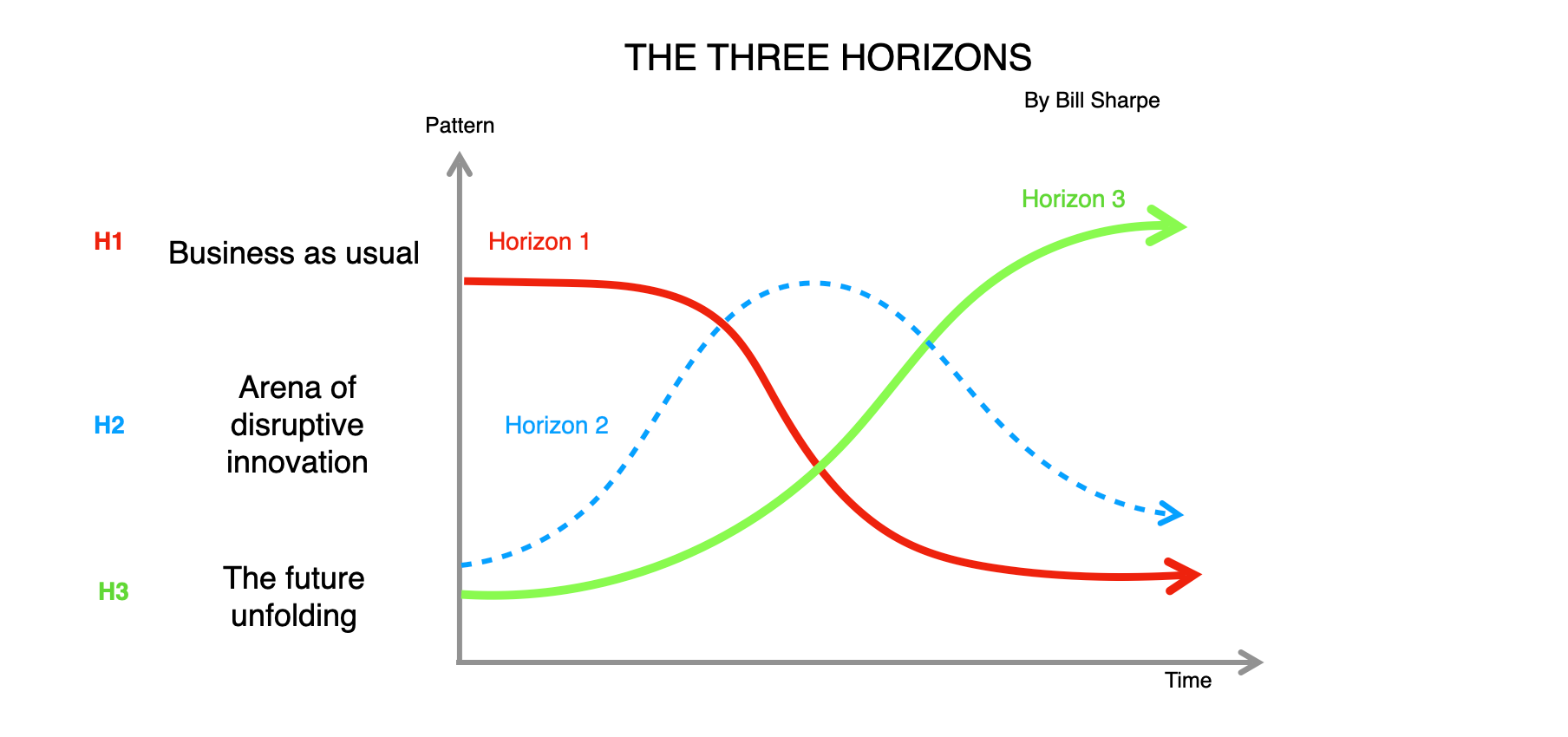
This is Horizon Two, the turbulent middle country of disruption and experiment and uncertainty, the space we are living through right now, where the old coherence is failing faster than the new coherence can form. And beyond it lies Horizon Three — not a prediction, not a blueprint, but the next pattern of coherence struggling to be born, visible so far only in fragments and intuitions and the stubborn work of people building what cannot yet be fully seen.
Set the Buddha’s teaching on impermanence beside this and watch what happens. What had appeared to be a spiritual insight about the passing nature of all things suddenly reads as an exact description of how civilizations actually evolve. Nothing remains fixed — not ecosystems, not economies, not paradigms, not the assumptions we would have sworn were simply the way things are. The word the contemplatives used for the deepest nature of reality turns out to be the word the systems scientists need to describe the behavior of every complex living thing they study. Impermanence and evolution are two names, arrived at from two directions, for one truth.
The future, though, does not spring from imagination alone, and this is where the biologist Stuart Kauffman offers one of the most beautiful ideas I know. He describes evolution as unfolding through what he calls the adjacent possible.
At every moment, the existing configuration of life creates a specific set of new possibilities that could not have existed before and cannot yet be leapt past — a seed cannot become a forest in a single bound; each stage quietly assembles the conditions that make the next stage possible.
Evolution advances not by grand certainty but by feeling its way, step by step, into possibilities that only become visible, only become real, once the previous step has been taken. And perhaps human cultures move in exactly this way. The future is rarely invented from nowhere. It grows, patiently, out of capacities we are only now beginning to develop — which means the shape of what comes next depends less on the boldness of our imagination than on the maturity of our perception.
That may be the deepest lesson the living world has to teach us, and it inverts almost everything our institutions are built to reward. Before we can change the world, we have to expand our capacity to perceive it. Nearly all of our leadership education, all our training of the people who steer organizations and economies, concentrates on capability — how to decide better, design better, build better, manage more complexity more efficiently.
Living systems begins somewhere else entirely. It asks, first, whether we have developed the capacity to see the web of relationships from which all those decisions and designs and technologies actually arise. And the distinction is not academic, because capability without expanded perception does not transform anything; it merely optimizes the paradigm we already inhabit. It makes Horizon One more efficient. It polishes the reflection to a higher shine. Only a change in the observer changes what becomes possible — and when the observer does change, an entirely different world of possibility appears, not because the world was suddenly remade, but because we have finally learned to see what was standing there in front of us the whole time.
Perhaps this is where the two sciences quietly meet and recognize each other. Both begin by questioning the solidity of the separate self. Both discover that relationships are more fundamental than the things they connect. Both understand reality as a continual becoming rather than a permanent being. And both, in the end, suggest the same startling thing — that freedom begins not with rearranging the world but with learning to see past the reflection we once mistook for it.
The river, it turns out, has been teaching this lesson from the very beginning. The only question it has ever asked is whether we were willing to learn to see it. And once we have seen it — once perception itself has changed — what, then, are we actually being asked to do?
FIVE
The Regenerative Path
What does the practice actually look like?
Seeing differently is only the beginning. It is a great deal — it is nearly everything — but it is still only a beginning, because every genuine transformation eventually turns and asks the one question that cannot be answered in thought alone:
now that you see the world differently, how will you live within it?
This is where the contemplative traditions and the living sciences converge for the last time, and converge most completely. Neither, in the end, is truly interested in changing our ideas. Both are interested in changing our practice — in how we actually move through our days, what we attend to, what we reach for, how we meet the person in front of us and the land beneath us. Perception matters only because it gives rise, eventually, to a different way of inhabiting the world. An insight that does not become a practice is just a more sophisticated reflection.
For a long time I believed that regenerative design was fundamentally about landscapes. About restoring degraded soils until they held water and life again, about recovering the biodiversity that industrial agriculture had stripped away, about designing communities resilient enough to endure the shocks already arriving, about building economic arrangements that could flourish within ecological limits rather than devouring the very ground they stood on.
I still believe in every one of those things; I have given my working life to them and do not recant a day of it. But I have come, slowly and somewhat against my own expectations, to suspect that regeneration begins somewhere much closer to home than the soil — that it begins, in fact, with the regeneration of perception itself.
Every landscape we transform exists first as a landscape of thought. Every organization is the outward expression of the mental models of the people who designed it. Every economy grows from a set of buried assumptions about what life is, what value means, and what human beings are ultimately for. And this is the quiet trap waiting inside all our good intentions: if perception itself remains unchanged, then we simply reproduce the same world with better and more powerful tools. We become, as I have come to put it to myself in my less generous moments, a more efficient Narcissus — kneeling at the same water, more skillfully than ever, polishing the same reflection.
This is why regenerative design has become, for me, something far larger than a professional discipline. It has become a practice, in almost exactly the sense the contemplatives mean the word. Like meditation, it asks me to cultivate new habits of attention, and to keep cultivating them long after the novelty has worn off — to look first for relationships before I fixate on objects, to search for patterns before I get lost in isolated events, to recognize the feedback loop before I rush to assign blame, to notice what is present and possible in a place before I catalogue what is missing or broken, and always, always to ask not merely what a thing is but what it is quietly becoming.
These are not analytical techniques that I pick up in working hours and set down again. They are disciplines of perception, and they are slowly reshaping the one who practices them, which is the whole point.
Over the years I have found myself returning, again and again, to a small handful of principles — not because they compose a formula, and not because following them guarantees anything, but because each one keeps inviting me to see more completely than I would have on my own.
That everything possesses an essence that cannot be reduced to its function, a particular quality of being that is uniquely its own and that no list of uses will ever exhaust. That within that essence lies potential — not a destiny already written, but the particular possibility of what this living system, and no other, might become if the right conditions allow it to express itself more fully.
That nothing whatever exists in isolation, and that life unfolds through reciprocity and relationship, through the endless exchanges by which each being participates in the existence of others. That every system is nested within larger systems that quietly shape what is possible for it, so that nothing can be rightly understood apart from the wholes to which it belongs.
That wholeness can never be reached by studying fragments alone, however carefully, because the whole is not merely the sum of its parts but the pattern of relationships through which those parts become something more together.
That development is life’s continuous movement toward greater capacity and expression — the process through which potential can unfold over time as relationships, conditions, and possibilities change. Development, in this sense, is not simply becoming more; it is becoming more capable of expressing what was latent within the system all along.
And that every real transformation begins somewhere particular — through specific people, specific relationships, and specific places capable of becoming living nodes, points of concentrated possibility from which a different pattern can take root, strengthen, and gradually propagate outward into the larger systems of which they are part.
These are design principles, and I have used them as such for years. But I have come to understand that they are also, and perhaps more truly, practices — disciplines of attention no less demanding than Right Speech or Right Action, and no less transformative of the one who takes them up. Each of them, in its own way, reminds me to step back from the water. To look beneath the surface I am tempted to mistake for the whole. To ask, of any place and any situation and any person, not what can be extracted from it, but what is quietly trying to come alive in it.
Perhaps this is what every path has been pointing toward from the beginning, beneath all the differences of vocabulary and culture and century.
Not a better ideology. Not a more sophisticated theory. Not even, in the end, a more accurate model of reality — though it will give us that too, as a kind of side effect.
What every path has been cultivating is something more like a different quality of attention: an attention spacious enough, and humble enough, to perceive that we do not stand outside the living world attempting to manage it from some clean vantage above, but that we are woven into it, shaped by it in the very act of shaping it, participants and never spectators.
And the moment we begin to experience ourselves that way — as participants in a living process rather than observers of a dead one — something subtle but genuinely decisive shifts. The organizing question of a life quietly changes. It is no longer how do I succeed within the system? It becomes, instead, what is life asking of me, here, in this place, at this moment?
That is not a question one answers once and files away. Like the river, it has to be entered again each morning, its current a little different than the day before. And perhaps that is all a path has ever really been — not a destination one finally reaches and is done with, but a way of walking that one takes up, and takes up again, for as long as there is ground beneath the feet.
SIX
Leaving the River
What kind of human being does this ask us to become?
The story of Narcissus ends, strangely, with a flower. The young man who spent his life bent over his own reflection at last disappears — and where he had knelt, the myth tells us, there grows something rooted in the earth, drawing quiet nourishment from the very waters that had once imprisoned all his attention. It is an odd and beautiful ending, and I have come to think it hides a possibility the moralists never noticed. Transformation begins exactly where fixation ends. What had been trapped on the surface becomes, in the end, something living and rooted and turned toward the light — no longer an image floating on the water, but a life fed by it.
We have become, in our age, extraordinarily skilled at producing reflections. Our screens mirror our own preferences back to us with uncanny fidelity. Our algorithms learn our habits before we have consciously noticed them ourselves and then quietly deepen the grooves. Our markets reward what can be measured and grow blind to everything that cannot. Our institutions optimize relentlessly for efficiency, and our newest machines have become capable of generating representations of reality so convincing that we increasingly struggle to tell the reflection from the river at all.
There is nothing inherently wrong with any of this; a reflection is not a lie, and a map is not a betrayal of the territory. The danger begins only when we forget which is which — when the map quietly becomes more real to us than the land, when the data comes to matter more than the experience it was meant to represent, when optimization slips into the place where understanding used to live, and the image of life takes the seat once held by life itself.
And this is no longer merely a private predicament, a danger for the occasional Narcissus. It has become the condition of a civilization. The ecological crisis, the crisis of meaning that hollows so many outwardly successful lives, the political polarization, the corrosion of trust between people and their institutions, the loneliness that has become almost ambient, even our uneasy and accelerating relationship with the machines we are building to think for us — on the surface these look like separate emergencies, each with its own experts and its own remedies. But they may all be surfacings of a single deeper condition. We have grown remarkably, dazzlingly capable of manipulating reflections, while gradually losing our intimacy with the living systems from which every reflection ultimately arises. We have perfected the image and forgotten the river.
Perhaps this is why so many of the oldest traditions begin, when you strip everything else away, with the same quiet and almost embarrassingly simple instruction: pay attention. Not because attention is a moral virtue, a way of being good. But because attention is, quite literally, world-making. What we repeatedly learn to notice is what eventually becomes, for us, the reality we are able to perceive — and so the quality of our attention silently determines the quality of the world we come to inhabit. The path of Dharma cultivates that attention through the long inward discipline of contemplative practice. The living sciences cultivate it through the equally long and patient outward observation of relationship, emergence, and wholeness. Different languages, arriving from opposite directions. The same fundamental movement of a mind learning, at last, to see.
Neither of these paths asks us to abandon science, and neither asks us to reject the technologies we have built, and neither, whatever the nostalgic voices claim, asks us to retreat into some imagined pastoral past that never actually existed.
What they ask is far more demanding than any of that, and far less comfortable. They ask us to become capable of seeing — of recognizing that every paradigm is provisional and none is final; that every certainty we now hold, however unquestionable it feels, will eventually become someone’s outgrown Horizon One; that every living system contains possibilities we cannot yet begin to imagine from where we stand; and that the future is not waiting for us somewhere out beyond the horizon, fixed and finished, ready to arrive on schedule. It is emerging, right now, quietly and unglamorously, through the choices we make and the relationships we tend and the sheer quality of the attention we are willing to bring to this ordinary and unrepeatable moment.
Perhaps that is the deepest lesson the river has been offering all along, patiently, to anyone who would stop admiring their own face long enough to hear it. Its waters never hold the same reflection twice. Everything changes; everything flows; everything participates in a becoming that no single observer, however clever, will ever fully comprehend or command.
The wisdom, then, was never to search for a more perfect reflection, and it was never — this is the part the moralists always got wrong — to reject the self altogether in some final act of self-erasure. The wisdom is simply to discover that the self was never separate from the river in the first place. That we belong, wholly and without exception, to a living world that is ceaselessly creating itself through relationship and reciprocity and emergence, and that we do not stand outside that unfolding as its spectators or its managers, but move within it as one of its expressions — an expression that happens to carry the rare and vertiginous responsibility of becoming a conscious participant in its becoming.
Maybe this is what awakening was always pointing toward, underneath all the words that have gathered around it over the centuries. Not an escape from the world. Not a transcendence that leaves the earth behind. But learning, a little at a time and never finally, to see deeply enough that we can at last take part in the world’s becoming rather than merely polishing its surface. And that — not certainty, not mastery, not a better image of ourselves floating on undisturbed water — may be the true opposite of Narcissus’s blindness.
Not certainty. Relationship.
And the path, of course, continues.
If this piece gave you something to think about, consider planting a seed. I invite you to subscribe—or become a paid subscriber. If you’d like to support the continued exploration of these ideas, you can also buy me a coffee
Ah - this was beautiful, Ernesto. I see the same image you do, and I love that you are also seeing science, spirituality and other ways of seeing as simply different apertures on the same whole.
Interesting that we came to similar moments in the same week - I posted this earlier this week, and I think it might be related..
https://substack.com/@theaperturefieldnotes/note/c-307391385?r=781cue&utm_source=notes-share-action&utm_medium=web
Reading this, I realized that I have been seeing myself as an outside observer of the goings-on in the world. What power do I have in such a huge system to make any difference beyond my own consciousness and the small circle of beings around me? Maybe this point of view has been a cop out. I'll have to sit with that for a while.