
The World Is Not Ending — Only the Story Is
What Dies in Us When the Old Paradigm Ends — and What Is Reborn

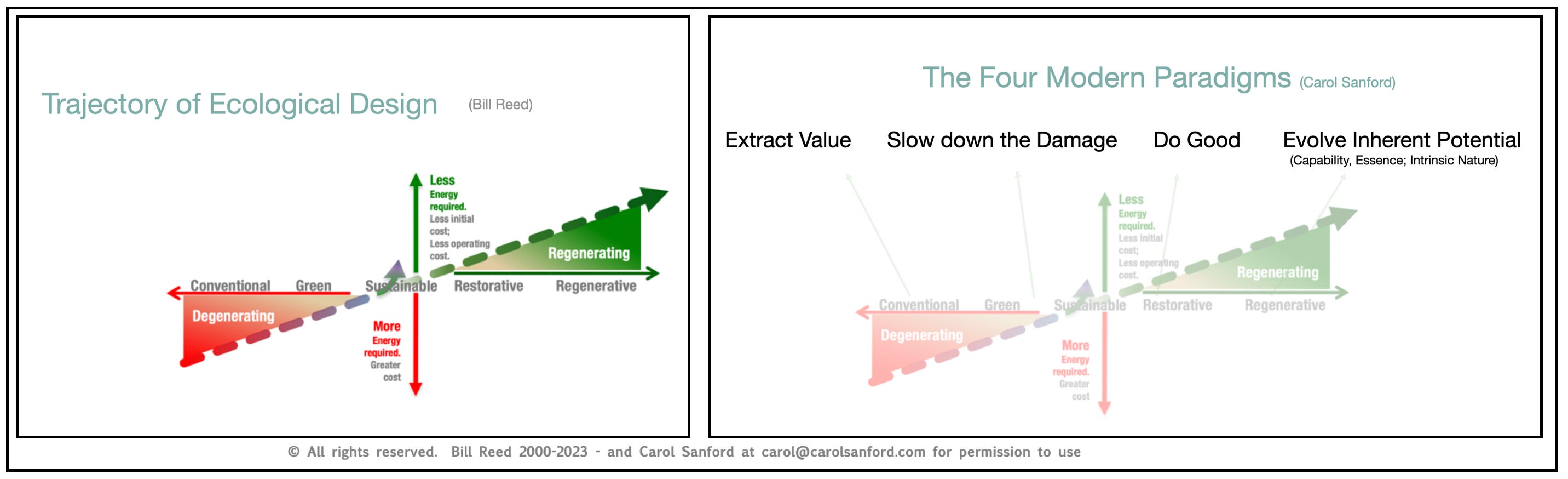
Bill Reed and Carol Sanford Paradigms.
Today I left Buenos Aires at dawn, climbed through the morning haze, and now sit in São Paulo during a four-hour layover on my way to Bahia, waiting for the late-night hop to Ilhéus. Around me, families rearrange luggage, business travelers negotiate delays, and airport speakers echo the small anxieties of modern life. And yet here, in this corridor between departure and arrival, I feel a quiet clarity surface — the kind that rarely shows up in ordinary days, where responsibilities, conversations, and the thousand textures of life demand their due.
Airports give me permission to be still while everything moves.
To observe without needing to intervene.
To think without being carried by the momentum of a schedule.

Photo by Brett Sayles: Pexels
And maybe that’s why
‘s The Truth About Collapse Acceptance hit me so deeply when I read it somewhere between the passport queue and the boarding gate. His words opened a door I didn’t know I had been walking past, a door into a part of myself that has been trying — gently, insistently — to speak.Traveling offers these sudden apertures.
A sentence lands differently.
A truth you weren’t ready for becomes undeniable.
A worldview you thought was stable begins to loosen its seams.
Lambert gave language to something I had been living but not naming: that the collapse we speak about in systems and ecology is also an interior event. A psychological unravelling. A shedding of a worldview that once held us. And as I watched the planes taxi outside the window, I realised that this entire journey — from Buenos Aires to São Paulo to Bahia — is taking place not just in geography, but in the etymology of my own thinking.
So while I wait for my next flight, in this strange geography of nowhere, I’ve begun weaving the reflections that follow. They arrived with the stillness of a layover, the intensity of a long travel day, and the spaciousness that airports sometimes grant those who are willing to pause.
What you will read over the next three articles is the result of this passage through non-place:
the clarity that comes when we step outside the stories that normally hold us, and the courage to look at the deeper truths emerging beneath them.
These pages are an offering from that threshold.
What You Will Find in This Three-Part Journey
Part I — The Architecture of Paradigms
A brief map of the five paradigms and the archetypes they awaken — a journey through the belief-structures that shape our identity, and the quiet inner deaths required to cross from one worldview to the next.
Part II — Why the Old Paradigms Cannot Hold
A clear-eyed look at why our inherited worldviews — Conventional, Green, Sustainable — collide with a finite planet. Breached boundaries, energy limits, and the cultural myths that make decline unavoidable.
Part III — The Inner Crossing
An intimate exploration of what happens when a paradigm dies inside you — the grief, the solitude, the unlearning — and how collapse acceptance, illuminated by Adrian Lambert, becomes the threshold to a regenerative self. Link to Part III
Part I: The Five Paradigms: The Architecture of a Dying and Emerging World
There are moments in history when the world does not simply change — it sheds a skin.
And when it does, the shedding happens first inside us before it ever shows up on the surface of civilization.
Today, as the old world begins to creak under the weight of its own assumptions, we are being asked — quietly, insistently, and often painfully — to confront the architecture of the paradigms that built us. And perhaps more importantly, to confront the parts of ourselves built inside them.
Bill Reed and Carol Sanford call these paradigms — not strategies, not ideologies, but the deep, often invisible scaffolding of belief, meaning, identity, and purpose that shape how we see the world and how the world sees itself through us.
And once you understand these paradigms, you understand why so many of us feel a subtle but increasing dissonance in our bones today. The ground is shifting — not only beneath our feet, but beneath our assumptions, our identities, our hopes, and the stories we once knew how to tell.
The Paradigm Is the Story That Makes You Possible
A paradigm is the cultural DNA we rarely notice.
It is a choreography of beliefs, meanings, and unconscious commitments that instruct us:
what a “good life” means,
what progress looks like,
what success requires,
what nature is “for,”
and who we are allowed to become.
A paradigm is not a lens.
It is a womb.
It shapes the self who can emerge from it.
Reed and Sanford describe five paradigms that characterize the evolution of human consciousness in relation to the world:
Extractive — The world as resource.
Green/Optimizing — The world as system to improve.
Sustainable — The world as something to protect.
Restorative — The world as something to heal.
Regenerative — The world as partner in co-evolution.
These five paradigms are not philosophical categories. They are identity structures.
They shape not only how we act, but how we are.
Building on Reed and Sanford, I have found that each paradigm awakens a distinct interior archetype¹:
The Extractor
The Optimizer
The Sustainer
The Restorer
The Regenerator
These are not roles.
They are developmental characters — each carrying a worldview, an emotional center of gravity, and an invisible contract with reality.
And the remarkable thing is that you cannot fake a paradigm.
You cannot pretend to be a Regenerator while thinking like an Extractor.
The world knows.
Your body knows.
Life knows.
The Extractive Super-Paradigm: Three Different Masks, One Single Logic
The first three paradigms — Conventional, Green, Sustainable — seem very different on the surface.
But at their core, they share a single super-paradigm:
Extraction.
Conventional: Take without apology.
Green: Take more politely and efficiently.
Sustainable: Take less, but keep taking.
Carol Sanford describes these first paradigms with two stark expressions:
Extract Value and Slow Down Damage.
The world becomes a resource, a warehouse, a set of parts to manage.
Even sustainability — our once-sacred ideal — functions as a life-support system for the old worldview.
It does not usher a new world.
It extends the dying one.
These paradigms can upgrade your moral posture.
They cannot upgrade your ontology.
And ontology — the deep structure of “what is” — is ultimately what shapes civilization.
The Moment You Realize the Old Paradigm Is Dying
If you’ve ever felt the quiet, disorienting sensation that the stories of “progress” no longer feel true…
If you’ve noticed that “growing the economy” sounds less like common sense and more like superstition…
If you’ve wondered why “saving the planet” feels increasingly hollow and impossible…
…you already know the sensation of a paradigm shaking inside you.
This is not burnout.
This is not disillusionment.
This is the beginning of paradigm death.
The old story no longer holds you.
You cannot pretend the Extractor is still alive in you.
You cannot sustain enthusiasm for optimizing a system that is unravelling.
You cannot believe that “sustainable” is a destination instead of a pause between breaths.
A paradigm shift begins when your body stops believing what your mind continues to recite.
When the self shaped by the old worldview begins to fade.
When life taps you on the shoulder and whispers:
“Dear one… this story is too small for you now.”
The Death of the Old Identity
We often imagine paradigm shifts as intellectual upgrades.
But here is the truth:
A paradigm shift is a death.
A death of the identity built inside the previous paradigm.
The Extractor identity dies first.
Then the Optimizer, with its polished efficiency and cleverness.
Then the Sustainer, clinging to noble efforts and moral clarity.
Each death takes something from you:
the certainty of what success means,
the comfort of belonging to the mainstream narrative,
the emotional shelter of believing that the future is an extension of the past.
Each death is a kind of mourning.
You lose the worldview that once gave your life shape.
You lose the inner architecture that buffered you from existential fear.
You lose the symbolic self you spent a lifetime constructing.
This is not a conceptual evolution.
It is a psychological and spiritual dismemberment.
And it happens quietly — without applause, without ceremony, without guidance.
When Sustainability Dies Inside You
One day, you realise that sustainability — the moral plateau of the old world — was never an endpoint.
It was a hospice.
You realise that restoring ecosystems is not enough if the extractive super-paradigm still governs our politics, our economies, and our perception of reality.
You realise that the only paradigm capable of matching the complexity, fragility, and beauty of the living world is the fifth one:
Regeneration — Living Systems Stewardship.
And this realisation is not a triumph.
It is a surrender.
Because to enter the regenerative paradigm, you must first bury the parts of yourself that were shaped by the previous ones.
You cannot optimize your way into regeneration.
You cannot sustain your way into regeneration.
You cannot even restore your way into regeneration.
You must become something else.
The Bridge That Isn’t Enough
The Restorer — the archetype of Paradigm 4 — arrives with beauty, courage, and sincerity.
It tries to repair, heal, mend, and patch the torn fabric of life.
But here is the tragedy:
Restoration alone cannot counterbalance the gravitational pull of the three extractive paradigms that dominate the global psyche.
A garden planted in the middle of a burning city is beautiful.
It is necessary.
But it cannot extinguish the fire.
Restoration is a bridge.
But not the destination.
The real destination — Paradigm 5 — requires a deeper surrender.
It requires letting go of the worldview that created the damage in the first place.
Regeneration: The Paradigm That Outlives Collapse
The Regenerative paradigm is the only one that aligns with the operating system of life:
reciprocity
nestedness
potential
co-evolution
aliveness
essence
developmental growth
This paradigm teaches that humans are not managers of nature but participants in her unfolding.
Not controllers, but kin.
Not owners, but stewards.
Not dominators, but designers of coherence in partnership with living systems.
In this paradigm, the question is no longer:
“How do we sustain the world we built?”
It becomes:
“How do we build the kind of self that the future needs?”
Regeneration is not a technique.
It is an identity.
A way of perceiving.
A way of being lived by life.
And the transition into it is not smooth.
It demands sacrifice:
the death of your old identity,
the loss of your old belonging,
the dissolution of your old narrative.
But what emerges is honest, humble, and deeply alive.
A new self shaped not by extraction, but by participation.
Not by mastery, but by reciprocity.
Not by survival, but by service.
The New Story Emerging
There is a story waiting on the other side of the paradigm boundary — a story in which humanity evolves not by conquering nature, but by returning to it.
A story in which:
the soil becomes a teacher again,
water becomes a relative,
community becomes wealth,
and meaning is measured not in GDP but in aliveness.
A story in which human intelligence is not defined by our ability to control, but by our ability to be in relationship.
This is the story of the fifth paradigm.
This is the story of regeneration.
This is the story of becoming fully human again.
upcoming soon, Part II — Why the Old Paradigms Cannot Hold
FootNotes:
¹ You may notice that the names used in the visual diagram (originally published in this article) above differ slightly from the archetypes described in the article. This is intentional. We are still in the process of refining the exact naming for each stage of ecological consciousness. The visual representation explores alternate titles — such as “The Exploiter,” “The Optimizing Reformer,” and “The Well-Intentioned Manager” — to invite broader reflection and resonance.
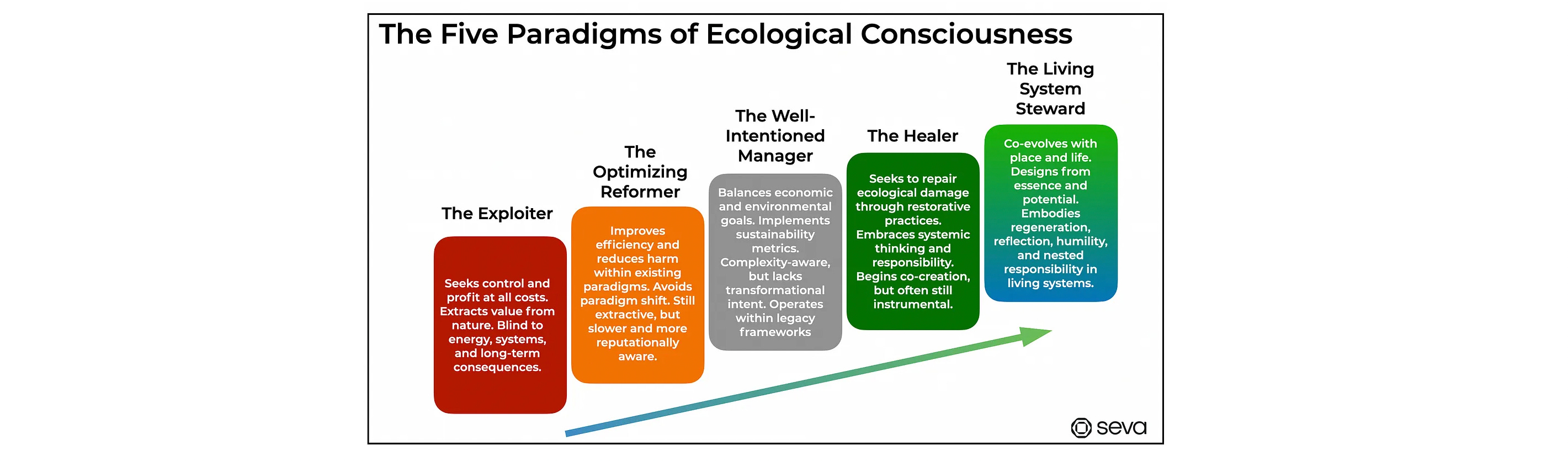
The written essay stays closer to the root archetypes as they emerged from our design conversations. But the essence remains the same: each paradigm reflects a worldview, a way of relating to nature, and a threshold of consciousness. As language evolves and our understanding deepens, so too may the labels we use. What matters is the directional arc — the journey from extraction toward
Thank you for this article Ernesto!
Thank you Ernesto 🌿