
What Pulls the Future Into Being
The regenerative mindshift is not, finally, a change in what you think. It is a change in what you are capable of sensing.

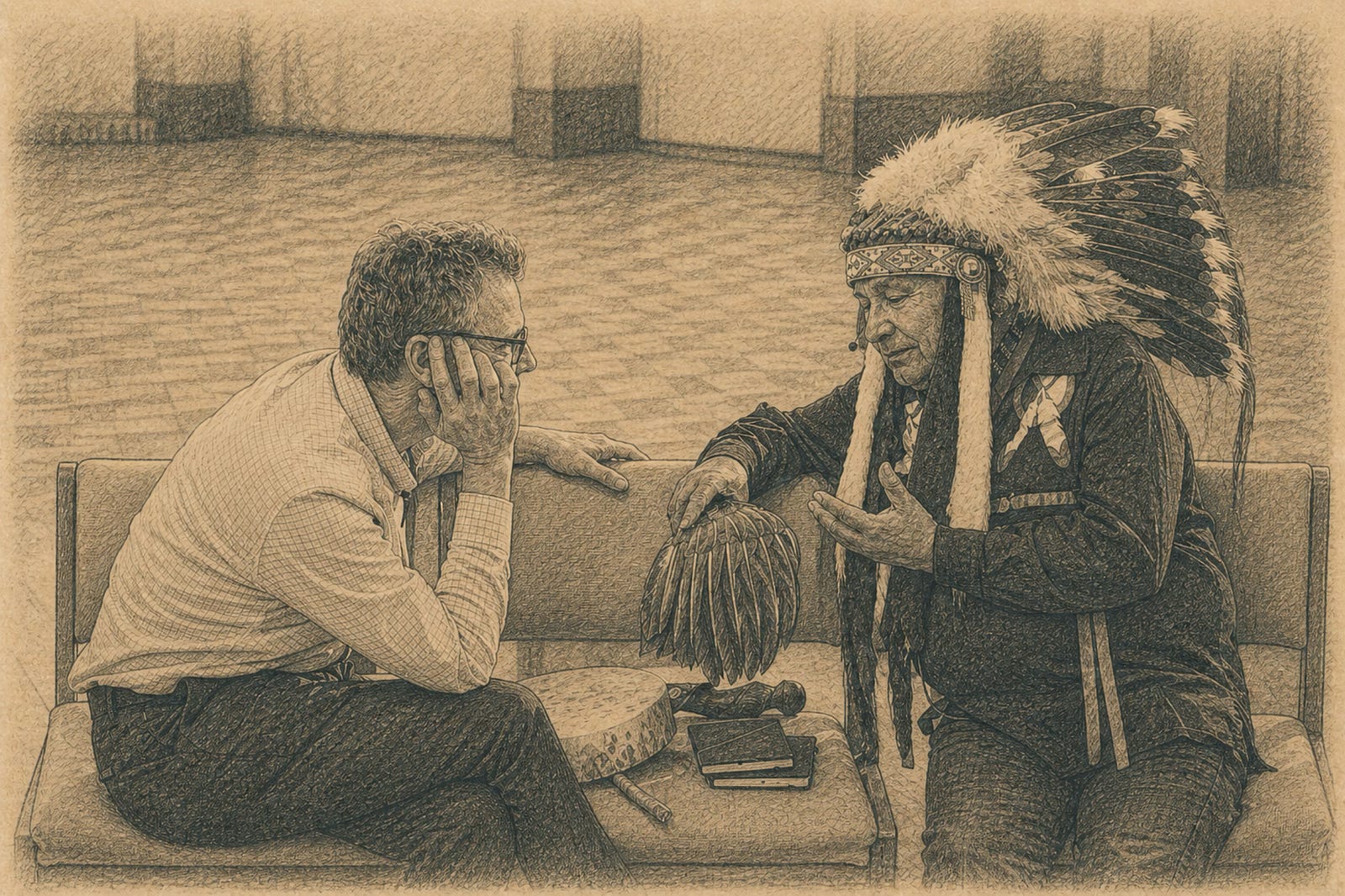
Grandfather Dominique Rankin and I sit across from one another, yet in a deeper sense we are facing the same horizon. As an Indigenous elder, he carries the memory of a coherence once lived — an ancient understanding of reciprocity, belonging, and relationship with the living world that modernity largely suppressed. As a regenerative practitioner, I am searching for a coherence not yet fully realized within contemporary systems. One remembers. The other anticipates. Yet both point toward the same attractor. In the deeper field where past and future coexist as possibility, our conversation felt less like an exchange of ideas than the recognition of a shared signal arriving through different paths of time.
The Future Has Gravity
There is a question I used to ask backward. I used to ask: how do we build the future we want? I assumed the future was something to be constructed — assembled from better policies, better technologies, better institutional designs. The metaphor was always architectural. We draw the plans, we source the materials, we build the structure. Progress is the gap closing between the present and the intended design.
I no longer think that metaphor is adequate. Not because building is unimportant — it is essential. But because the architectural metaphor assumes that the future is passive. That it waits to be imposed upon. That it has no pull of its own. And what I have come to believe, through years of watching regenerative systems come alive and through an unexpected encounter with the implications of quantum physics, is that some futures are not passive at all. Some futures are already calling.
The question I now ask is different: what attracts possibility into manifestation? What is the force — if force is even the right word — that draws certain latent patterns out of the field of the potential and into the fact of the actual? And what does it mean, for those of us trying to participate in civilizational transition, to align with that force rather than simply push against the inertia of the present?
What quantum mechanics quietly suggests about time
The quantum realm does not behave the way our ordinary experience of time suggests it should. In classical physics, causation flows in one direction: past events produce present conditions, which produce future states. The arrow of time points forward, and only forward. The present is shaped by what has already happened.
Quantum mechanics is stranger than that. At the level of fundamental particles, certain interpretations of the mathematics — not fringe interpretations, but serious ones debated by serious physicists — suggest that the boundary between past and future is more porous than it appears. Some quantum processes appear to be influenced by boundary conditions that include the future state, not only the past state. The particle doesn’t just carry forward a history. Under certain readings, it also responds to a destination.
I want to be careful here, as I always am when the physics starts to feel too convenient for the philosophy. These are contested interpretations. The science does not simply hand us a metaphysics. But it does something important: it holds open a door that classical physics had closed. It restores the possibility that the present moment is not only pushed by the past but also, in some sense, pulled by what could become. That the future is not only an empty space we move into but also a field of already-existing possibility that exerts something like a gravitational influence on what happens now.
In the quantum realm, there is no time, no space as we experience them — only a field of probability in which all possibilities coexist until observation collapses them into the actual.
Which means that ancient wisdom and future possibility are not separated by the distance we imagine. They are, in some sense, neighbors. Both exist in the same dimensionless field of potential. Both are available to the observer who knows how to reach them.
“The regenerative observer becomes sensitive to signals arriving from both directions of time — from the deep past as accumulated wisdom, from the deep future as unrealized potential.”
The centripetal force — life’s tendency toward wholeness
In physics, gravity is a centripetal force: it does not push matter outward, it draws matter inward, toward centers of mass, toward coherence. Without gravity, the universe would be a dispersing fog. With it, matter organizes into stars, planets, galaxies — structures of increasing complexity and relationship.
Something analogous appears to be at work in living systems. Not a physical force, but an organizing principle — a centripetal tendency toward greater complexity, greater consciousness, greater coherence, greater relationship. Look at the four-billion-year trajectory of life on this planet. A single replicating molecule becomes a cell. A cell becomes a multicellular organism. An organism becomes part of an ecosystem. Individual consciousness becomes culture, language, accumulated wisdom, the capacity to ask questions about the origin of everything. At each transition, the units of the previous level do not disappear. They become participants in a larger wholeness that was not possible before.
This is not progress in the triumphalist sense. It does not mean life moves only upward, or that every turn of evolution is a gain. Extinction is real. Collapse is real. The centripetal tendency is not a guarantee; it is a tendency, a pull, a recurring pattern across deep time. But the pattern is there. Life keeps moving, when the conditions allow it, toward more elaborate forms of relationship. Toward more consciousness. Toward more interbeing.
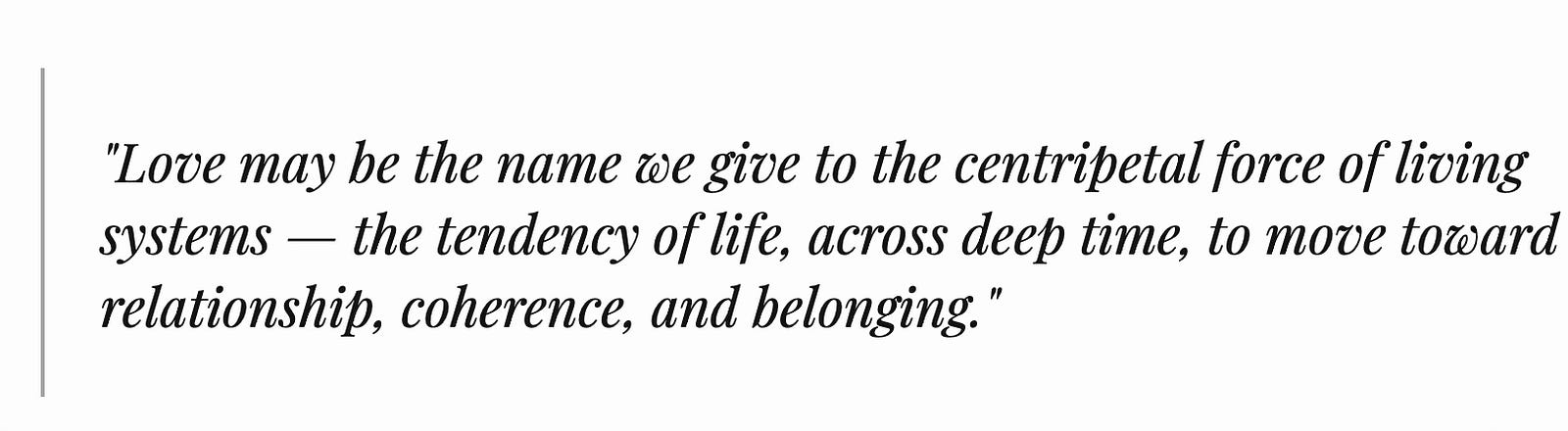
I want to give that tendency a name, even while knowing the name will be imprecise. The name I reach for is love — not as sentiment, not as emotion in the narrow personal sense, but as the fundamental organizing principle that draws toward wholeness, belonging, coherence, and relationship. What we call love in human experience may be our most direct, embodied encounter with the deepest physical and biological tendency of the universe. The pull toward union. The pull toward the part becoming something larger than itself. The pull toward belonging.
If that is true, then love is not merely a human feeling. It is the centripetal force of living systems. And the regenerative movement, in its deepest impulse, is not a social movement or a design movement or an economic movement. It is an attempt to align human civilization with that force — to stop resisting the pull toward wholeness and begin participating in it.
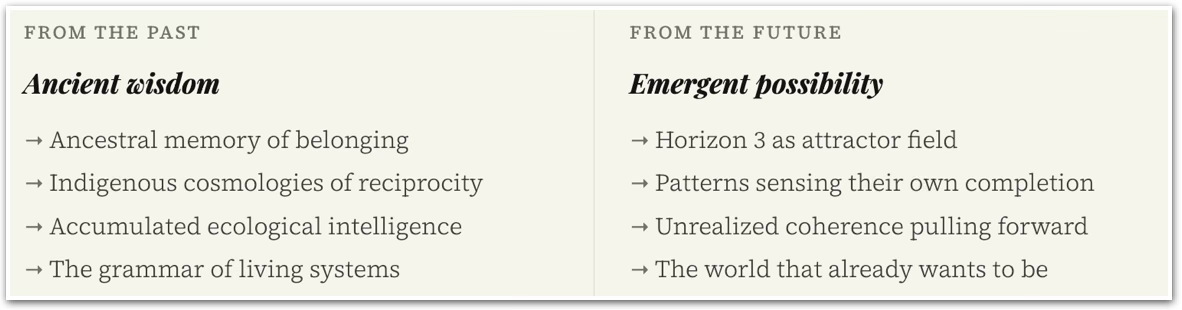
In the quantum field, past and future are not separated by time — they are neighbors in the same dimensionless field of possibility. The regenerative mind learns to live at their intersection.
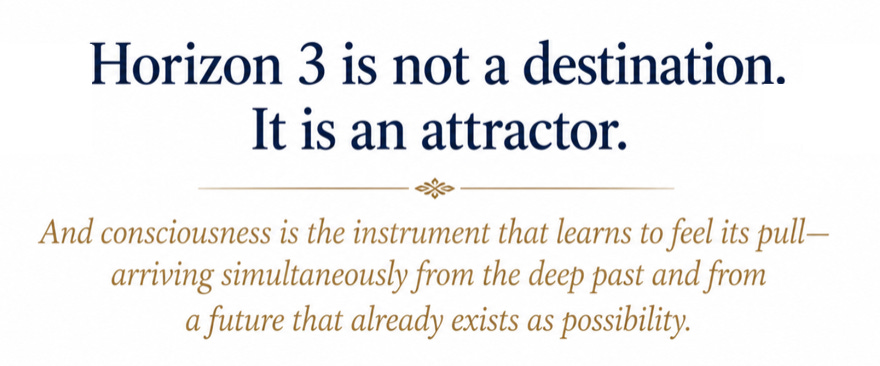
Horizon 3 is not a destination — it is an attractor
This reframes something fundamental about how we understand civilizational transition. Most representations of the Three Horizons framework — the framework I described in the previous essays — present Horizon 3 as a future state. A place we are trying to get to. A vision of the world as it could be, projected forward on the timeline, marking the destination toward which Horizon 2 work is straining.
I want to propose something different. Horizon 3 is not primarily a future state. Horizon 3 is an attractor. It already exists — not as an institution, not as an economy, not yet as a stable civilization, but as a pattern. As a latent coherence. As a field of possibility that is already exerting a pull on the present. The people capable of perceiving Horizon 3 are not inventing it. They are sensing it. They are, in the language of the astronomer, observing a star whose light is already traveling toward them, even though most of the people around them cannot yet detect the signal.
This distinction has consequences. If Horizon 3 is a future state, then our work is fundamentally constructive: we assemble it from parts, we engineer its conditions, we project it forward and then close the gap.
If Horizon 3 is an attractor, then our work is fundamentally receptive as well as generative: we attune ourselves to the pull, we remove the obstacles that prevent it from manifesting, we cultivate the quality of observation that allows us to sense the pattern already present in the field of possibility — and then we act from what we have sensed.
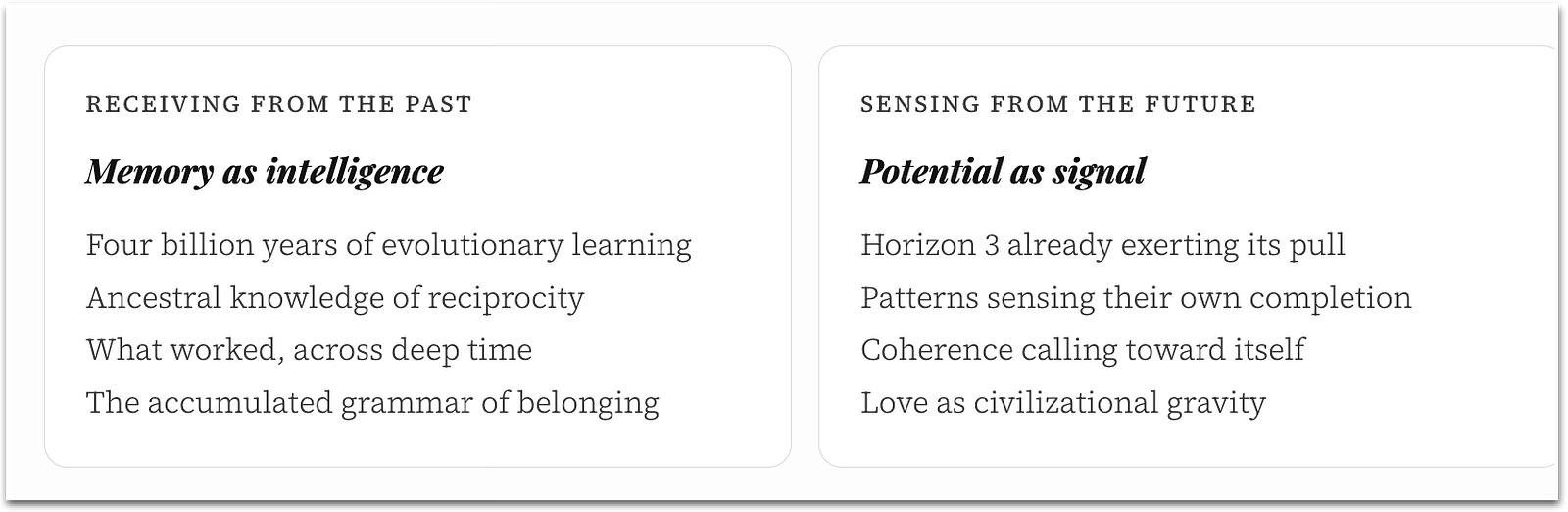
This is also why so many Indigenous traditions feel strangely contemporary to people working in regenerative thought. It is not coincidence. It is not nostalgia dressed as innovation. It is because those traditions and these emerging practices are, in a very real sense, responding to the same attractor from different temporal positions. The Indigenous elder remembers a coherence that was once manifest and has been suppressed. The regenerative practitioner anticipates a coherence that has not yet been fully realized. Both are pointing toward the same thing. One remembers it. The other anticipates it. In the quantum field, where time is not the barrier it appears to be at ordinary scales, they may be receiving the same signal.

Consciousness as the bridge between both directions
The regenerative mindshift, understood this way, is not simply a change in ideas or practices. It is a change in the temporal structure of consciousness itself. The mind trained by extractive civilization is almost entirely oriented toward the recent past and the immediate future — toward what has worked in the last quarter, what the model projects for the next year, what the competitor did last month. Its temporal range is narrow. Its receptivity to signals from deep time — from either direction — is correspondingly limited.
The regenerative mind learns to extend its temporal range in both directions simultaneously.
Backward: into the accumulated intelligence of evolutionary time, into the cosmological depth from which every present moment emerges, into the ancient wisdom of cultures that lived in sustained relationship with the living world.
Forward: into the attractor field of what wants to become, into the signals arriving from a coherence that already exists as possibility even before it exists as fact.
This is not nostalgia, and it is not utopian dreaming. Both of those are single-directional — one looks only backward, the other only forward. What I am describing is something different: a consciousness that holds both streams simultaneously, that listens to what has been and what wants to be at the same time, and acts from the intersection of those two kinds of knowing. A mind that has learned to occupy, however briefly and imperfectly, the position of the quantum observer standing in the dimensionless present where past and future are not opposites but neighbors.
When ancient wisdom and emergent possibility enter into genuine conversation — when memory and imagination begin to inform each other rather than compete — something becomes available that neither direction alone can provide. A kind of orientation. A sense of both rootedness and direction. The confidence to act not because you have certainty about outcomes but because you can feel, with some precision, the pattern you are participating in.
What calls us, and how we learn to hear it
I want to be honest about the difficulty of what I am pointing at. The capacity to receive signals from deep time — from both directions — is not a technique. It cannot be learned in a workshop or installed through a framework. It develops through the kind of long, patient, often uncomfortable practice of becoming genuinely present: present to the intelligence of a specific place, present to the grief of what has been lost, present to the quiet insistence of what wants to grow, present to the accumulation of living systems’ wisdom encoded in soil and seed and watershed and the oral traditions of people who stayed close to the land.
It also requires the quality of observer we discussed in the previous essays — the alignment with essence, the coherence between what you most deeply are and how you act in the world. Because the signals from both directions of time are not loud. They are not the signals of urgency or alarm or ambition, which tend to dominate a fragmented attention. They are quieter than that. They require an observer who has become still enough, coherent enough, present enough, to feel a pull that most of the noise of ordinary civilization is specifically designed to drown out.
This is why the regenerative mindshift is not, finally, a change in what you think. It is a change in what you are capable of sensing.
The attractor that is Horizon 3 — the pull of wholeness, reciprocity, and belonging that I am calling love — does not become perceivable through argument alone. It becomes perceivable through a gradual expansion of the observer’s range, a progressive alignment of the self with the patterns that life itself has been elaborating across four billion years of accumulated intelligence.
The electron collapses a possibility into actuality through the simple act of interaction. The regenerative observer does something analogous — but not through passivity. Through the active discipline of becoming someone through whom the pull of the future can actually land. Through learning to hold both the memory of what belonging once felt like and the anticipation of what it is still trying to become. Through the practice of being present enough to the living world that the living world can speak — and then having the courage to act from what you have heard.
If this article resonated with you, consider subscribing — or even better, becoming a paid subscriber — to help sustain and expand this work. Your support allows these conversations to reach further, nurturing the awakening, awareness, and acceptance that may help us move from isolated insight toward a shared, collective consciousness.
Reading this, I found myself reflecting on the importance of holding both memory and possibility at the same time. So much of the work of regeneration seems to require exactly that, honoring the wisdom carried through cultures, communities, and living systems while remaining open to what is trying to emerge.
What resonates for me is the idea that the future is not something we simply build through effort and planning alone. There is also a quality of listening involved. Listening to place, to relationship, to the lessons of the past, and perhaps even to possibilities that have not yet fully taken form.
Whether described through Indigenous wisdom, systems thinking, or regenerative practice, I keep returning to the same insight: meaningful change begins when we shift from seeing ourselves as separate from the larger living system to understanding ourselves as participants within it.
Thank you for this thoughtful reflection. It left me considering not only what kind of future we hope to create, but what kind of observers we must become in order to recognize it.
This piece touches something important: the regenerative shift is not only conceptual, but perceptual. Before different systems can be built, different signals have to become available to us.
The line that stays with me is the idea of the observer becoming sensitive to deep past and deep future at the same time. Memory and possibility. Rootedness and direction.
The question I find myself sitting with is: how does that sensing become accountable?
If Horizon 3 is an attractor, and some people become sensitive to its pull earlier than others, then the next design question is not only how to listen. It is how to keep listening from becoming authority.
How does private signal become shared practice?
How is intuition tested by relationship?
How does the field protect itself from charisma, projection, ego, or false certainty?
The signal may arrive through an observer, but it cannot belong to the observer.
Perhaps the regenerative observer needs a regenerative field around them: one that can receive the signal, practice it, verify it, correct it, remember it, and prevent the one who sensed first from becoming the owner of the future.