
Winter Has Arrived
When climate, energy and geopolitics stop being separate stories

Part One
Five weeks ago I published an essay called Winter Is Coming. I meant it as a warning about a condition, not a prediction of catastrophe — the way an old farmer reads the sky before the storm and says nothing, because language is too slow for what she already knows in her bones. The clouds had shifted. That was all I could honestly claim.
I am writing again because the tense has changed.
The screens still say the world is fine. Markets hover near record highs. Supermarkets are full, flights depart, credit moves, ships sail. From every window through which our civilization observes itself, the light looks ordinary. But beneath those abstractions runs another economy — the economy of molecules. Oil moving through narrow waterways. Diesel leaving refineries. Natural gas becoming ammonia, ammonia becoming nitrogen, nitrogen becoming grain, grain becoming bread. And that economy has begun to tighten in a way the screen cannot see.
I spent twenty years in investment banking and private equity learning to find where value hides before the market notices — where a trend is bending, what is about to become scarce, where yesterday’s assumption is still priced into today’s number.
Then, about a decade ago, my question changed. I stopped asking only where is the trend going? and began asking what is connected to what?
It sounds like a small shift. It is not. The financial mind isolates variables until they are clean enough to model. The living world does the opposite: it refuses to let the variables stay apart. A forest cannot be understood by counting its trees, because most of what makes it a forest lives between the things we count — the fungal threads, the moving water, the exchange of nutrients, the shade that holds moisture. Take the relationships away and you have a lumberyard. Leave them intact and you have something alive.
Our economy is no different. And what I have watched arrive these past weeks is not a single crisis but a set of relationships tightening at once.
The signals have begun to connect.
A strengthening El Niño — which the World Meteorological Organization now warns will intensify further from August — is emerging into an ocean that never cooled between the last warm phases. The forecast is not merely for a strong event, forecasters putting the odds of a “very strong event”, possibly unprecedented one: the middle of the model ensemble sits at or above the all-time record, with an expected peak near 3.6°C in the Niño 3.4 region — the central equatorial Pacific whose temperature largely determines whether the world experiences El Niño or La Niña. To feel the weight of that number, consider that in a century and a half of observation no El Niño has meaningfully passed 2.73°C — the level of the 1877–78 event, which helped trigger famines across three continents. This one is arriving into a hotter world than that.
Three of the planet’s great maritime arteries, the Black Sea, the Red Sea, and the Persian Gulf through the Strait of Hormuz, are no longer abstract vulnerabilities; they have become a persistent architecture of conflict.
Refineries have been damaged. Diesel markets have tightened. Fertilizer supply has become increasingly vulnerable as natural gas, refining capacity, and geopolitics converge.¹²³
Roughly a third of the world’s traded urea and close to half its seaborne sulfur once moved through Hormuz, and much of it has been delayed or rerouted. Grain routes are threatened at precisely the moment the climate is destabilizing the harvest.
Each of these, alone, the system could absorb. That is the point everyone keeps missing. The danger was never El Niño alone, or Hormuz alone, or diesel alone. The danger is that they have stopped being independent. And systems do not fail one variable at a time. They fail through relationships.
But I want to be precise about the shape of that failure, because the precision matters. It is tempting to describe it as a closed loop, as if climate volatility were somehow caused by political instability, each feeding the other in a perfect circle. That is not what is happening, and it is not what I mean. The truth is harder to argue with, and darker.
It is not a loop. It is a ratchet.
Follow the system. Climate volatility lands on farms that depend upon precisely timed rain. The farms encounter fertilizer that has become expensive — or simply unavailable — because natural gas becomes ammonia, ammonia becomes nitrogen, and that same gas is caught inside the geopolitical tensions constraining diesel and energy markets. Tractors need diesel. Fertilizer production needs gas. Harvests depend upon both.
As food prices begin to rise, governments do what governments almost always do: they protect their own people. Exports are restricted. Strategic inventories are released. Countries begin securing supply before others do. Global markets tighten. Prices rise further. Importers start hoarding. Fiscal support expands to cushion households from the shock. Public debt grows. Political temperature rises with it.
Capital responds in the only way it knows how. It moves toward security. But security itself is extraordinarily material-intensive. It demands more steel. More copper. More concrete. More energy. More industrial capacity. It competes for precisely the same physical resources already becoming scarce.
The result is not a perfect circle. It is a spiral — or, more accurately, a ratchet.
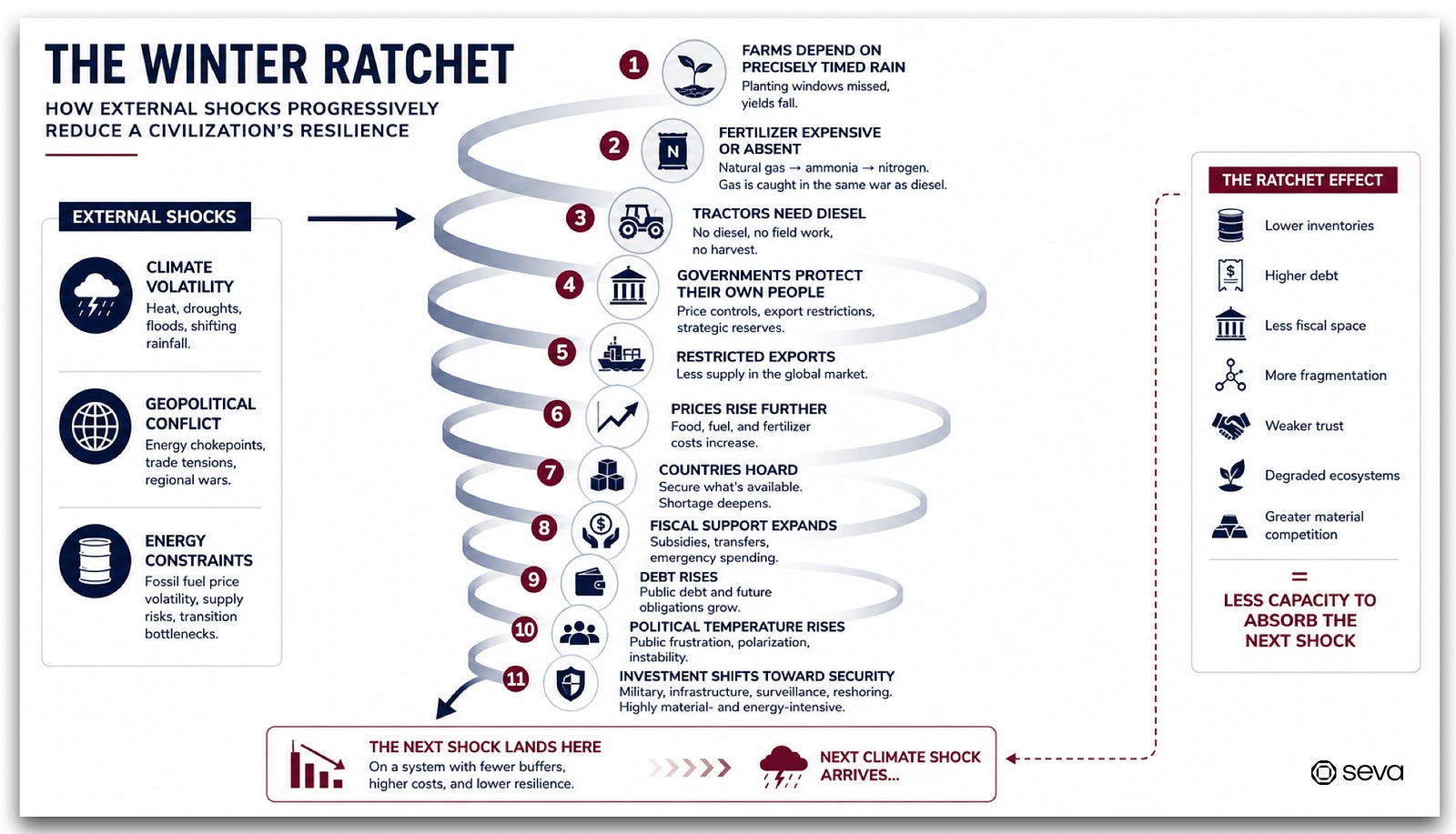
The climate shock eventually passes. Supply chains recover. Markets stabilize. The headlines move on. But the system does not return to where it began. Inventories are lower. Debt is higher. Trust is weaker. Fiscal capacity is thinner. Biological systems have endured another season of stress. Another layer of complexity has been added simply to preserve normality. Then the next climate shock arrives — not into the world that existed before, but into a world with fewer buffers.
Climate volatility is not caused by the instability around it. Each shock simply lands on a system that the last shock already made less able to bear it. That is the ratchet. It only turns one way.
And here is where the abstraction becomes concrete, because the ratchet is already visible — not in GDP, not in the stock market, but where these things always appear first: in inventories ⁴.
In Moldova, commercial diesel stocks fell from the equivalent of more than seventeen days of consumption at the end of June to fewer than seven by late July, and the government declared a thirty-day national state of alert as roughly one in ten filling stations ran dry.
Myanmar imposed nationwide rationing, down to odd-and-even license plates.
Russia — one of the world’s largest diesel exporters — suspended its own diesel exports after Ukrainian drones knocked its refineries offline.
These events are geographically unrelated. Yet they express the same underlying phenomenon. The physical economy is becoming tighter. Winter is not arriving everywhere at once. It is arriving unevenly. But it is arriving.
And notice where it arrives first. Not in the countries that caused the shock, but in the ones least able to outbid the others for a scarce cargo.
In March Ethiopia has watched its daily diesel supply fall by roughly half. Even Australia — a wealthy country — has had hundreds of service stations run dry. This is the cruel grammar of the ratchet: the shortage does not distribute itself according to need. It distributes itself according to purchasing power, and it reaches the edges of the system long before it reaches the center. By the time the shortage is visible from the comfortable rooms where policy is made, it has already been lived, for months, by everyone downstream.
And beneath the visible economy lies another one, almost invisible. The natural gas burned today to keep factories running, homes heated and power stations operating is the very same natural gas that tomorrow becomes ammonia, and then nitrogen fertilizer, and eventually bread. We imagine we are consuming energy. In reality, we are also consuming future fertility. Every molecule burned today is one less molecule available to sustain next season’s harvest, unless the system can replace it. We are not simply spending fuel. We are drawing down tomorrow’s productive capacity to preserve today’s normality.
Winter does not begin when something breaks. It begins when we start financing the present with the resilience that was meant for the future.
Here is what I most want to say, and it is the hinge of the whole thing.
The screen has been lying — or rather, showing one slice of reality while the physical world followed its own grammar.
We built a civilization on the belief that money summons matter. That price always calls forth supply. That if something runs short we simply pay more, and the world obediently appears behind the transaction. For forty years it worked, because whenever the physical world resisted, inventories absorbed the shock. Whenever inventories tightened, governments opened reserves. Whenever markets trembled, liquidity appeared.
But inventories are not production. They are stored time — yesterday’s surplus waiting in tanks, caverns and silos so tomorrow’s disruption can be absorbed before anyone has to feel it. And stored time eventually runs out.
We did not eliminate the fragility. We spent part of our accumulated resilience surviving the warning. The orchestra is playing again, but the hull still bears the scars.
And this is the misconception hiding underneath the whole conversation about oil. We keep asking about crude — how many barrels are being produced, how full the fields are. That is increasingly the wrong question. Civilization does not eat crude oil. It does not harvest wheat with crude oil. It harvests with diesel. Diesel is not merely another petroleum product; it is the working fluid of civilization — the fluid that moves combines, tractors, mining equipment, construction machinery, freight trucks, locomotives, ships, backup generators, military logistics, and the refineries themselves. The modern economy does not run on oil. It runs on refined products. And the bottleneck now is no longer geological. It is industrial.
Goldman Sachs has named diesel the epicenter of the constraint. Global diesel exports fell by roughly thirty-five percent in July — about 2.6 million barrels a day — while total refinery throughput ran some 5 to 6 million barrels a day below the previous year, as outages in Russia and the Middle East collapsed the supply of refined fuel even while crude kept moving through the system.
Crude continued flowing. Refining capacity did not. That distinction is everything. You can possess crude oil and still lack the capacity to turn it into the fuel your economy actually depends upon. A refinery destroyed by a drone cannot be replaced by another oil field.
You can read the whole story in a single number. The 3–2–1 crack spread — the standard measure of the difference between the value of refined products (primarily gasoline and diesel) and the crude oil from which they are produced — rose this summer above its previous record from 2022, climbing beyond US$60 per barrel.
That is an extraordinary signal. It does not mean the world suddenly needs dramatically more fuel. It means the world has become less capable of refining the crude it already produces into the diesel, gasoline and jet fuel on which modern civilization depends. The bottleneck is no longer simply oil. It is the industrial capacity to transform oil into function.
A record crack spread signals that the constraint is no longer crude oil, but the world’s ability to refine it into diesel and other fuels that keep the physical economy functioning.
It is a system failure made visible.
As one analyst put it, the market is rationing supply through price because it can no longer ration it through volume. And refined products behave differently from crude. A diesel shortage does not announce itself at the supermarket. It travels — first through transportation, then agriculture, then mining, then industry — so that by the time the shelves notice, the shortage has already passed through nearly every layer of the productive economy. That is why the market keeps mistaking the calm on the surface for the absence of risk beneath it. The screen whispers while the machinery shouts.
Jeff Currie, former long-time Global Head of Commodities Research at Goldman Sachs, put it more cleanly than I ever could in a recent conversation with Nate Hagens: “Crude is the noise. Products are the signal.”
You can print money. You cannot print diesel. You cannot print copper, or ammonia, or rainfall, or fertile soil. Money can mobilize the systems that produce these things — but only if the physical capacity exists, and only within the time the physical world requires. And the physical world keeps its own calendar, one that has nothing to do with markets.
A copper mine takes two decades from discovery to production. A refinery takes years. A degraded soil takes years to rebuild. But the farmer needs diesel next week, the crop needs nitrogen this month, and the household needs bread tomorrow morning. That gap — between financial time and biological time — is where winter deepens.
And copper, the most strategic metal of the AI era, is where the ratchet closes on itself most tellingly, because it exposes the deepest illusion of all: that our new economy has escaped the physical one. It has not. We were promised that intelligence would be weightless — software, clouds, models floating free of matter.
Instead, artificial intelligence has turned out to be one of the most physically hungry things we have ever built. A single AI-optimized data centre draws four to five times the electrical infrastructure of a conventional one, and data centres alone are on course to consume something like 475,000 tonnes of copper this year.
The IEA now projects a gap of roughly thirty percent between copper supply and demand by 2035. And the same copper is being asked to become, at the same moment, the transmission line, the electric vehicle, the defence system, the grid upgrade, and the data centre.
The response to scarcity — build more, secure more, electrify more — turns out to demand precisely the material the scarcity is making scarce. The snake begins to eat its own tail. This is not an argument against building. It is an argument that building is now a physical project bounded by physical limits, not a policy announcement bounded only by ambition.
I want to name a third kind of volatility here, because I think we have been missing it. We talk about climate volatility and geopolitical volatility. What Moldova and the diesel markets and the copper squeeze reveal is a third:
Operational volatility.
It is the moment a civilization begins to lose confidence that its essential physical systems — diesel, fertilizer, electricity, ports, shipping, rail, refining, logistics — will simply keep working. Not because they stop. Because they become unpredictable. That is a new category, and it is arriving.
Even the institutions built on the old grammar are beginning to feel it. When the head of the International Energy Agency, Fatih Birol, warned this summer that there is “no room for complacency on oil security amid the escalation in hostilities and a continued drawdown of available commercial inventories,” notice what word he reached for. Not climate. Not decarbonization. Security.
Even the IEA is now speaking the language of resilience. That is one of the quiet structural migrations happening beneath the surface of the economy: from optimization, to security, to resilience.
And this is where I need to name the deepest problem, because it is not diesel and it is not copper.
It is that the institutions asked to steer us through this cannot see it. Not because they lack data — they have more data than any civilization in history. Because their intelligence was shaped by the world that is disappearing behind them.
I think of Napoleon entering Russia in 1812. He did not lack maps, officers, logistics, experience, or a model of war that had won again and again. What he lacked was a correct understanding of the terrain he had entered.
He kept looking for the Russian army — find it, force the battle, win — while the real adversary was the landscape itself: the distance, the mud, the emptied cities, the horses dying for lack of forage, and finally the cold. He was prepared to defeat an army.
The system defeated him.
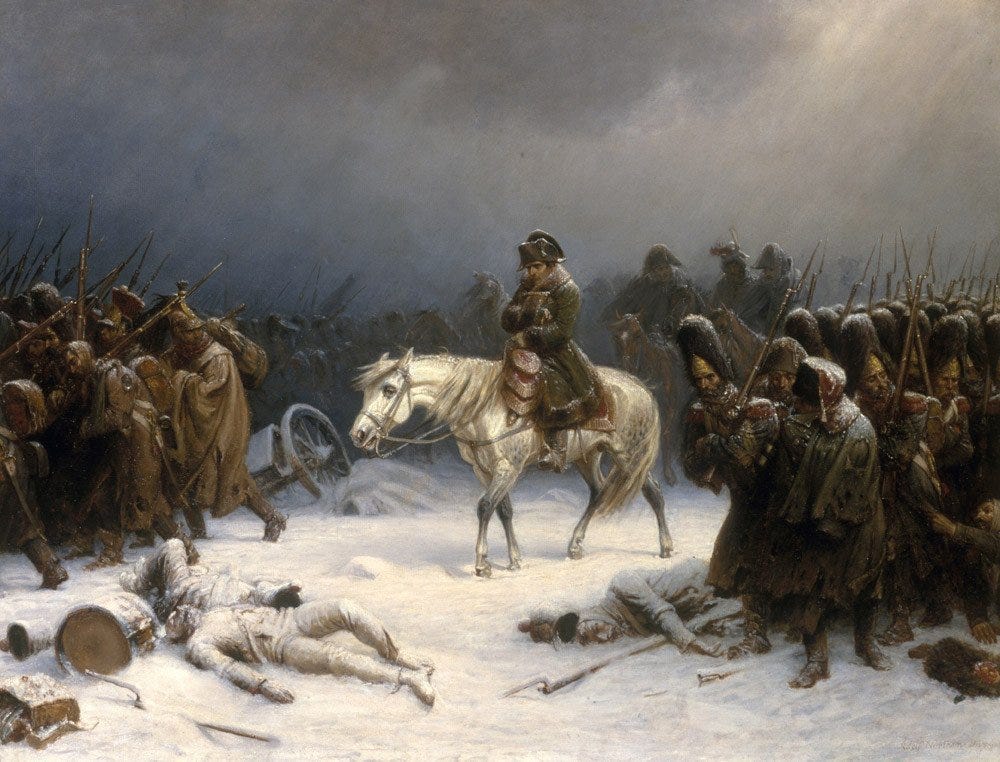
I increasingly wonder whether this is exactly where our institutions stand. We keep hunting the decisive variable. What will oil do? When will rates fall? Will the war end? When will Hormuz reopen? These are legitimate questions — and they are Napoleon asking where the Russian army is, while the terrain quietly closes around him.
The agricultural ministry watches crops. The energy ministry watches fuel. The central bank watches inflation. Each sees a part of the elephant. But the elephant is moving, and its movement is relational, so no single dashboard captures what matters most. Dashboards show variables. Systems emerge from relationships. There may be no dashboard for what happens when the diesel chart, the fertilizer chart, the drought forecast, the debt chart and the AI-electricity chart all belong to the same body.
This may be the defining governance challenge of our time. We have become extraordinarily capable of managing sectors, yet increasingly incapable of stewarding systems. Living systems do not recognize the divisions we have created between agriculture, energy, finance, ecology, and national security. They operate through relationships, feedback loops, and interdependence. Our greatest shortcoming, therefore, may not be a shortage of resources or technology, but a shortage of systemic perception — the ability to see how disturbances in one domain ripple through every other. Winter is not revealing a failure of expertise. It is revealing the limits of expertise when it is disconnected from the whole.
This is not simply an institutional problem. It is a cognitive one. Institutions can only perceive the world through the mental models that gave birth to them. When those models fit reality, they produce extraordinary progress. When reality changes, however, institutions rarely notice immediately. They continue interpreting a new landscape through an old map. The difficulty, then, is not that our leaders lack intelligence or expertise. It is that the very paradigms that made them successful were shaped by a world whose underlying conditions are beginning to disappear.
This is what living-systems people call Horizon One — the dominant system, so successful for so long that its assumptions stopped feeling like assumptions and began to feel like laws. Capital seeks return. Trade seeks efficiency. Price summons supply. Growth expands the future. These are not foolish ideas; they describe much of what actually happened. That is precisely what makes them dangerous. A bad model is easy to abandon. A model that worked for forty years becomes your identity. And when a successful paradigm meets a problem it cannot solve, its instinct is to reach for more of what made it successful — more efficiency, more scale, more optimization — even as those are the very reflexes that stripped the system of its slack. We optimized the Formula One car to perfection and then drove it onto a dirt track, and our response is to make the car faster.
Because here is the reversal winter forces. For forty years we priced efficiency and treated everything else as waste. Redundancy looked inefficient. Slack looked wasteful. A second supplier, a full warehouse, healthy soil, a diverse rotation, a strategic reserve, a community that trusts itself — all of it looked like idle capital, like an environmentalist’s concern to be dealt with after the real economic decisions were made.
But a system optimized for efficiency under stable conditions becomes extraordinarily fragile the moment conditions stop being stable. And in that moment, the things we filed under inefficiency acquire another name. They become resilience. The soil that holds water. The farm that needs less fertilizer. The region that can feed itself. The inventory that buys time.
What living systems have always called resilience, the market is about to start calling value. There is a Potawatomi word — puhpowee — the force that lifts a mushroom out of the earth overnight. It exists because a people paid close enough attention to the living world that they needed a word for a power science still cannot fully explain: the surge of life through matter, in the dark, invisible until the morning it is suddenly there.
I keep thinking of that word, writing about chokepoints and crack spreads and drawdowns, because the crisis arriving is not, at its root, financial. It is a crisis of perception.
For decades we believed the abstractions — the prices, the claims, the digits on the screen — were more real than the physical systems they were meant to represent. Energy is not a line item; it is the metabolic rate of civilization. Nitrogen is not a market; it is the quiet condition on which nearly half the world eats. Soil is not an input; it is a community of organisms ten thousand years in the making that cannot be restored on a quarterly cycle. Winter is the season in which the living world remembers this, and forces us to remember it too. The tree does not try to hold its leaves. It sends its energy down into the root. It invests in what will survive.
So let me say it as precisely as I can. I do not mean collapse is here. I do not mean famine is certain or that any single war or Niño determines what comes next — complex systems contain too much surprise, too much adaptation, too much stubborn human ingenuity for that kind of prophecy. What I mean is that the regime has changed. The climate no longer behaves by the grammar our infrastructure was built for. Energy security can no longer be read off a reserve of crude — it has become a question of refining, logistics, geopolitics and surplus. Food can no longer be separated from fuel and fertilizer and shipping and rain. Technology is no longer weightless. Financial claims are colliding with the time-constants of physical things. And resilience is moving from the margin of the conversation to its center.
To understand why this matters, imagine a family preparing for the harshest winter in generations. Their woodshed is only half full. The pantry contains a fraction of the food it once held. The roof still needs repair. Their savings were spent surviving the previous season. And now the forecast is no longer for an ordinary winter, but for one unlike anything they have experienced before. No prudent family would prepare by assuming that somehow everything will return to normal. They would rebuild reserves. Strengthen relationships. Repair what is fragile. Distinguish carefully between what is essential and what can wait.
I believe civilization now finds itself in a similar position.
We enter a period likely to be shaped by an exceptionally disruptive climate, potentially including a Super El Niño, intensifying geopolitical tensions, constrained energy and fertilizer systems, and institutions whose reserves of trust, fiscal capacity, and political legitimacy have already been partially consumed. Whether each of these risks unfolds exactly as expected is almost beside the point. The deeper question is whether we are entering this winter with sufficient resilience to absorb whatever arrives.
Winter is not dangerous simply because storms exist.
It becomes dangerous when we meet extraordinary conditions with ordinary preparation.
Winter has Arrived.
Not catastrophe — a new operating environment. It does not arrive with a trumpet. The first cold night is not winter, and neither is the first fallen leaf; the season reveals itself only through accumulation, and one morning you look back and understand it was already here. The shops are still open. The lights are still on. That does not contradict the thesis. It is the thesis. The pipes have not frozen. But the ratchet has already turned, and it does not turn back.
Our ancestors knew this season by name in every climate that has one, and they did not meet it with denial or despair. They met it with preparation, which is its own form of hope — the grain threshed before the frost, the wood split in the summer’s heat, and, most sacred of all, the seed kept apart from the food. That seed might look identical to what fills the granary. But everyone understood that to eat it would be to cross a line, because it did not belong to this year. It belonged to the spring, and to people who did not yet exist.
We have become a civilization extraordinarily skilled at eating the seed — the soil, the aquifers, the surplus energy, the trust, the reserves accumulated by generations before us. Winter asks the only question that finally matters: what do we keep apart? Which landscapes, which relationships, which capacities do we refuse to consume because they belong to what comes after us? That is no longer an environmental question. It has become the economic, political and moral question of the age.
Spring is not guaranteed. Not everything that enters winter survives to see it. That is exactly why what we do now matters — not because the future is safe, but because it is still open. The roots we send down now, in soil and in governance and in the way we finally learn to count what is alive, are the only thing that will still be there when the light returns.
If it returns to a world we recognize. That part was always up to us. Our ancestors understood it before we did. It is time we remembered it too.
This is Part One — the diagnosis. In Part Two, “Hope Is a Reserve,” I turn from what has changed to what it asks of us: the ratchet as a compass, resilience as the real economy, and the most fragile reserve of all.
_________________________________________________________________
¹ Recent attacks on refineries in Russia and the Middle East have significantly reduced global refining capacity, tightening supplies of diesel and other refined fuels. See Reuters, Refinery attacks keep European fuel prices around record highs. Reuters: Refinery attacks keep European fuel prices around record highs
² Diesel has become the principal bottleneck in global energy markets. Russia’s export ban, refinery outages, and low inventories have pushed refining margins to record levels despite relatively stable crude prices. See Reuters, Forget crude. War pushes refiners to the brink. Reuters: Forget crude. War pushes refiners to the brink
³ Nitrogen fertilizer depends on ammonia, which is produced primarily from natural gas. Disruptions to gas supplies, refining capacity, and shipping routes have therefore increased the vulnerability of global fertilizer supply chains. See Bloomberg, Goldman Sachs Warns Oil’s Biggest Shock Will Hurt Fuels Most. Bloomberg: Goldman Sachs Warns Oil’s Biggest Shock Will Hurt Fuels Most
⁴ Several observations in this section on global diesel markets draw on the research of @brittgillette, an independent writer and geopolitical commentator, in his article The Diesel Crisis Nobody Is Talking About — Is Your Country Next? Read the article. While I do not necessarily share all of the author’s broader conclusions, his compilation of current diesel market data and country-specific developments is a valuable contribution to understanding the emerging constraints in refined fuel markets.
If this piece gave you something to think about, consider planting a seed. I invite you to subscribe—or become a paid subscriber. If you’d like to support the continued exploration of these ideas, you can also buy me a coffee
Dear Ernesto,
I subscribed to your Substack sometime back after reading much of what you have written about regeneration. My gratitude to you for so succinctly helping me to see some of the major issues involved in what we are facing today.
My wife and I lived in 'Santa Fe, NM for nearly 14 years before coming to a small town in the Northern Rivers area of NSW, Australia to help our daughter and son in law with their new child. They have an organic farm that uses regenerative agricultural principles including green manure...no nitrogen purchases needed.
As I read your latest article, "Winter is Here" I wonder how can I communicate some of these perceptions to a small town with a curious mix of environmentalists, conservative farmers, dairy and cattle, miles of pasture, rivers, logging mills, aboriginal peoples and anglo settlers that goes far back to the first migrations from England.
In reading your article this is what I summarized, with the last 2 points being the most critical summary of all that went before.
1. Everything is connected through relationships.
2. Every system, be it environment, resources, climate, economy, product availability, industrial, political, or even collective belief systems can be affected by changes or failures in any other system.
3. System changes compound as the number of systems changing or failing increase or intensify. This process results in external shocks whose effects compound leading to increasingly difficult and longer recovery times. This is called the “ratchet effect”.
4. Accelerating systems failure and negative effects on essential products and energy are hidden from view because we are buffering these effects by drawing down stored inventories (reserves) meant to be used for the future. Resilience is increasingly diminished.
5. Diesel is the life blood of the global society, not crude oil.
6. Overall, refinery of oil into diesel relative to production of crude oil, keeps declining as external shocks to systems keep increasing or compounding. Focusing on oil production as opposed to the production of diesel is blinding us to an impending crisis that may affect transportation, food production, farming, mining, air travel, electricity, alternative energy and almost everything else.
7. During times of system failure, money loses its ability to mobilize production because the physical ability of industrial production has been diminished.
8. It is a myth that our new economy has escaped the limitations of a physical economy.
9. While AI appears on the surface to be weightless it is one of the most physically resource demanding inventions ever created by man in terms of copper, electricity and water.
10. We are now in a vicious circle demanding more of the very things we are making scarce.
11. Confidence in our essential physical systems is eroding because they are becoming unpredictable and therefore insecure.
12. Essential problem behind all of this is that despite all available information, we cannot see the forests for the trees. We are looking at the parts, at abstractions, at the symptoms-debt, inflation, price of oil, etc. as if the abstractions were the reality when what we should be looking at is the whole-systems, relationships, the feedback loops, the interactions.
13. We are now facing a crisis of perception and cognition.
I hope I got that right.
Thank you
Richard Welker
Thank you for this sober look at the realities underlying the headlines. I lack the knowledge to usefully critique the evidence but the process that you describe feels as solid as a rock.
Your description of surviving a shock but with depleted reserves almost writes the self-congratulatory speeches that will certainly follow the next shock as they interpret survival as a validation of their paradigm.
‘Pivoting’ to a new model of husbandry will, as Mike Chitty points out, be anything but the smooth transition this mot de jour suggests but it represents our best hope of longer term survival.