
Winter Is Coming
The Old World Discovers It Was Never Financial

Before We Begin
What follows may sound pessimistic. It may even sound alarmist.
That is not the intention.
Those who know my work know that I am generally optimistic about the future. I spend very little time dwelling on collapse narratives, conspiracies, or catastrophism. My attention is usually directed toward possibility: regeneration, bioregions, commons governance, living capital, the slow emergence of Horizon 3.
But optimism without reality is not hope. It is denial.
The purpose of this essay is not to predict disaster, nor to argue that any particular outcome is inevitable. It is an attempt to look honestly at a series of converging signals now appearing across energy systems, geopolitics, finance, food production, climate, and technology — to read them the way one reads any complex living system, which is to say: without flinching, and without catastrophizing.
A farmer cannot regenerate a landscape without first understanding the condition of the soil. A physician cannot begin to heal without an accurate diagnosis. The discomfort of an honest assessment is not the problem. Refusing to make one is.
I want to be especially careful about one thing, because it is the hinge on which this entire essay turns. There is a specific crisis unfolding as I write — a closed strait, a shooting war, a global supply shock. By the time you read this, that particular crisis may be cooling. It may already be resolving.
And it would change nothing about what I am trying to say.
Because the argument here is not that this winter is the winter.
The argument is that the system has just shown us, in daylight, that it has winters — that beneath the calm surface of prices and screens there runs a physical reality we had stopped accounting for, and that the buffers protecting us from it are thinner than we believed and getting thinner with each shock we survive.
A crisis that resolves without resolving that fragility is not a refutation of the thesis. It is the purest possible illustration of it.
The Three Horizons framework has always been useful precisely because it holds multiple truths simultaneously.
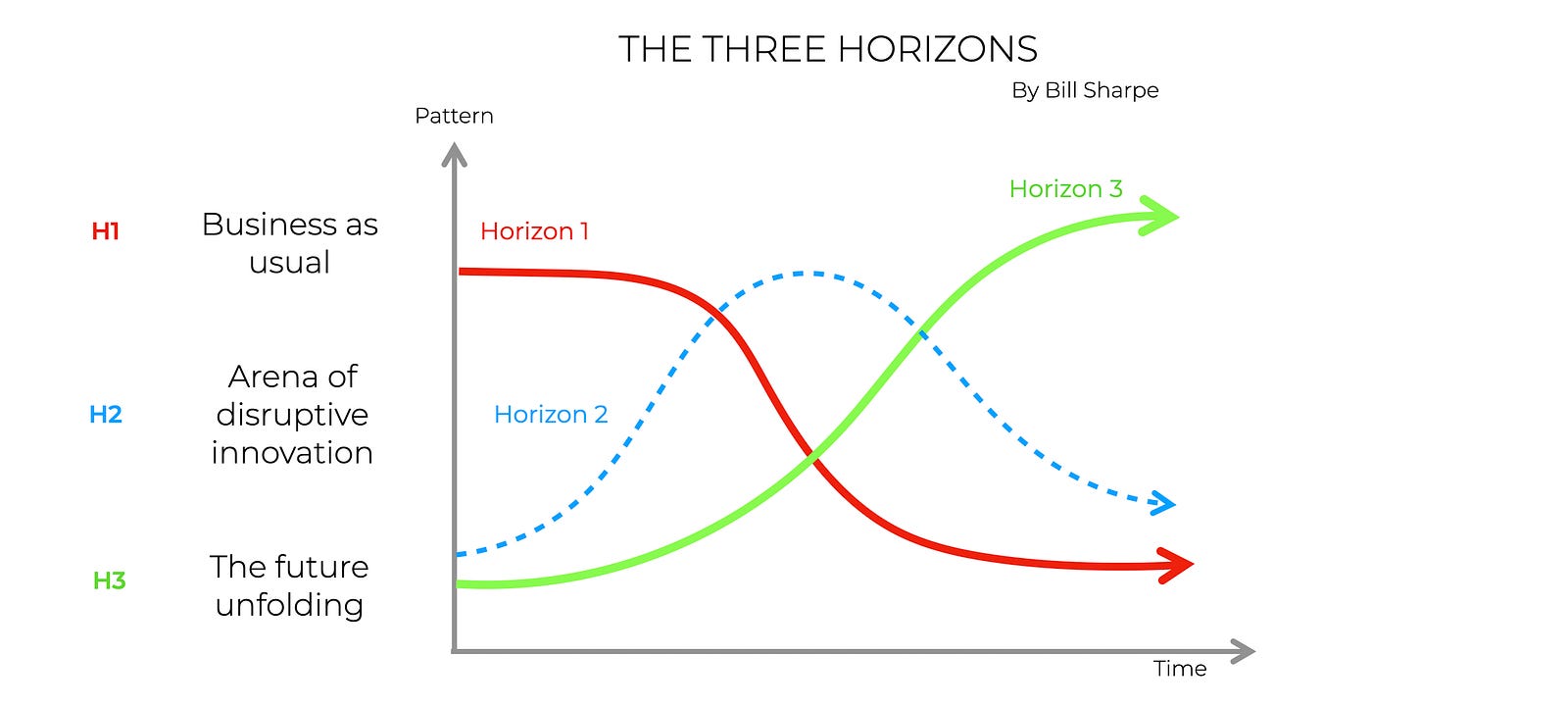
Horizon 1 is the world currently operating — the dominant system, with all its embedded assumptions. Horizon 3 is the world struggling to be born. Horizon 2 is the turbulent, dangerous, generative space between them: the arena where old coherence breaks down before new patterns have fully emerged.
This essay is primarily about Horizon 2. About the fractures appearing in the dominant system. About the pressures accumulating beneath a surface that still, for now, looks relatively calm. About the forces that may shape what comes next — and about the choices, still available to us, that could shape how those forces land.
To observe these forces is not to celebrate them. To describe risk is not to advocate fear. Clarity about what is actually happening is not a concession to despair. It is the precondition for any response worth making.
The future is not predetermined. That is not a consolation I offer lightly — it is the structural truth of complex systems, which remain sensitive to intervention at points of instability in ways they are not when everything is running smoothly.
A period of Horizon 2 disruption is, among other things, a period of unusual leverage. Things that seemed impossible become thinkable. Things that seemed permanent become negotiable.
The Overton window — the range of subjects and arguments politically acceptable to the mainstream population at a given time — has moved.
The question is not whether disruption is coming. The question is whether those of us who carry a different vision of the world — regenerative, relational, rooted in the logic of living systems rather than the logic of extraction — arrive in that disruption with something to offer. With roots already established. With language for what is actually happening. With practices already tested and relationships already built.
That is the lens through which I invite you to read what follows.
Not as a forecast. As an orientation.
There is a particular kind of knowing that arrives not through argument but through the body. Farmers have always had it. So have sailors. The old woman who watches the sky before the storm and says nothing, because language is too slow for what she already understands in her bones. What she knows is not prediction. It is pattern recognition at the level of the living. The clouds have their grammar. The wind shifts register before any instrument records it. She doesn’t need a model. She has been paying attention.
I am writing this because the clouds have shifted.
Several voices have been tracing the shape of what is coming —
Michael Every, the global strategist at Rabobank, in conversation with Nate Hagens on The Great Simplification;
Britt Gillette, constructing a provocative thesis around the infrastructure of a possible systemic reset;
Daniel Schmachtenberger, and his Third attractor perspective holding the failure modes side by side.
I would not read any of them as prophecy.
I would read them the way the old woman reads the sky: as signal, pattern, grammar. They are voices among many now pointing toward the same uncomfortable possibility. The world we have been living in — the world organized around the premise that money summons matter, that price governs reality, that markets are truth — has just shown us how thin the membrane is between that world and the physical one beneath it.
Not in theory. In supply. Not in spreadsheets. In molecules.
The Strait That Is Not a Strait
We have been taught to watch screens. The screen says oil is elevated but not catastrophic. The screen says equity markets are near record highs.
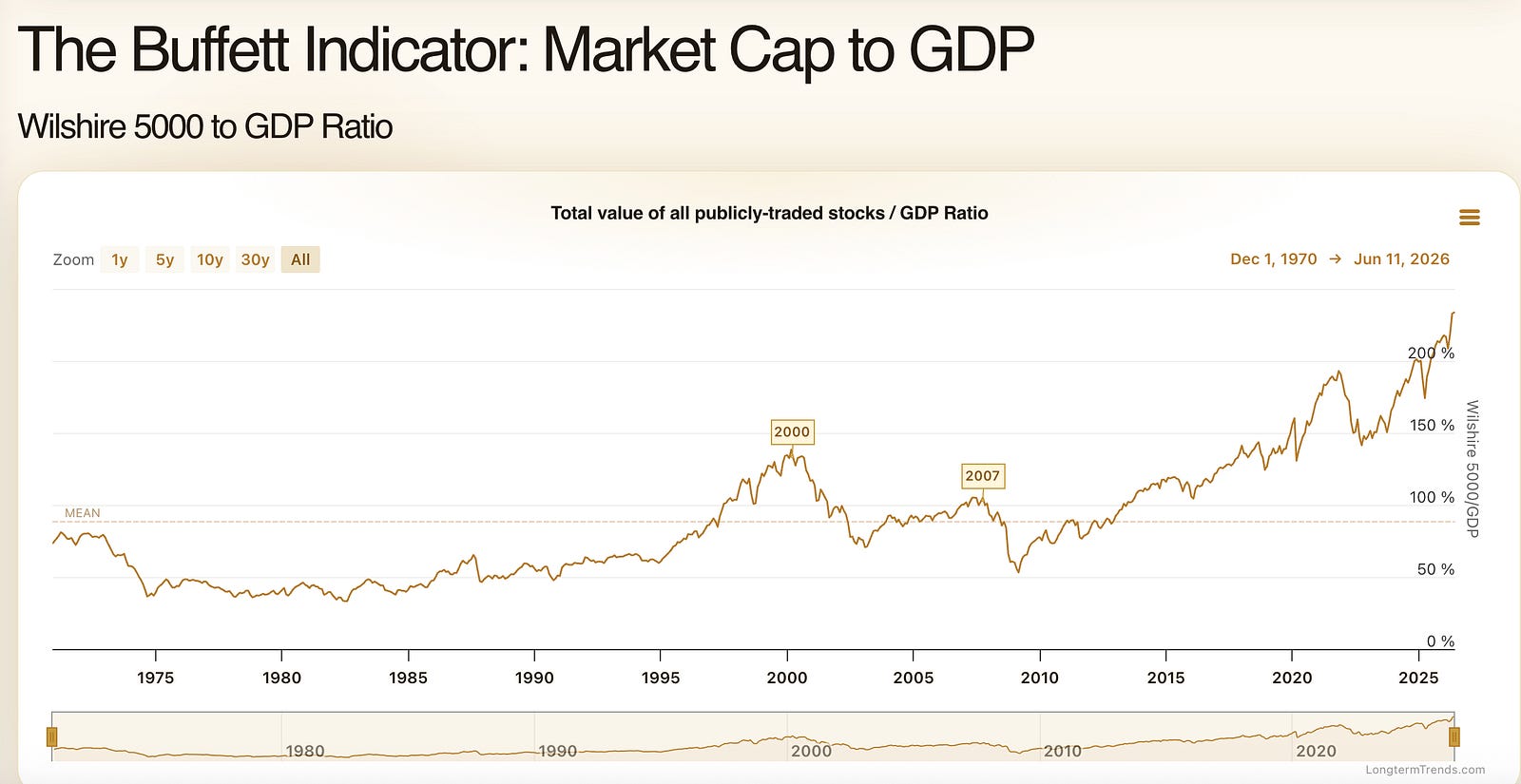
By most conventional measures of valuation — The Buffett Indicator: Market Cap to GDP, the ratio of total market capitalization to output, the price-to-sales ratio of the broad index — the screen sits at levels that rival or exceed the historic manias of 1929 and 2000. (Take the precise figures as the moving, time-stamped things they are; what matters is the order of magnitude, not the decimal.) Everything on the screen suggests that the world is, improbably, fine.
But there is another world the screen does not show. It runs not on prices but on molecules, and that world has been convulsing since late February of 2026, when a US–Israel conflict with Iran began a process that effectively closed the Strait of Hormuz to ordinary commercial traffic for more than one hundred days — collapsing shipping through the passage by something on the order of ninety percent at its worst.
The Strait of Hormuz is described by most commentary as an oil chokepoint. That framing is both true and catastrophically insufficient. Through that narrow maritime passage moves not just crude oil but the metabolic fluid of industrial civilization: liquefied natural gas, refined petroleum products, petrochemical feedstocks, the precursors to fertilizer, the sulfur that becomes sulfuric acid, the ammonia that becomes the nitrogen that becomes the bread. The Strait is not a chokepoint. It is an artery. And when you constrict an artery, you do not simply get higher prices. You get a body that begins to fail in ways that look, for a time, like normal variation — until they don’t.
What thinned or vanished from the seaborne market during the worst of it was not one commodity but a category: a large share of the world’s traded crude and LNG, gasoline and diesel and jet fuel, and the bunker fuel that moves the ships that move everything else. And then the less-visible materials — the sulfur and sulfuric acid, the urea and ammonia and phosphate that feed the world’s fields, the helium that cools the machines that make the machines. In aggregate, one of the largest energy and materials shocks in the recorded history of global trade.
Each of these, in isolation, would constitute a crisis. Together, they are something our existing language does not quite have a word for.
Michael Every,who has spent two decades reading the grammar of global finance, named it cleanly: we have moved, however briefly, from a world organized around price to a world organized around availability.
“How much is the bread?” “Three rubles.” “Do you have any?” “No, but it’s three rubles.”
The Soviet supermarket is not a relic of the past. It is an emergent property of any system that forgets it was built on physical things.
What Inventories Actually Are
The reason the screen stayed calm for so long is the same reason a tree looks healthy for weeks after its roots have been severed. Inventories.
China has been drawing down stocks, running its refineries off stored crude rather than new imports.
The United States released reserves. Commercial inventories worldwide absorbed the shock and masked the fracture.
But inventories are not production. They are stored time. They are the surplus of yesterday being spent to hide the fragility of today. And stored time, by definition, runs out.
Here is the part that matters even if — especially if — this particular crisis now cools.
As I write, mediators have announced a memorandum of understanding intended to wind the conflict down over the coming weeks, with the hardest question, Iran’s nuclear program, still unresolved and the underlying hostility intact. The strait may reopen. Traffic may resume. The screen may exhale.
And the stored time will not come back.
The reserves that were drawn down are drawn down. The buffer that absorbed this shock is the buffer that will not be there for the next one — and there is always a next one, because the conditions that produced this one are structural, not accidental.
A single waterway carrying a quarter of the world’s seaborne oil. A just-in-time logistics system optimized for cost and stripped of slack. A food system in which three billion people eat because nitrogen flows through that same narrow passage. We did not fix any of that. We spent our savings surviving the warning. The band starts playing again. The hull is still scarred.
The Molecule That No One Is Watching
In the grammar of industrial civilization, oil is not one word. It is a sentence — a long, dependent clause in which every element conditions every other. The temptation, in an essay like this, is to recite the whole sentence: the sulfur and the helium and the diesel and the copper, each with its own cascade. But cascades are easier to feel than to follow, and so I want to follow just one molecule, all the way down, because it is the one on which the most lives quietly depend.
Nitrogen.
No ammonia means no urea. No urea means no synthetic nitrogen fertilizer. No nitrogen fertilizer means farmers applying less, or late, or not at all. And here is where the abstraction becomes a body: when a corn plant is deprived of nitrogen during its critical growth windows — the period when the kernel sets, when the grain fills — it does not simply become smaller. It fails to complete itself. Yield crashes. Protein falls. The plant cannot improvise its way around a missing element the way a market improvises its way around a missing price.
The farmer absorbs the first blow in the field. The city feels the second blow at the table. The geopolitical rupture arrives third, when governments that cannot feed their people begin to make the kinds of decisions that governments make when they cannot feed their people.
This is why a country like India sits at the center of this moment. A vast agricultural civilization, one of the world’s great fertilizer importers, deeply dependent on a monsoon that climate volatility is making less reliable. If fertilizer prices surge while rainfall destabilizes, the trap closes on itself: subsidy costs rise, import capacity shrinks, application timing slips, yields fall, food prices climb, fiscal pressure mounts, and the political temperature rises with it.
The same logic runs across much of Asia, where dense populations, energy-import dependency, and exposure to maritime disruption converge into a fragility with no comfortable cushion.
The other molecules — the sulfur that mining needs, the helium that cools the chips, the bunker fuel that moves the fleet — form the chorus around this single line. But nitrogen is the melody, because nitrogen is the quiet condition on which bread exists. Follow it and you understand the whole. The cascade is not metaphorical. It is physical. It is biochemical. And it does not negotiate.
How a Molecular Crisis Becomes a Financial One
Japan imports ninety-seven percent of its crude oil. and before the conflict a large majority of that crude passed through Hormuz. Its reserves drew down at a historic rate. Hold that fact, and now follow the thread out of the Persian Gulf and into the pension accounts of the world.
For decades, global markets have been funded in part by what is called the yen carry trade: investors borrowing in yen at near-zero Japanese interest rates and deploying those funds into higher-yielding assets elsewhere. The true scale of this trade is genuinely contested — estimates range across a very wide band, and the largest headline numbers should be treated with caution rather than cited as fact — but even the conservative measures describe something enormous and deeply woven into the plumbing of global finance. As long as Japanese rates stay low and the yen stays weak, the trade is profitable. But an energy shock that forces inflation into Japan could force the Bank of Japan to act, and when this trade unwinds, the unwind can be violent: leveraged players selling foreign assets to meet yen-denominated margin calls, a sharp appreciation of the yen, more margin calls, more selling, a feedback loop that runs until it finds a new equilibrium — having destroyed an enormous quantity of financial wealth on the way.
This is how a maritime fuel shortage in the Persian Gulf becomes a crisis for a retirement account in Wisconsin or Munich. This is how a molecule becomes a market crash.
And it would arrive into a financial system already priced for a world in which physical reality cooperates with financial abstraction indefinitely.
It will not cooperate indefinitely. Reality, as the economist’s catechism never quite admits, has veto power.
The Honest Counterargument
I owe you the strongest case against everything I have just written, because a theory that cannot survive its best critic is not worth offering.
The case is this: markets are not blind. Prices do transmit physical scarcity — that is precisely what a price spike is, the system screaming that something is short. And systems adapt. Ships reroute around the Cape. Pipelines and alternative coastal routes carry part of the load. Demand destruction does its quiet work as the expensive thing simply gets used less. Substitutes appear. And history is full of chokepoint panics — tanker wars, blockade threats, pipeline sabotage — that frightened everyone and then resolved without the cascade ever arriving. The doom, the skeptic says, is always coming and never here.
This is a serious argument, and most of it is true. Prices do transmit scarcity. Systems do adapt. The cascade I have described is a tail risk, not a certainty, and anyone who tells you otherwise is selling something.
But here is why the adaptive case, however true, is not reassuring. Every one of those adaptive mechanisms runs on the same buffers we have just spent.
Rerouting works when there is slack in the fleet and time on the clock — and the fleet is tight and the clock, for a corn plant in its grain-fill window, does not extend. Demand destruction is a euphemism: in fuel it means a recession, in fertilizer it means a smaller harvest, in food it means someone, somewhere, eats less.
Substitution takes years; biological systems keep their own calendar. And the reason past panics resolved is that the system had thick reserves and ample redundancy to resolve them with. We have been steadily trading that redundancy for efficiency for forty years. The skeptic is right that the system adapts. The question is whether it can keep adapting after it has eaten its own savings — and that is not a question the optimistic case has answered. It has only assumed.
The thesis, stated honestly, is not collapse is certain. It is the tail is fatter and the buffer is thinner than the price on the screen will ever tell you — and a civilization that keeps mistaking the absence of catastrophe for the absence of risk is one that will eventually be surprised.
Energy Is Not a Commodity
Underneath all of this sits a confusion so deep that most of economics is built on it. We treat energy as one input among many — a line item, a commodity, a cost to be optimized. It is not. Energy is the budget within which every other transaction occurs. It is the metabolic rate of civilization.
This is the insight of the biophysical economists, a tradition most of the profession has spent a century ignoring.
Nicholas Georgescu-Roegen showed that the economic process is not a closed circular flow but an entropic one-way street, drawing low-entropy energy and matter from the world and returning high-entropy waste.
Howard Odum built an entire accounting of “emergy” — the energy embodied in everything, the real cost beneath the monetary one.
And the practitioners of net energy analysis gave us the single number that ought to sit at the center of economic policy and almost never does: EROI, the energy return on energy invested. A civilization does not run on its gross energy. It runs on its surplus — the energy left after the energy it took to get the energy. And that surplus has been quietly thinning for decades, even as the headline production figures rose. Natural gas EROI is estimated to decrease from 141.5 in 1950 to an apparent plateau of 16.8 by 2050.
Nate Hagens calls the result of all this the “superorganism”: a global economy that behaves like a single metabolic entity, blindly pursuing energy and converting it into complexity and waste, largely unconscious of its own appetite. The point is not mystical. It is arithmetic. Money is a claim on energy and matter. When the energy and matter are abundant, the claims look real, and price seems to govern the world. When they tighten, the claims reveal themselves for what they always were — claims — and the physical substrate reasserts the authority it never actually surrendered.
The Strait did not create this condition. It merely lifted the curtain on it.
The Loop That Feeds Itself
There is a particular cruelty in how this kind of crisis works, and it has a name. It is a reinforcing feedback loop — a vicious cycle, the engineers would say; a self-fulfilling prophecy, the rest of us might. The thing everyone is bracing against is produced, in part, by the bracing itself.
Watch how it turns. A chokepoint like Hormuz tightens, and the first thing it does is broadcast a signal: scarcity is coming.
That signal is true. And because it is true, every rational actor responds the only sensible way — by reaching for the resource while it can still be had. Nations draw down strategic reserves. Refiners run off stored crude rather than buy into a spiking market. States quietly hoard. Buyers front-run the shortage they can see arriving. Each of these moves is individually prudent. Collectively, they are the disaster. Because the reserves and inventories being drawn down were the only buffer the system had — the stored time standing between an ordinary disruption and a genuine break. The scramble to brace for winter is precisely what strips the woodpile bare.
And the depletion deepens the very fragility that triggered it. Thinner buffers mean the next tremor lands harder, which sharpens the signal, which intensifies the scramble, which thins the buffers further. Around it goes, each turn tighter than the last, a system manufacturing the scarcity it is trying to escape.
This is why a crisis can resolve on the surface — the strait reopens, the headlines cool — while leaving the underlying body weaker than it found it. The loop does not need the war to continue. It only needed the fear to be reasonable.
Here is the turn, the part almost no one is watching. The fuel and the LNG being pulled forward and burned through in this scramble are not only energy. Natural gas is the feedstock from which ammonia is made, and ammonia is the nitrogen, and the nitrogen is the bread. So the loop has a second floor beneath the one we can see. The global rush for energy security is quietly cannibalizing food security, one molecule upstream, in a place the screens do not show and the negotiators do not mention. We are spending the fertilizer of next year’s harvest to keep this year’s machines running, and calling it prudence.
Asleep at the Threshold
What that loop reveals, when you stand back from it, is the depth of our unpreparedness — and it is not the unpreparedness of a household that forgot to buy batteries before a storm. It is unpreparedness at the level of civilizational design. The reserves we hold were built for ordinary turbulence, not for a convergence. The institutions that would need to coordinate a response are the same ones whose internal metrics drove the depletion in the first place. And the political attention of the world, at the exact moment it most needs to widen, has narrowed to the single question of who wins the strait.
While nations posture over a chokepoint, while traders argue over a barrel price, while factions on every side calculate their leverage, the deeper account keeps running.
Aquifers that took millennia to fill are being drawn down in decades. Topsoil that took centuries to build is eroding in seasons. Fisheries are thinning. Forests that regulate rainfall across entire continents are being cleared faster than they can be named. None of this shows up on the screen that says markets are near record highs. It shows up later, in the system, as the loss of exactly the slack that would have let us absorb a shock like this one without flinching. We are not only stranding molecules in a closed strait. We are stranding the living capacity that was always the actual reserve beneath the financial one — and we are doing it while distracted by the fight over who controls what remains.
And there is more bearing down than the strait. As I write, a strong — possibly historic — El Niño is building in the Pacific, the periodic warming of equatorial waters that reorganizes rainfall and drought patterns across the entire planet. It does not cause wars or blockades. It does not need to. It simply means that the monsoon many of the same nitrogen-starved farms depend on may falter at precisely the moment fertilizer is scarce and expensive; that the same reservoirs already drawn thin by an energy crisis may also run short of rain; that heat will arrive in fields and cities already carrying every other form of stress this essay has named. Climate does not wait for geopolitics to resolve itself. It does not negotiate, and it does not care whose turn it is to claim victory.
This is what I mean by sleepwalking. Not ignorance — the data is public, the warnings are public, the molecules are countable. Something closer to a trance: a civilization so accustomed to crisis as spectacle, so practiced at watching disaster scroll past as content, that it has lost the capacity to feel what the data is actually saying. We have built extraordinary instruments for measuring the depth of the water and somehow forgotten how to notice that we are already standing in it.
It is time to wake up. Not into panic — panic is just another way of staying asleep, a reflex instead of a response. Wake up to what it actually means to be a human being inside this particular threshold: an animal with the rare capacity to see several moves ahead, embedded in a body that still needs water and grain and warmth, born into a civilization magnificent enough to move a continent’s breakfast through a single strait and fragile enough to lose it there.
That is the contradiction we are required to hold now, with open eyes, before the architecture of the next emergency gets poured into permanence around us.
The Digital Architecture Waiting in the Wings
When buffers deplete far enough, allocation returns. Not by ideology. By necessity. Scarcity forces distribution.
In the twentieth century, allocation meant ration cards and queues. In the twenty-first, it would mean something more sophisticated and more consequential: biometric digital identity, programmable wallets, fuel quotas delivered through verified accounts, food entitlements tied to verified identities, real-time transaction monitoring by governments and central banks.
The legal scaffolding is already partly built. Stablecoin frameworks include the technical capacity for issuers to freeze, seize, or cancel digital balances when legally required.
Central bank digital currencies under development in multiple jurisdictions treat programmability as a feature — money that can be conditioned, targeted, restricted, expired. The language around these tools is the language of efficiency, transparency, fraud prevention. The concern is not the language. It is the ratchet: emergency architecture, once built, tends to become permanent architecture. The response to scarcity quietly becomes the foundation of a new social contract, one in which access to food, fuel, money, and movement flows through a permissioned gate.
Britt Gillette maps the sequence with uncomfortable precision: first the energy shock removes the physical buffer; then financial markets break, exposing the hidden leverage and double-pledged collateral that abundant credit always conceals; and then the proposed solutions — tokenized assets linked to digital identity, central bank digital currencies replacing compromised bank holdings, digital rationing offered as the equitable response to scarcity — arrive dressed as rescue, welcomed by populations desperate to have their losses restored.
The question every serious person must eventually confront is not whether digital monetary infrastructure will be built. It will. The question is whether it is built as a commons or as a cage. Whether the governance around it preserves the rights, the freedoms, and the exit options that distinguish a free society from a managed one. Technology does not answer that question. Only governance does. And governance emerges from the quality of attention a civilization brings to a crisis — whether it reaches for control because it has forgotten how to reach for resilience, or whether it reaches for something deeper.
What Horizon 2 Actually Is
In the Three Horizons framework that Bill Sharpe and others have used to map civilizational transition, Horizon 1 is the dominant system: the operating assumptions of the present. Horizon 3 is the world that wants to be born — regenerative, distributed, relational, rooted.
Horizon 2 is the space between: the zone of disruption, innovation, and dangerous possibility.
What I want to name directly is that Horizon 2 is not automatically good.
Horizon 2 is where wars are fought over chokepoints. Where digital rationing gets built. Where stablecoins become the new petrodollar. Where AI — still mostly understood as a productivity tool, a novelty, a disruption to white-collar work — reveals itself as the active infrastructure of a crisis world: amplifying panic through algorithmic trading, automating surveillance inside rationing systems, optimizing logistics at speeds institutional governance cannot match, and shaping the information environment at precisely the moment when clear perception matters most.
The coming period is likely to be the first major systems crisis in which agentic AI is not background technology but active participant. And this exposes one of the great unexamined governance problems of our time: the mismatch of speeds. Markets move fast. Machines move faster. Democracy moves slowly. Ecosystems move in pulses, across seasons and decades. When the fastest actor in a crisis is the one with the least wisdom and the longest reach, the system does not become smarter. It becomes more brittle at higher velocity.
Horizon 2 can combust in ways that accelerate toward Horizon 3 — toward genuine systemic renewal. Or it can combust into a smarter, more surveilled, more controlled version of what we already have: Horizon 1 rebuilt with better software, more concentrated power, and a digital infrastructure designed to prevent the next crisis by preventing the freedoms that made the previous world what it was.
This is the window.
What the Roots Know
As I have mentioned in several entries already, there is a Potawatomi word that Robin Wall Kimmerer writes about: puhpowee, the force that causes mushrooms to push up from the earth overnight.
The word exists because the people who made it were paying close enough attention to the living world that they needed language for a phenomenon science still cannot fully explain — the surge of life through matter, in darkness.
I think of that word now, writing about chokepoints and carry trades and digital rationing, because the thing I most want to say is this:
the crisis that is coming is not, at its root, a financial crisis. It is a crisis of perception.
For decades, an entire civilization organized itself around the belief that the abstractions — prices, derivatives, financial claims, digital representations of wealth — were more real than the physical systems they were meant to represent. That money could summon matter. That price would always call forth supply. That the screen told the truth about the world.
The screen has been lying. Or rather: it has been showing one slice of reality — the slice financial engineering could manipulate — while the physical world beneath it followed its own grammar.
Energy is not a commodity; it is the metabolic rate of civilization. Nitrogen is not a market; it is the quiet condition on which three billion people eat. Soil is not an input; it is a living community of organisms that took ten thousand years to become what it is and cannot be restored on a quarterly earnings cycle.
Winter is not only what is coming geopolitically — the season of energy shock and financial rupture and emergency architecture.
Winter is also the season in which living systems remember what matters. The plant sends its energy down into the root. The tree does not try to sustain its leaves. It invests in what will survive.
What would it mean to invest in what will survive?
Institutions That Behave More Like Forests Than Factories
So what is the response?
If the crisis is, at root, a crisis of perception — a civilization that mistook its abstractions for the living world beneath them — then the deepest answer is not a cleverer instrument or a better number.
It is a different kind of institution.
This is the part of the landscape that Horizon 2 has quietly rearranged, and almost no one has noticed because we are all too busy managing yesterday’s emergency.
The Overton window — Joseph Overton’s name for the corridor of what a society considers thinkable, then permissible, then finally obvious — has moved. Not because the advocates of regeneration grew more eloquent, though some of them did. Not because the science grew more alarming, though it has. The window moved because reality shifted the ground beneath everyone’s feet.
Horizon 2 delivered precisely the disruptions required to make the old answers untenable and the new ones imaginable. What was confined to the margins of ecological economics is beginning to enter the vocabulary of central banks, sovereign funds, and agricultural credit institutions.
What was visionary is becoming necessary.
And what is becoming necessary is this:
institutions that behave more like forests than factories.
Consider what a forest actually does. It has no central planning office. No committee decides how water moves from canopy to root to fungal network to neighboring tree. No board allocates carbon across species. And yet the forest coordinates — exquisitely, across millions of simultaneous interactions, across scales from the microbial to the regional, across time horizons from the seasonal to the millennial.
What makes it work is not control. It is information. Every root tip is a sensor. Every mycelial thread is a channel. Every chemical signal in the soil announces surplus here, scarcity there, need in the gap.
The forest, as Robin Wall Kimmerer teaches, is a commons of extraordinary sophistication — one that has been refining its governance for four hundred million years. It is, in the deepest sense, a commons that can see.
Now consider what we built instead. Elinor Ostrom won the Nobel for demonstrating what communities had known for millennia: that people can govern shared resources without privatizing them and without surrendering them to distant control — that the tragedy of the commons was a design failure, not a law of human nature. But she was honest about the limit.
Her principles worked at scales where trust could travel at the speed of conversation, where everyone could know everyone, where reputation moved through relationship. Scale broke the intimacy.
As the watershed became a basin and the foodshed became a globally traded commodity system, we compensated with larger institutions — governments, development banks, multilateral agencies — and each of them solved a piece of the coordination problem while introducing a new one: distance. The forest became a spreadsheet entry. The river became a concession. The bioregion became an administrative boundary drawn for the convenience of census-takers rather than the logic of watersheds. And gradually, almost invisibly, the map replaced the territory. The indicator replaced the ecosystem. The model replaced the land — which is exactly the confusion the closed strait has now exposed at planetary scale.
This is not a brief against institutions. Institutions are how human beings coordinate beyond the handful of relationships a single mind can hold in full complexity. We cannot do without them. The whole question is whether we can build institutions that stay responsive to the living reality they were meant to serve, rather than being slowly captured by the logic of their own internal metrics. For most of history the answer at scale has been: not reliably, and not for long.
What has changed is that we now have, for the first time, tools capable of holding complexity at something approaching the scale of living systems — capable of perceiving the metabolism of a territory and the relationships of the people within it at once, and of making both legible without flattening either. Used carelessly, those same tools build the smarter cage. Used in service of life — as a nervous system rather than a controller, with sovereignty left where it belongs, with people and with place — they make it possible, perhaps for the first time, for an institution to sense, learn, and adapt the way a living system does. To remember, in other words, that it is embedded in something alive.
That is the institutional imagination the window has opened. Not a new machine for extracting value more efficiently, but a different way of organizing ourselves that begins from where value actually comes from:
the capacity of a place to keep generating life.
The watershed is not a cost center. The soil is not an input. The biodiversity is not an externality. They are the principal. Everything else has only ever been the interest.
The Responsibility That Cannot Be Deferred
Daniel Schmachtenberger,who has mapped civilizational risk as carefully as anyone alive, names two failure modes worth holding together in this moment.
The first is collapse: the uncontrolled failure of complex systems, the unraveling of the coordination infrastructure that sustains eight billion lives.
The second he considers equally dangerous: a kind of anti-collapse — a dystopia that preserves the system’s physical structure while eliminating the conditions for genuine human freedom and ecological flourishing. The smarter cage.
Both are on the table. Neither is inevitable. The space between them is the space that human choices, made now, in this window, will determine.
If fertilizer supply chains are fragile, the response that points toward Horizon 3 is not emergency rationing administered through biometric identity. It is the long, slow, unglamorous work of rebuilding soil fertility — the mycorrhizal networks, the microbial communities, the composting and the agroforestry and the rotations that make external nitrogen unnecessary. It takes years, which is precisely why it must begin before the crisis forces the choice, while alternatives still exist and the emergency architecture has not yet been poured into permanence.
If shipping is fragile, the response that points toward Horizon 3 is not military corridors protecting fossil flows. It is the shortening of supply chains, the relocalization of essentials, the wise reindustrialization of regions that hollowed themselves out chasing comparative advantage on a spreadsheet.
If digital monetary infrastructure is coming, the response is not to resist it as such but to insist it be built as a commons — governed by rights, transparent in operation, constrained by subsidiarity, accountable to institutions that can actually modify it.
The question is not whether digital money exists. It is who programs it, for whose benefit, and whether exit remains possible.
If AI is accelerating through this crisis, the response is not to slow it — that window has likely passed — but to insist that its deployment in critical systems be embedded in what Kimmerer calls a grammar of animacy: a way of seeing that recognizes the world as alive, that asks not only what a technology can do but what it will damage, what relationships it will sever, what it will make impossible for the living systems downstream.
These are not utopian demands. They are, in the most precise sense, the practical ones. A civilization that rebuilds after a crisis using only the tools the crisis hands it — the emergency powers, the digital identity, the programmable money, the military corridors — will have learned nothing and built nothing new. It will simply have digitized the same extraction in a more efficient form.
Winter Is Coming
We are in the paradigm window. That is what “Winter is coming” actually means.
Not simply a cold season. A season in which what is real and what is abstraction become, finally, impossible to confuse. A season in which the Overton window moves — where things once dismissed as extreme become discussable, things once authoritarian become administratively convenient, and things once merely ecological become, as the UK government issued in this report, suddenly, become a matter of national security.
And let me return, one last time, to the hinge I named at the beginning. This particular strait may reopen next month. This particular war may end on schedule. The screen may go green again and the commentators may declare that the doomsayers were wrong, as they always do in the warm season. Do not be disoriented by the thaw. The vulnerability the crisis revealed is permanent. The reserves it consumed are gone. The next shock arrives against thinner buffers and a more brittle, faster, more concentrated system.
Winter, in the sense that matters, is not a date on a calendar. It is a condition we have entered and will not simply exit.
The question that matters — the only question that finally matters — is not whether the world changes. It will change. It is already changing. The question is who brings the better map. Who arrives in the disruption with language for what is actually happening, with roots already established, with relationships already built, with practices already tested, with the moral clarity to tell the difference between a tool that serves life and one that only controls it.
Horizon 1 is cracking. Horizon 2 is combusting. Horizon 3 is not a destination. It is a direction — the direction of living systems, of reciprocity, of the kind of knowing that arrives not through models but through attention, the way the old woman reads the shift in the wind before any instrument records it.
Winter is coming.
Our ancestors knew this season by name, in every climate that has one. They did not greet it with denial, and they did not greet it with despair. They greeted it with preparation, which is its own form of respect. The grain was threshed and stored before the first frost, not after. The wood was split in summer’s heat for a fire that would not be needed for months. The seed — the most important object any agricultural people possessed — was selected, dried, and kept apart from the food, sacred precisely because it was not for eating: it was the bet a whole community placed on the spring it could not yet see. Roots, bulbs, the diversity of what the land would give again, were learned and remembered and taught to children before the children could understand why it mattered. None of this was pessimism. It was the most practical optimism a human community has ever practiced — the kind that does not assume the future will be kind, and prepares anyway, so that it might be lived all the way through to the other side.
That is the inheritance available to us now, if we are willing to wake up and reach for it. Not a forecast we can outrun, and not a doom we must submit to, but a discipline as old as agriculture itself: to read the season honestly, to store what can be stored, to keep the seed apart and sacred, to build the kind of relationships and institutions and soil that do not break when the cold finally arrives.
The roots we plant now — in soil, in governance, in relationship, in the regenerative practices that make life more alive, in the instruments that finally make living value count — are the only thing that will matter when spring arrives.
If it arrives for a world we recognize.
That part is still up to us. It always was. Our ancestors understood that before we did. It is time we remembered it too.
This Substack is a reader-supported publication. Consider subscribing — or even better, becoming a paid subscriber — to help sustain and expand this work. Your support allows these conversations to reach further, nurturing the awakening, awareness, and acceptance that may help us move from isolated insight toward a shared, collective consciousness.
Bro, Space X is valued at a trillion, we're going to the moon!!!!! Etc, etc, Do you ever get that? You put a well reasoned assesment, people listen politely, then say something like the above? Indicating they haven't listened and/or don't understand or, really care caus stox do up. 🤪🫠
Great post- reminds me a bit of the book, Ministry of the Future - probably should be required reading for all of us right now..