
Should We Be Talking About Collapse?
After Acceptance: From Grief to Stewardship

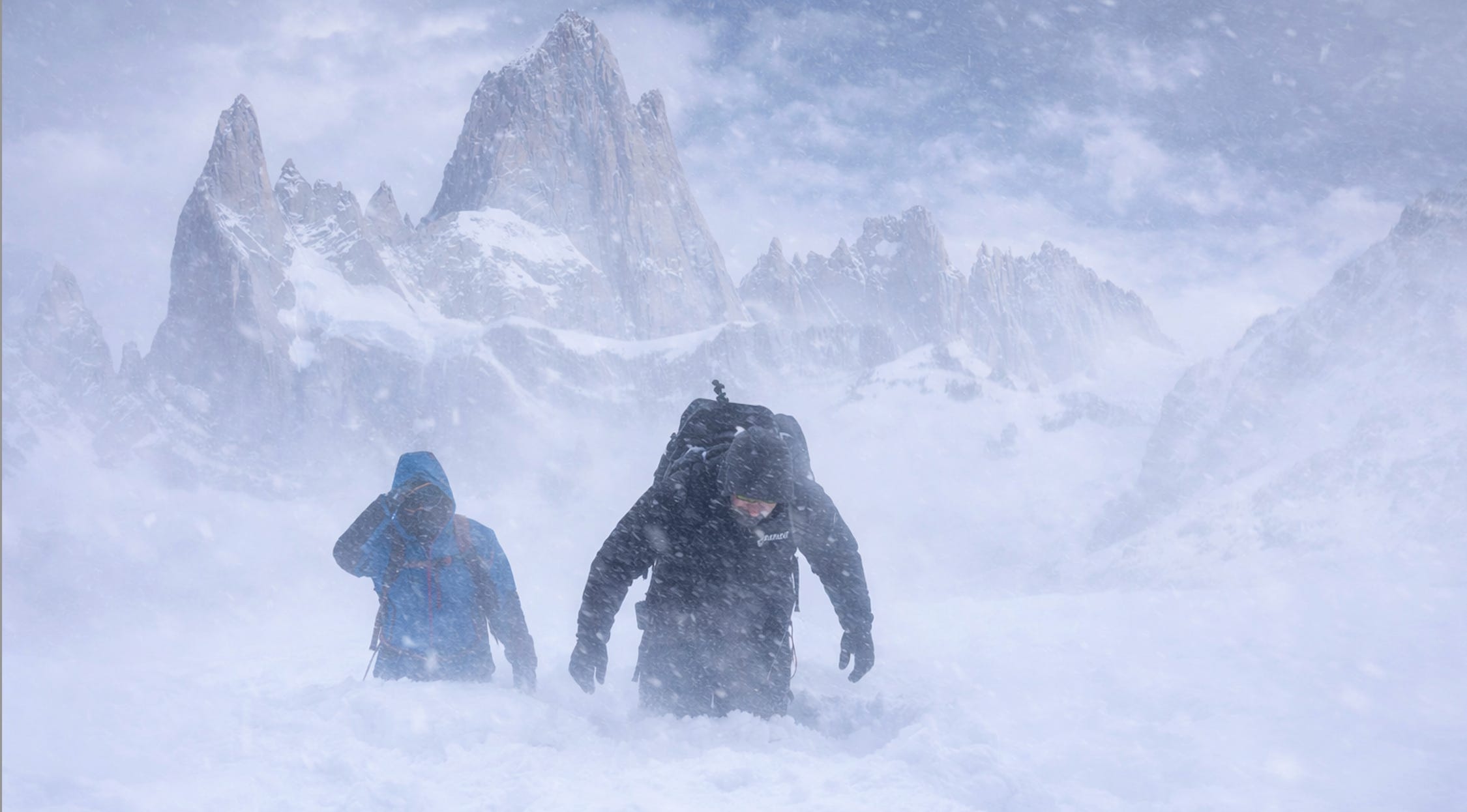
Pedro Friedrich and his climbing partner emerge from a Patagonian blizzard, waist-deep in snow, after a night of taking turns carving a path forward. Roped together, they move through exhaustion into action — turning grief into motion, and motion into life. The image reminds us that stewardship begins not with certainty, but with the choice to move together through what is hardest. (AI generated Image)
If collapse is inevitable, should we really be talking about it — or does naming it risk paralysis, fear, or self-fulfilling prophecy?
For years, the conversation has been treated as taboo, too bleak, too destabilizing, too irresponsible. And yet, avoidance has not made collapse less real; it has only delayed our capacity to respond. The deeper question is not whether collapse should be discussed, but whether refusing to discuss it leaves us less prepared — emotionally, socially, and practically — for what is already unfolding. Perhaps the risk is not in talking about collapse, but in doing so without maturity, without care, and without a path forward.
This essay is a continuation of a previous piece titled “Why Collapse Is Inevitable.” In that earlier article, we explored collapse not as a failure of imagination or leadership, but as the predictable outcome of civilizational overshoot — of exponential growth colliding with finite planetary boundaries. Collapse, we argued, is not a single future event but an ongoing process already unfolding across nested systems: climate, biodiversity, energy, finance, governance, and social trust. The invitation was not fear, but clarity — to understand collapse as a phase transition, not a moral verdict, and to move from denial toward awareness and acceptance.
We have now crossed an invisible line.
Not everyone has noticed it yet, but many have felt it — in the body, in the chest, in the quiet moments when the future no longer behaves the way it used to. Collapse, once an abstract concept or a distant alarm, has become experiential. It is no longer something we debate in panels or footnotes. It is something we live inside.
Awareness of collapse is the first rupture.
Acceptance is the second.
And acceptance, as Adrian Lambert so clearly articulated, in his article The truth about collapse acceptance, is not resignation. It is not giving up. It is the moment when illusion dissolves — the illusion that systems will somehow self-correct, that growth will resume its upward climb, that yesterday’s assumptions will still organize tomorrow’s world. Acceptance is clarity. And clarity, once reached, carries weight.
What follows acceptance is grief.
Not abstract grief, but a very specific kind of mourning: the grief of realizing that much of what we were promised — stability, progress, continuity — will not arrive in the form we were taught to expect. We grieve futures that will not unfold, landscapes that will not recover in time, institutions that cannot adapt. We grieve not only what is already lost, but what we now know will be lost.
This is bereavement — not metaphorical, but real. What is dying is not one thing, but a worldview. A paradigm. A story about how the world works and where it is headed.
Threaded through this grief is solastalgia — the term coined by Australian philosopher Glenn Albrecht to describe the distress that arises when one’s home environment changes faster than one’s capacity to adapt. The forest still stands, but it is quieter. The seasons still turn, but out of rhythm. Society still functions, but with thinning trust and growing friction.
For those who begin to see clearly, this grief is unavoidable. It is the price of perception. The more deeply you understand the systemic nature of collapse, the more acutely you feel the pressure of time. You know transformation is possible — but you also know inertia is immense, that destruction has momentum, and that things may get darker before they get lighter.
This is not pessimism.
It is what it feels like to be awake in a world in transition.
And yet — this is not where the story ends.
Because grief, if fully metabolized, does not immobilize. It clears the ground.
What comes after acceptance is not certainty, but a choice. Not a moral choice, but an existential one: do we remain seated in despair, or do we enter movement?
A story about Pedro Friedrich captures this threshold with startling clarity.
Pedro was descending from The Fitz Roy mountain, exhausted, dehydrated, frozen. The weather had turned violently. Snow fell without pause, piling higher and higher until it reached nose level. His companion — overwhelmed and depleted — sat down and said he was finished. That he would die there.
Pedro paused. He felt the same exhaustion. The same cold. The same fear. But something else moved through him — a refusal not just to die, but to die passively. “I’m not dying like this,” he said. And he began to move.
With gloved hands, he started scooping snow — shoulder-high drifts — clearing a path inch by inch. It was absurd. Inefficient. Almost certainly not optimal. But it was movement.
And everything changed.
Movement changed his temperature, his breath, his orientation. With motion came circulation. With circulation came agency. With agency came possibility.
There is one more detail in that story that matters. Pedro and his friend were roped together. As Pedro carved forward, he suddenly felt the rope pull tight at his waist. He stopped and turned back, afraid that his friend had finally surrendered. But as he moved toward him, he felt something unexpected — the rope was growing lighter. Then he saw it: his friend was standing, stumbling forward, no longer sitting down to die. He pushed past Pedro and began scooping snow himself, carving the path. Pedro sat down to rest while his friend worked. Then they switched. All through the night they took turns — one moving, one recovering — bound by the same rope, the same exposure, the same refusal to stop. Slowly, almost imperceptibly, the snow dropped from shoulder-high to chest-high, from chest-high to knee-deep. By morning, they were walking again, crossing the glacier back to their secure campsite.
This is the teaching.
When you move, the world rearranges itself around you.
You are inside possibility again.
But possibility does not mean ease. And it certainly does not mean certainty.
One of the hardest questions that follows acceptance is not what do we do? but how do we remain whole while everything around us fragments? How do you carry grief without being crushed by it? How do you stay coherent when collapse accelerates — when institutions fail faster, when social trust erodes, when conflict and unrest intensify?
Because collapse has a brutal property: velocity. Systems do not decline gently. They cascade. Feedback loops amplify. Scarcity narratives sharpen. Fear rises. And those who see clearly often feel isolated — holding awareness in a world that would rather not look.
So the real question becomes: how do you stay coherent inside incoherence?
How do you remain mentally healthy when the emotional field is dysregulated?
How do you remain optimistic without lying to yourself?
This is where optimism must be reclaimed from its shallow caricature.
Mariano Grondona, the Argentine journalist and political thinker, offered a definition that feels almost tailored for collapse. For him, optimism is not a naïve illusion, but a realistic and active attitude toward life. The optimist, Grondona wrote, is not someone who avoids facts, but someone who enters the “jungle of facts” without paralysis — someone who does not make illusions, yet refuses to surrender agency.
In his framing, optimism rests on four pillars.
Realism: seeing challenges clearly without minimizing them, but also without being overwhelmed.
Action: refusing passive waiting, choosing movement over resignation.
Pragmatism: focusing on what is possible and concrete, not fantasies or abstractions.
Active hope: not belief that things will magically improve, but confidence in one’s own capacity to influence reality, however partially.
This is not optimism as mood.
It is optimism as discipline.
For the Living Systems Steward, this distinction is everything. Stewardship does not mean pretending collapse is not happening. It means staying engaged when it is. It means cultivating inner coherence that does not depend on external stability. It means regulating oneself — emotionally, psychologically, relationally — so as not to amplify the very chaos one is navigating.
Practically, this begins close to home. It means tending to the nervous system before tending to systems. Anchoring in body, place, and relationship. Working at scales where feedback is visible — soil, water, food, trust — rather than drowning in abstractions too large to metabolize. Choosing contribution over commentary. Presence over projection.
Grief does not disappear. Nor should it. The Living Systems Steward does not bypass sorrow; they integrate it. They allow grief to deepen devotion without collapsing courage. They understand collapse not as an ending, but as the loosening of a story that no longer served life.
Stewardship, then, is not heroic. It is relational. It is not about saving the world. It is about becoming a stabilizing presence inside instability. Modeling coherence where coherence is scarce. Building bridges — quietly, patiently — between what is dissolving and what is trying to emerge.
There is a way to live beyond acceptance of collapse.
A way to remain realistic without becoming cynical.
Active without becoming frantic.
Hopeful without becoming naïve.
That way is the path of the Living Systems Steward.
And in the pieces that follow, we will explore this path not as an idea, but as a lived practice — how to stay mentally healthy, emotionally grounded, and creatively engaged while moving through a world in accelerating transition.
Not because collapse can be avoided.
But because life, even here, is still asking to be served.
Actually, a third option for the poll:
I have been aware of collapse for some time, and I am taking steps. (I hope I am not too far behind.)
All of this makes enormous sense to me. The body’s registering of seasons that are shorter or longer, colder or hotter, the rising of landfills, days when haze makes breathing difficult, and above all of that, the way we invest more energy in doing the same old things. Working longer hours, buying air conditioners, caving to the commodification of everything - meals that come in kits, exercise that needs to be tracked, and endless consumption alongside its externality, pollution. Yesterday a lovely young man came to my house too do some repair and I traded a dryer that I no longer use because I hang my laundry. He is young, a single father, and he works in the construction industry doing odd jobs. He's bright, kind, and motivated but he has only a high school education and two young daughters who rely on him for everything. When I think about our changing world, I think about people like him. How will they become stewards? How do we go from the theoretical to the practical? Is it inevitable that people will die? I love reading your column because it gives me hope… I do wonder what this looks like on the ground. We're talking about the brutality of the end of our world. And we're also talking about a new one, but what happens – literally – in between? You may have already written about this and I just missed it. I feel a formless grief almost every day because my body knows something nearly unbearable is coming. I think we should be talking about it... But what about those for whom this will all sound fantastic and impossible?