
The Event — Learning to Live Through it
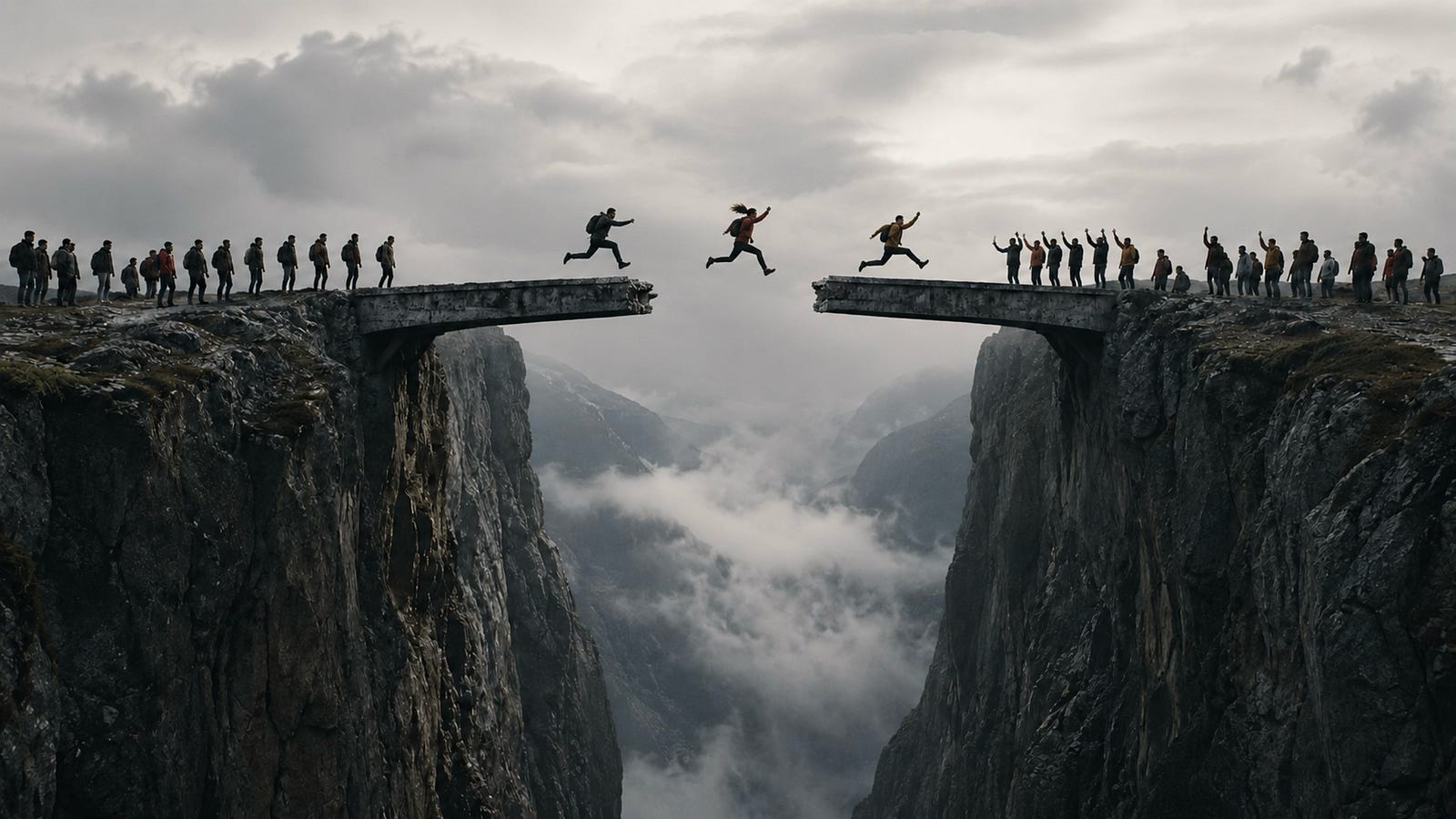
How we become the bridge between the world that is ending and the one struggling to emerge.

Part Two
Living Through the Event
Stewardship Through Horizon Two
Part One ended on a recognition more unsettling than any single forecast:
the crises of our moment have stopped arriving one at a time.
A drought no longer stays a drought — it moves, into the harvest and the price of bread, into the politics of a country and the cost of its energy and the outcome of its next election — and somewhere along that path the disturbances begin reinforcing one another faster than anything built to absorb them can keep pace.
Climate, we saw, is not one problem among others but the medium the others travel through, every future El Niño now beginning from a warmer ocean than the last; and beneath the food that medium grows, a single molecule and a single strait showed how little slack we had left ourselves. What looked, problem by problem, like a set of separate emergencies turned out to be one system finding a new shape — and a system reorganizing itself is not something we can predict our way out of.
Which is why this second part has to begin somewhere other than analysis, because the question that now matters is not one a policy brief can finish.
If disruption is becoming the ordinary weather of the century rather than a passing storm, then forecasting it is no longer the work; the work is learning to stand inside it without losing coherence — to live, and to keep tending what is ours to tend, in the long turbulent passage between a world that is ending and one not yet born.
That passage is what the Three Horizons frame calls the second horizon, the bridge, where both worlds stay true at once and the old certainties thin out before the new ones have arrived.
How we carry ourselves across that bridge is the subject of everything that follows. And it begins with something harder than any strategy: the willingness to stop arguing with what is already here.
Four — Awareness vs Acceptance
There is a difference between becoming aware of something and accepting it, and it is larger than it sounds.
Awareness lives in the mind and lets you go on living almost exactly as before, the new information filed neatly alongside the old life without disturbing it.
For years I lived there. I read the climate reports and the food-system analyses, the work on energy and machine intelligence and geopolitics and complexity, and each new paper pressed the same intuition a little deeper — that we had crossed into a period unlike any other I knew of — and still some part of me kept negotiating with what I was reading.
Surely the innovation would accelerate in time. Surely the governments would find a way to cooperate. Surely the markets would adapt as they always seem to, and surely someone, somewhere, already held the whole picture and was quietly tending it on our behalf.
Awareness is comfortable precisely because it costs nothing; it lets you know and not move.
Acceptance shifts the ground beneath your feet, because acceptance arrives the moment you notice that reality has stopped waiting for your consent.
The river will come over its banks this spring whether or not you have made your peace with it. The glacier is already letting go of the mountain it has held for ten thousand years, and it is not consulting our optimism or our grief before it does.
What acceptance asks is not that you approve of any of this but that you stop spending the better part of your strength arguing with it, because that strength is the one raw material you actually have for the work that comes next, and as long as it is going into the argument it is going nowhere useful.
So acceptance is not pessimism and it is not surrender, though it is often mistaken for both by people who have never tried it; it is closer to the relief of finally putting down a weight you had been insisting wasn’t heavy.
And when I set the argument down, a different question rose into the space where it had been, one that no amount of science or economics could answer for me, because it was an inner question and not an outer one.
Regardless of what happens — who am I becoming?
I have come, slowly, to read this whole period as an initiation more than a crisis, and every initiation worth the name asks you to relinquish an identity that no longer fits the world you are walking into.
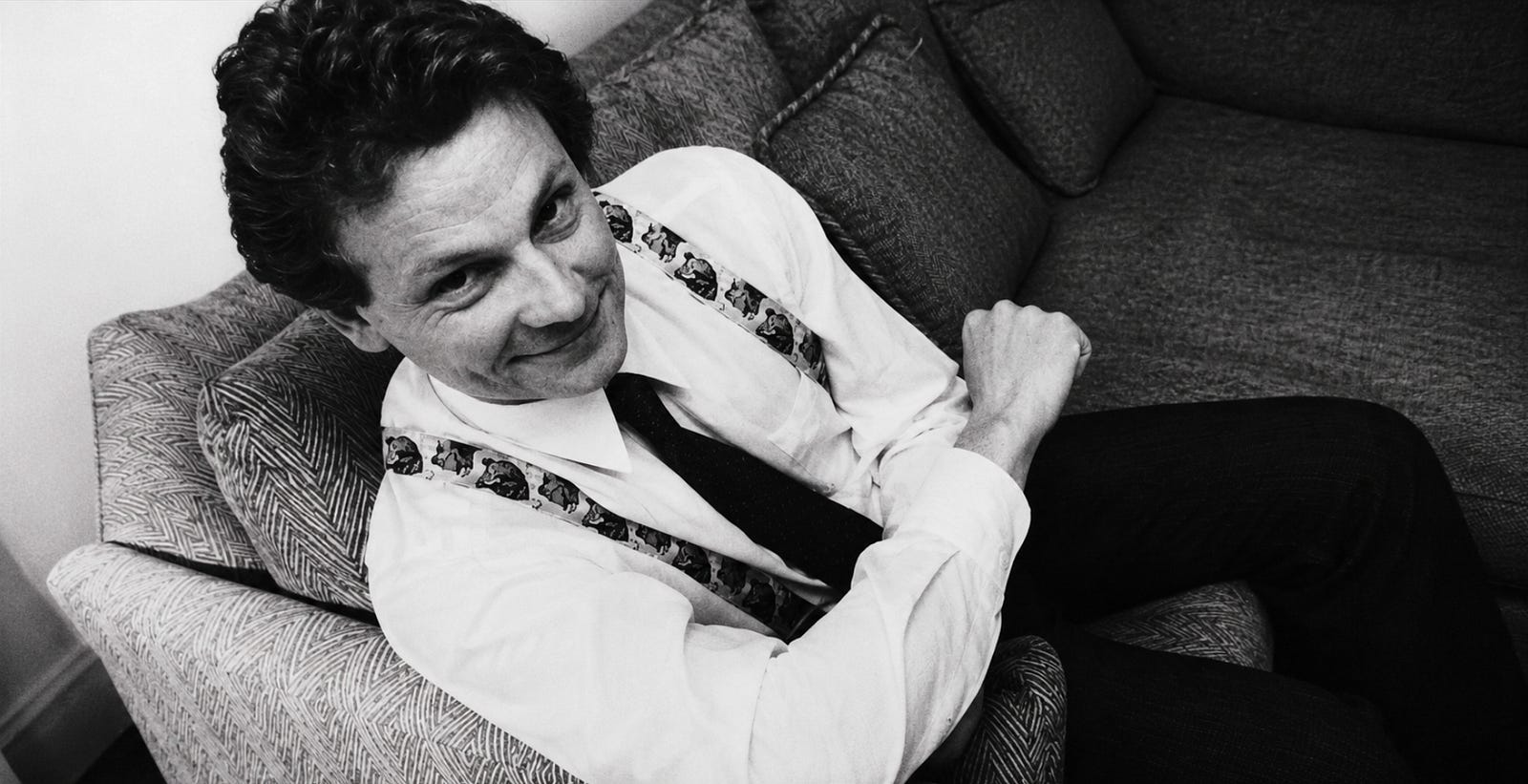
This photograph above captures a former version of myself. I was wearing an Armani suit, a Sulka tie, and suspenders embroidered with the bulls and bears of Wall Street — symbols of an identity I then inhabited with conviction.
I saw myself as a self-reliant individual, trained to compete, to optimize, to win, and to create value within the logic of investment banking and financial markets.
Looking back, I do not reject that person; he was an essential chapter of my own becoming. But I now recognize how deeply that identity was shaped by the modern myth of separation: the belief that we stand apart from one another, from nature, and even from the places that sustain us. Much of what follows in this essay is, in many ways, the story of the long journey from that separate self toward a self that understands itself as part of a living whole.
The identity now dissolving, I think, is the one modernity taught me to be proudest of — the separate self, the self-reliant individual standing a little apart from the world, the consumer and the unencumbered professional and the investor detached from any particular place, the citizen who assumes the institutions will handle whatever he cannot.
We were taught that this autonomy was the same thing as freedom, and the living world quietly teaches the opposite at every turn, because nothing alive survives alone. The forest does not, nor the river, nor the mycelium threading the dark beneath them, and neither, whatever we tell ourselves, do we.
This is what finally brought the old teaching of interbeing out of the realm of philosophy and into something I could feel in my hands.
Several years ago, I spent time at Thich Nhat Hanh’s Plum Village Monastery in southwest France, not simply as a visitor but as a student, trying to understand more deeply what he meant by that deceptively simple word. I arrived imagining interbeing as a beautiful idea about the interconnectedness of all things.
I left with the sense that it was something much more immediate: a way of experiencing reality itself. Days shaped by mindfulness, silence, shared work, meditation, and community gradually dissolved the illusion that anything exists independently. We do not merely coexist with one another and with the living world; we become through one another. That experience transformed interbeing from an intellectual concept into a lived practice and opened the door to what I have since come to think of as interbecoming — the continuous co-evolution of people, communities, and the living systems that sustain them.
I have never found a perfect word for this, because interbeing already contains it, yet interbecoming captures something that became increasingly clear to me. Life is never static. Everything is continuously shaping everything else.
The condition of a watershed finds its way into the people who drink from it, those people cultivate the soil, the soil becomes the food they eat, the food becomes their bodies, their bodies become the culture they pass on to their children, and those children, in time, return to shape the same watershed.
It is not a chain of cause and effect so much as a living conversation unfolding across generations. There is no clean place to stand outside of it and imagine ourselves separate, because we are always participants in the world that is, at the same time, quietly making us.
That changes what preparation even means. It stops being a matter of accumulating supplies against a future you are bracing to survive, and becomes the cultivation of capacities you will need whichever future arrives — the capacity to stay present when everything in you wants to flee into certainty, the courage to remain in relationship at exactly the moment fear is whispering that separation would be safer, the patience to keep learning, the discernment to tell a signal from the noise that surrounds it, the generosity to build trust with the people around you before the day comes when you cannot do without it, and the imagination to recognize that another civilization may already be taking root, quietly, underneath the one we still think we live in.
Looking back, this is the thread that ran through everything I was writing in the recent Regenerative Light series, because fire was never only destruction; fire is an old teacher that burns away what has stopped serving and clears the ground for what could not otherwise have come, and acceptance, it turns out, leads not toward certainty but toward responsibility — which is its own kind of clearing — and responsibility immediately asks the next question, the most practical one in the whole essay.
Where does a person begin?
Five — Where
Every real transformation eventually narrows to that single word, and it is not when and not why but where — where, exactly, does another way of living begin.
The reflex of modern civilization has always been to answer at the largest possible scale, to reach for the one policy or the one technology or the one market or the one ideology that could be rolled out everywhere at once, and living systems have never worked that way and never will.
A forest does not grow healthier because another forest is thriving a thousand kilometers off. A river cannot be restored in the abstract, only in its own bed, and a watershed cannot be regenerated from a distance by anyone, however well-funded or well-meaning.
Life regenerates somewhere. It is always, without exception, a place.
This is what drew me years ago to the work of Elinor Ostrom, whom I had the good fortune to meet after she received the Nobel, and what moved me was not only her demolition of a comfortable economic assumption but the extraordinary hope buried inside the research that did the demolishing.
For most of a century economists had taken it as settled that people sharing a common resource were doomed to wreck it — that a shared fishery would be emptied, a shared forest stripped, a shared irrigation system bled dry by the arithmetic of individual self-interest — and Ostrom spent her life walking the actual ground and finding the opposite written all over it.
She studied communities that had governed their commons successfully for centuries: inshore fisheries off the coast of Maine, the irrigation huertas of Spain where water disputes are still settled by a tribunal that meets, as it has for hundreds of years, in the open air; the high mountain pastures of the Swiss Alps, the community forests of Nepal, groundwater basins, place after place where people had worked out, without any economist’s help, that their own prosperity could not be prised apart from the prosperity of the commons that fed them.
Different cultures, different landscapes, different histories, and across all of them a startlingly similar pattern — the commons endured wherever people had built clear boundaries and shared rules and reciprocity and local participation and ongoing learning and ways to resolve their conflicts and hold one another to account, governance supple enough to change as the land itself changed. The commons survived, in other words, because the relationships survived. The institution was the relationship, made durable.
Reading her now, I find myself asking a question she did not quite ask, which is what happens when the commons we most need to learn to govern is no longer a single forest or a single fishery but an entire bioregion — its water and its soils, its biodiversity and its productive capacity, but also its culture and its memory and its web of relationships and the future it is still capable of growing into.
This is why I have started to draw a line between a bioregion and a bioregional commons, because a bioregion exists whether anyone recognizes it or not, drawn by the watershed and the soil and the climate long before we arrived, while a bioregional commons only begins to exist in the moment the people living there understand that they have become responsible for its flourishing.
The word that does the real work is not commons, which can sit there as a noun and a possession, but commoning, which is a verb and a practice and, finally, a way of belonging — and commoning is not the conservation of a landscape under glass but participation in its continued becoming, which asks an entirely different set of questions than conservation does.
What is the productive essence of this place?
What relationships would let life here grow more abundant rather than less?
How might the people who live here add to its vitality instead of subtracting from it, so that production becomes regeneration rather than extraction?
I have been pulled, for years, toward the North American prairie as the clearest teacher of this, because for a long time people were certain the bison were destroying the grasslands, and the truth ran exactly opposite to the certainty.
The prairie and the bison had been shaping each other for thousands of years; the grass needed the grazing, the grazing needed the predators to keep the herds moving, the movement kept the soils alive, and the whole arrangement had evolved as a single co-authored thing.
The question was never how to conserve the prairie as if it were a museum piece.
The question was how to restore the relationships that allowed the prairie to keep on becoming the prairie, and I have come to suspect every place is asking some version of the same thing — not what shall we impose on it but what is it trying to become, and can we learn to assist that.
The Amazon offers another lesson, one that overturns an equally persistent myth.
For generations we imagined the rainforest as an untouched wilderness, thriving despite humanity. Increasingly, archaeology, ecology, and soil science are revealing a far more intriguing story. Large parts of the Amazon were not simply inhabited; they were cultivated through relationship. Indigenous peoples transformed poor tropical soils into what we now call Terra Preta — extraordinarily fertile black earth created through the careful accumulation of charcoal, organic matter, ceramics, microorganisms, and generations of patient stewardship. The fertility was not manufactured. It emerged from a long conversation between people and place.
The forest was not diminished by that relationship.
It became more abundant because of it.
The Amazon, like the prairie, was never merely a landscape. It was a co-evolving commons, where culture and ecology shaped one another over centuries. The remarkable productivity of Terra Preta reminds us that the deepest form of human intelligence has never been domination over nature, but participation within it. Indigenous wisdom did not begin by asking how to extract more from the forest. It began by asking how the forest itself could become more alive through human presence.
Perhaps every enduring landscape carries a memory of relationship. Across continents and cultures, the places that have sustained life for centuries rarely tell a story of pristine wilderness untouched by people. More often, they reveal generations of careful participation, where human presence became one thread in a much larger tapestry of soil, water, plants, animals, fungi, and time.
The enduring lesson of these landscapes is that belonging is not measured by how little we intervene, but by whether our presence leaves the place more capable of continuing its own unfolding.
Every place seems to ask the same quiet question: can the people who inhabit me become participants in my unfolding, rather than merely beneficiaries of my abundance?
This is where regenerative design begins, not as a methodology to be installed but as a way of seeing, and the vocabulary it offers — essence, nestedness, reciprocity, developmental potential, the nodal relationships through which a small intervention can ripple outward, vitality, wholeness — these are not principles you apply to a landscape from the outside. They are lenses you look through until the landscape starts revealing the intelligence it already holds, and the work becomes less a matter of governing nature than of learning to govern with a living system that knows things about itself we are only beginning to perceive.
It is precisely here that the new instruments may prove unexpectedly useful, and precisely here that we have to be most careful about what we expect of them.
Agentic Artificial intelligence, digital twins, distributed ecological sensing — these can help a community hold a degree of complexity no single human mind was ever built to integrate, illuminating the feedback loops and surfacing the invisible relationships and supporting genuinely better decisions. A digital twin can map the living metabolism of a whole watershed at a resolution no one could carry in their head, and it still will not love the river it has mapped; it can show a community the loop it is caught inside, and it cannot feel, on the community’s behalf, the belonging that would make anyone want to act on what they have been shown.
The instruments extend our perception almost without limit, and the commons has never been made of perception. It is made of people who have decided that their own flourishing and the river’s are finally the same question, and that decision is not something an algorithm can reach for anyone.
Which is why I have come to think the decisive technology of this century may not be artificial intelligence at all, but the much older and nearly forgotten human capacity to become, again, a people of a place — because if enough bioregions rediscover their own essence, if enough communities learn to steward their own commons, if enough watersheds are allowed to grow more alive than they were, then civilization itself becomes capable of something we have almost stopped believing it could do, which is to regenerate from the ground upward, not through one grand solution handed down from above but through thousands of particular places quietly remembering how to belong.
Six — Becoming the Bridge
Every transition asks something specific of the generation that has to live through it. Some are asked to build and some to defend; some inherit stability and some inherit the unraveling of it, and I have come to believe ours has been asked to become a bridge — to stand, uncomfortably, between an operating system that has reached the end of what it can do and another that has not yet fully arrived.
It is an awkward place to stand because the old world still pays the mortgages and still rewards the old reflexes, the extraction and the competition and the accumulation and the speed and the appetite for control, while the world coming into being seems to speak an almost entirely different language, one of relationship and reciprocity and regeneration and stewardship and belonging, and we are being asked to inhabit both at once without the relief of choosing.
This is what I have learned to see through the frame of the Three Horizons. Part of us is still living squarely inside the first horizon, and there is nothing shameful in that — it pays the bills and raises the children and runs the organizations and plants the crops and builds the companies, and it cannot simply be abandoned without abandoning the people who depend on it.
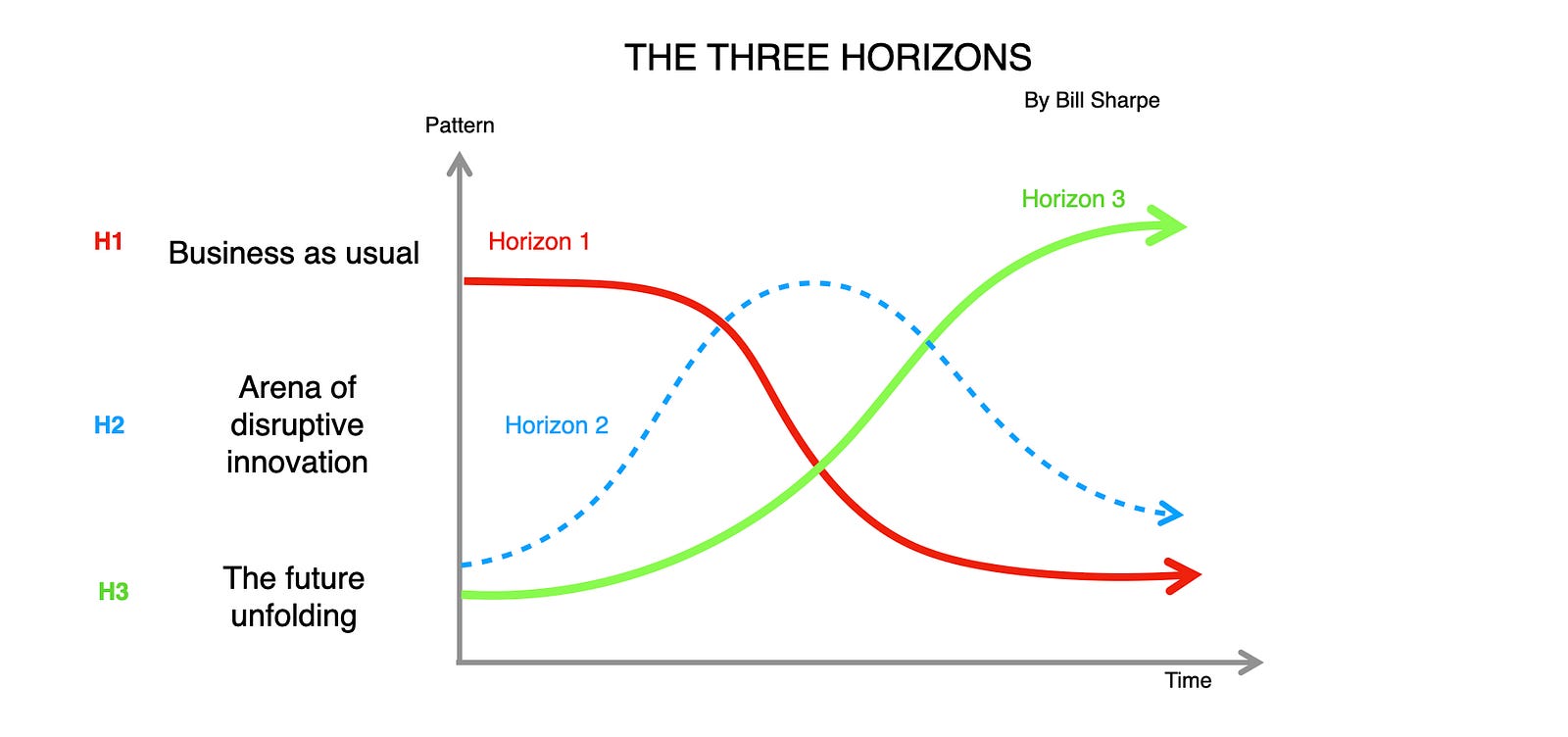
Another part of us already feels the strain of the second horizon, where the old assumptions have stopped explaining what we actually see, where the climate behaves in ways the models struggle to hold and the technology outruns the institutions meant to govern it and communities go looking for a belonging the market never learned to supply and economic success keeps quietly detaching itself from ecological health.
The second horizon is disorienting precisely because both worlds are true inside it at the same time, and there is no clean vantage point from which to watch one replace the other.
And then there is the third horizon, which is not really a destination so much as an attractor — a way of organizing a civilization around a different premise altogether, where the measure of success is not growth at any cost or extraction reframed as progress or ownership treated as the primary relationship a person can have with the Earth, but something far simpler and far harder, which is life creating the conditions for more life.
The thing worth saying plainly is that this third horizon is not a fantasy waiting somewhere over the edge of the future. It is already visible, in fragments, anywhere you actually look for it — in the regenerative farm rebuilding the soil it stands on, the restored watershed running clear again, the commons learning to govern itself, the cooperative, the Indigenous community that simply never severed the relationships modernity worked so hard to forget, the neighborhood rediscovering that mutual aid was always a technology, the entrepreneur designing finance to serve life rather than arranging life to serve finance, the scientist choosing humility over certainty, the teacher showing children how to think in living systems instead of isolated objects, the person who has decided their own success cannot be separated from the flourishing of the place they live.
No single one of these alters the trajectory of a civilization, and that has been the reason given for ignoring them, but taken together they are something the old accounting cannot see — another civilization beginning to recognize itself in the mirror, one act of stewardship at a time.
People ask me where the machines fit into a picture like this, and my honest answer is that they may turn out to be among the most extraordinary instruments we have ever made, not because they will replace human intelligence but because they might finally let us perceive complexity at scales that have always defeated us.
Imagine a community able to read the living metabolism of its entire watershed, governance informed by continuous ecological feedback rather than by the four-year rhythm of elections, finance capable of measuring vitality rather than only extracting value, digital twins helping people steward forests and rivers and soils and biodiversity with something like the sophistication our markets currently bring to the stewarding of capital alone.
These are real possibilities and they matter, on one condition that cannot be waived — that the instruments stay in service and never take the helm, because technology has always amplified whatever consciousness was already holding it, and it has never once supplied the consciousness in the first place.
The real transition was never going to be technological. It is civilizational, and underneath that it is a question about us: whether human awareness can mature quickly enough to steward the powers it has already brought into the world, whether we can grow up before our tools outgrow our wisdom.
Which is why I keep returning to a far older technology than any of the new ones — to community, to belonging, to reciprocity and trust and the commons, the technologies that carried our species for tens of thousands of years before we had any others.
The machines may help us finally understand the complexity we are inside of. Only relationship has ever let us actually inhabit it. So the bridge we are being asked to become is not poured from concrete or written in code. It is built out of character, out of courage and humility and the stubborn willingness to stay in relationship at exactly the moment uncertainty is tempting us toward the bunker — which may, in the end, be the deepest preparation there is for the Event, because civilizations have never finally been changed by ideas. They are changed by the people who agree to embody them.
Seven — The Invitation
If you have read this far, perhaps you already recognize something you have found difficult to name. Perhaps you have felt for a while now what it is to live between worlds — the world that still plainly functions, where the markets open and the planes depart and the harvests arrive and the children go to school and most mornings look reassuringly like the morning before, alongside the growing sense in some quieter chamber of yourself that something underneath all of it has already begun to move, not suddenly and not loudly, almost below the threshold of perception.
This essay was never an attempt to convince you that collapse is inevitable, and it was never an invitation to easy optimism either. It has been, from the first page, an invitation to responsibility. The future has always been uncertain; what is different now is that uncertainty itself has become one of the defining textures of the age, and perhaps that is not finally a thing to be feared so much as a thing to be inhabited, the way you inhabit a season rather than predicting it.
Every civilization eventually reaches the point where the assumptions that carried it begin to lose their power to explain, where the maps go vague and the institutions grow slow and the language turns inadequate to the experience, and what follows that loss is not only crisis. It is also, if enough people are awake to it, the possibility of cultural evolution.
We have walked through climate and geopolitics and food and finance and the machines and commoning and regenerative design across these pages, and none of them was ever really the subject, because they were only different windows opening onto the same landscape, and the landscape was always relationship — with ourselves, with one another, with place, with time, with the living world, and, most quietly of all, with the future.
The modern imagination trained us to stand in front of the future and ask what we want from it, and the living world keeps asking the question the other way around, the way a watershed might ask it of the people living in its folds:
what future is trying to emerge through us, and will we let it.
That small reversal changes nearly everything, moving us from control toward participation, from prediction toward presence, from the hunger for certainty toward the patience of practice — because the future is not waiting somewhere ahead of us fully formed, to be either reached or missed. It is being assembled right now out of millions of relationships already underway: the stream someone is restoring this week, the soil rebuilding itself under a field that stopped being poisoned, the conversation in which two people chose listening over the easier pleasure of polarization, the child learning to see a world of living relationships rather than a warehouse of separate objects, the farmer rebuilding fertility instead of mining it, the neighborhood relearning trust, the commons feeling its way toward self-governance, the person choosing belonging over the safety of separation.
Civilizations do not turn over all at once, by decree or by catastrophe. They turn over because enough people begin embodying the next pattern before the old one has finished dying, and that is the whole mechanism of the hope I am offering you — not a feeling, but an arithmetic.
So I will not leave you with answers, because I do not have them and would not trust anyone who claimed to.
I will leave you instead with the questions that have been working on me, in case they begin working on you too.
Where is the place that has already been quietly calling you?
What watershed is keeping your body alive while you weren’t looking?
What community already surrounds you, waiting to become something more than a collection of individuals who happen to share a postal code?
Which relationships need tending now, before the season arrives when you cannot do without them?
What capacities are still asking to be grown in you? And underneath all of these, the one none of us escapes — who are you becoming while history rearranges itself around you?
No scientist can answer these for you, and no economist and no government and no algorithm; they belong to each of us, and yet I have come to think they were never meant to be answered alone, which may be the oldest reason the commons has always mattered, and why every culture that lasted eventually learned that belonging is not a feeling that happens to you but a practice you take up.
The Event, if it comes, will pass, the way every event eventually passes, and what remains on the far side of it will not be decided only by what collapsed. It will be shaped, far more than we expect, by what was quietly taking root while everyone else stood watching the horizon.
Somewhere not as far from you as you might imagine there is a river that could be restored, a grassland waiting to breathe, a forest with the time to mature, a neighborhood that could learn to trust itself, a commons waiting to be stewarded, a child waiting for a different story about what it means to be a human being in this world — and there is the quieter possibility, the one I would ask you to sit with longest, that the person all of those places have been waiting for is already, slowly, becoming.
That, in the end, is the only invitation I have to offer. Not to prepare for the ending of one world, but to begin living as though another has already started.
Because I think it has — not loudly, and not all at once, but in the only way anything alive has ever begun, which is from somewhere, in relationship, on the ground.
Keep connected. A Part Three might be emerging soon.
If this article resonated with you, consider subscribing — or even better, becoming a paid subscriber — to help sustain and expand this work. Your support allows these conversations to reach further, nurturing the awakening, awareness, and acceptance that may help us move from isolated insight toward a shared, collective consciousness.
Our "civilisation" is going to crash and burn, "we" won't survive this.
Perhaps some isolated pockets of Indigenous culture might survive and form the next bottleneck through which our species passes but they won't bother remembering us, except as a warning.
Ernesto, this is stunningly beautiful. Thank you.